


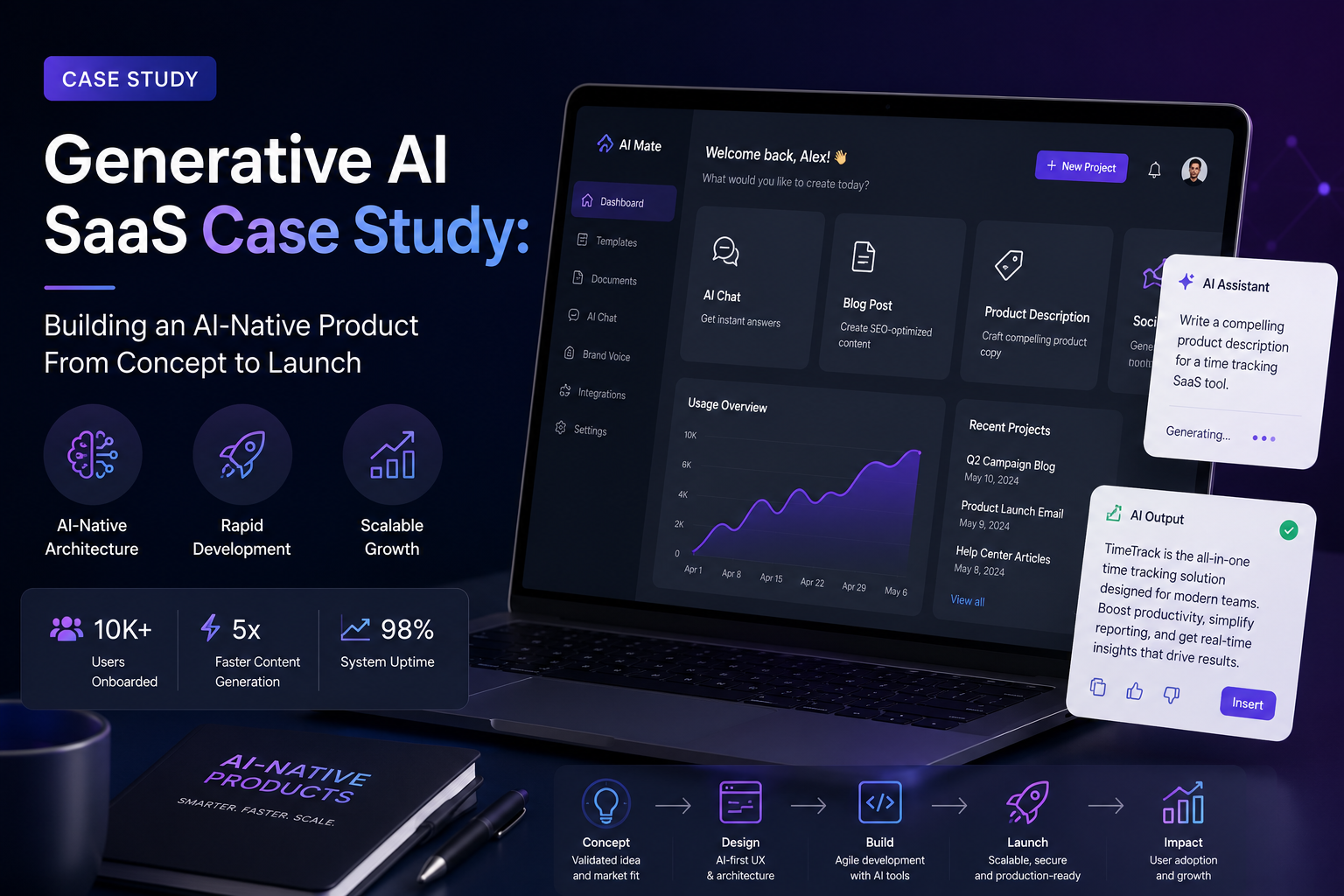
Generative AI SaaS Case Study: Building an AI-Native Product From Concept to Launch
A B2B marketing startup wanted to build a SaaS product that used generative AI to help customers draft marketing content grounded in their own brand voice and past campaigns, rather than generic, one-size-fits-all AI output. This case study covers how we built the product from the ground up, including the retrieval architecture that made brand-specific content generation possible, and how we approached the usage-based cost model that comes with running an AI-native SaaS product.
The Challenge
The startup faced technical and business model challenges specific to building a product with generative AI at its core rather than as an add-on feature.
Generic AI Output Without Brand Context
Off-the-shelf AI writing tools produced content that felt generic and required heavy editing to match a specific brand’s voice, which was exactly the pain point the startup wanted to solve for its customers.
Multi-Tenant Architecture With Per-Customer Context
Each customer organization needed the AI to draw on their own brand guidelines and past content, which meant building a system that kept each customer’s context properly isolated within a shared, multi-tenant platform.
Managing Unpredictable AI Usage Costs
Because every piece of generated content incurred a real, usage-based cost from the underlying language model, the startup needed a pricing and infrastructure model that stayed profitable even as usage patterns varied significantly across customers.
Our Approach
We built the product around a retrieval-augmented architecture designed specifically for the multi-tenant, brand-context challenge at the center of the startup’s value proposition.
Building Per-Customer Retrieval Context
We built a retrieval-augmented generation system that pulled each customer’s specific brand guidelines and past content into the AI’s context at generation time, ensuring output reflected that customer’s actual voice rather than a generic style.
Designing Secure Multi-Tenant Data Isolation
We architected the retrieval system so each customer’s brand context remained strictly isolated from every other customer’s data, a core requirement for a multi-tenant SaaS product handling proprietary brand content.
Building Usage-Based Cost Monitoring Into the Platform
We built cost monitoring directly into the platform’s usage tracking, giving the startup visibility into per-customer AI usage costs in real time, which directly informed their subscription tier and pricing decisions.
The Results
Following launch, the startup successfully brought its AI-native product to market with strong differentiation from generic AI writing tools.
Content Quality Differentiation
Customer feedback consistently highlighted that generated content required significantly less editing to match brand voice compared to generic AI writing tools they had tried previously.
Sustainable Usage-Based Pricing
Real-time cost monitoring allowed the startup to set subscription pricing that remained profitable across a range of customer usage patterns, avoiding the margin problems that can affect AI-native products without careful cost tracking.
Strong Multi-Tenant Reliability
The isolated retrieval architecture performed reliably as the customer base grew, with no cross-customer data exposure incidents during the period studied.
What This Means for Similar Businesses
This launch reflects a pattern common across generative AI-native SaaS products: the real differentiation and the real technical challenge both live in the retrieval and context architecture, not in the underlying language model itself, which is available to every competitor. If you’re building a similar AI-native product, our generative AI development team can help scope the retrieval architecture and cost model for your specific use case.
Key Takeaways
Retrieval-augmented generation grounded in customer-specific context is what differentiates an AI-native product from generic AI writing tools, since the underlying language model is available to every competitor. Multi-tenant AI products require deliberate architecture to keep customer context properly isolated, a requirement beyond what a single-tenant AI tool needs to solve. Usage-based AI costs need real-time monitoring built into the platform from the start to inform sustainable pricing, and the technical differentiation in AI-native SaaS lives in context and retrieval design, not in the model choice itself.
Frequently Asked Questions
What makes an AI-native SaaS product different from a traditional SaaS product with an AI feature bolted on?
An AI-native product is architected around the AI functionality as its core value proposition, with retrieval, context management, and usage-based cost monitoring built into the foundation, rather than adding an AI feature to an existing, unrelated product.
How does retrieval-augmented generation create brand voice differentiation?
By pulling a specific customer’s brand guidelines and past content into the AI’s context at the moment of generation, the output reflects that customer’s actual voice rather than the generic style a model produces without that context.
Why is usage-based cost monitoring so important for AI-native SaaS products?
Every AI-generated response carries a real, variable cost based on usage, so without real-time cost visibility, a SaaS business risks setting subscription pricing that becomes unprofitable for customers with heavier usage patterns.
How is data isolation handled in a multi-tenant AI product?
Each customer’s retrieval context, brand guidelines, past content, is kept strictly separated within the platform’s architecture, ensuring one customer’s proprietary content never influences or appears in another customer’s generated output.
Can a smaller startup build this kind of retrieval-augmented product without a large engineering team?
Yes, with the right architecture choices from the start. Retrieval-augmented generation and multi-tenant isolation are well-understood patterns that don’t require a large team, though they do require deliberate upfront design rather than being added as an afterthought.
How much does building a similar generative AI SaaS product cost?
Cost depends on your specific retrieval architecture, multi-tenancy requirements, and expected usage volume, so a general figure is only a rough guide. A detailed cost estimate scoped to your product is the most reliable way to plan your budget.