


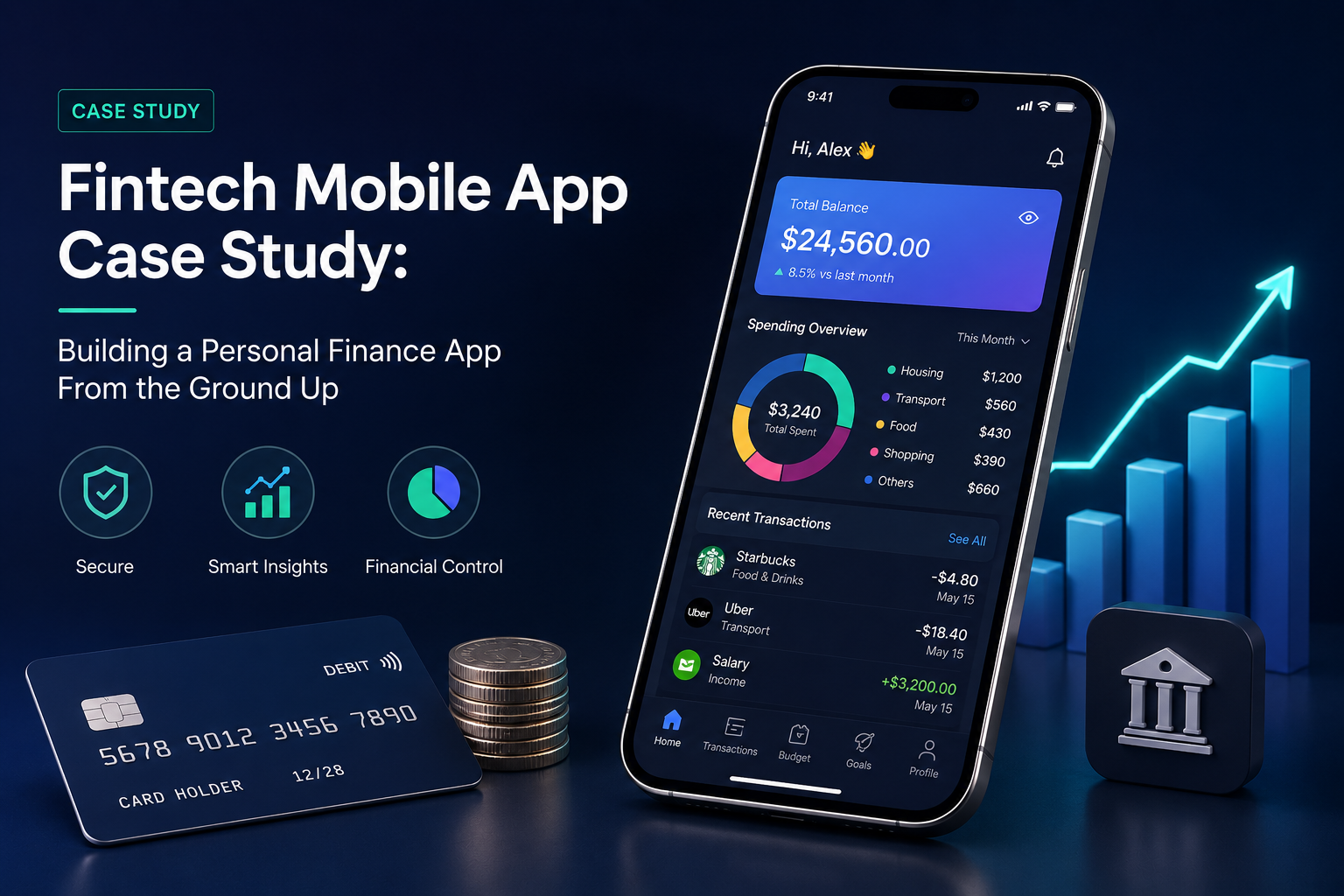
Fintech Mobile App Case Study: Building a Personal Finance App From the Ground Up
A fintech startup came to us with a clear vision, a personal finance app that could link to users’ bank accounts and give them a clear, real-time picture of spending and savings, but no existing technical foundation to build from. This case study covers how we built a secure, from-scratch mobile app handling bank account linking, transaction categorization, and budgeting tools, and how we approached the compliance and security requirements that come with handling users’ financial data.
The Challenge
The startup faced the specific set of technical and trust challenges that come with building a consumer app around real financial data.
Secure Bank Account Linking
Users needed to securely connect their existing bank accounts to the app, which required integrating with financial data aggregation services rather than attempting to build bank connectivity independently.
Accurate Transaction Categorization
Raw transaction data from linked accounts needed to be automatically categorized into meaningful spending categories, a task that’s deceptively difficult to get right given how inconsistently merchants and banks label transactions.
Building User Trust From Day One
As a new entrant with no existing brand recognition, the app needed to establish trust quickly, both through security practices and through a genuinely clear, honest presentation of how user financial data was being used.
Our Approach
We prioritized the underlying data and security architecture before investing heavily in surface-level features, since the app’s credibility depended entirely on getting this foundation right.
Integrating Financial Data Aggregation
We connected the app to an established financial data aggregation provider rather than attempting direct bank integrations, giving users secure account linking without the startup needing to manage banking-level security compliance directly.
Building a Transaction Categorization Engine
We built categorization logic that improved over time based on user corrections, since fully automated categorization is rarely perfect out of the box and the system needed to get smarter as real usage data accumulated.
Designing Clear, Honest Data Use Communication
Rather than burying data use practices in dense legal text, we worked with the startup to present clear, plain-language explanations of how financial data was used and protected, directly within the app’s onboarding flow.
The Results
Following launch, the startup successfully brought its personal finance app to market with strong early user trust indicators.
Successful Public Launch
The app launched with secure bank linking and budgeting functionality working reliably across a meaningful range of supported financial institutions.
High Account Linking Completion Rates
Users completed the bank account linking flow at a strong rate, reflecting both the smoothness of the linking experience and the trust established through clear communication about data handling.
Improving Categorization Accuracy Over Time
Transaction categorization accuracy improved measurably in the weeks following launch as the correction-based learning system incorporated real user feedback.
What This Means for Similar Businesses
This launch reflects a pattern common across fintech app builds: success depends on getting the underlying data integration and trust-building right before layering on additional features. If you’re building a similar financial product, our ewallet app development team can help scope the right approach for your specific financial data and compliance needs.
Key Takeaways
Financial data aggregation providers let fintech apps offer secure bank linking without needing to manage banking-level security compliance independently. Transaction categorization is rarely perfect out of the box and benefits from a system that learns from user corrections over time. Clear, honest communication about data use meaningfully affects user trust and account linking completion rates, and prioritizing data and security architecture before surface features gives a fintech app a stronger foundation to build on.
Frequently Asked Questions
Why use a financial data aggregation provider instead of building direct bank integrations?
Direct bank integrations require navigating banking-level security and compliance requirements independently for every financial institution, while an established aggregation provider already maintains these connections and compliance standards across a wide range of banks.
How accurate is automated transaction categorization out of the box?
Initial accuracy is rarely perfect, since merchant and bank transaction labeling is inconsistent, which is why building a system that learns from user corrections over time produces better long-term results than a static categorization model.
What builds user trust fastest in a new fintech app?
Clear, plain-language communication about how financial data is used and protected, presented directly during onboarding rather than buried in legal text, meaningfully affects whether new users feel comfortable completing account linking.
Does this type of app need to be compliant with specific financial regulations?
Yes, generally. Handling financial data typically involves data privacy and security requirements that vary by region, so compliance considerations should be scoped early alongside the technical architecture.
How long did this fintech app take to build?
Timeline depended on the scope of financial institutions supported and the sophistication of the categorization and budgeting features, with the security and data integration foundation prioritized before additional feature development.
How much does a similar fintech mobile app cost?
Cost depends on your specific bank integration scope, categorization requirements, and compliance needs, so a general figure is only a rough guide. A detailed cost estimate scoped to your project is the most reliable way to plan your budget.