


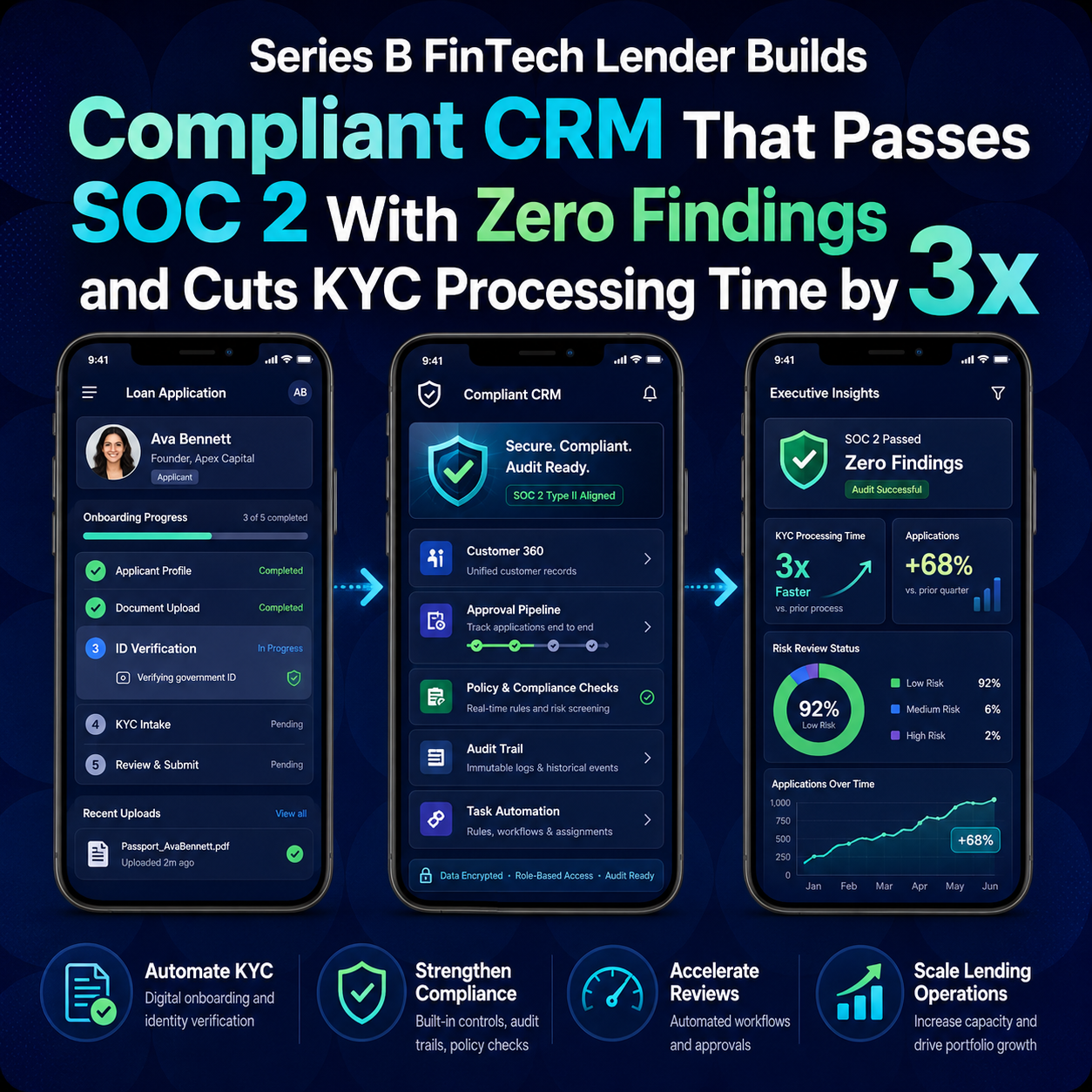
Series B FinTech Lender Builds Compliant CRM That Passes SOC 2 With Zero Findings and Cuts KYC Processing Time by 3x
At a Glance
Industry: FinTech — small business lending platform (working capital, equipment financing, term loans) Scale: Series B, ~$25M ARR at engagement, 80-person team (sales, underwriting, compliance, customer success, ops) Region: US-headquartered, lending into 38 states with multi-state licensing Engagement type: Full SuiteCRM Implementation with KYC/AML integrations, SOC 2-aligned architecture, and ongoing Managed Support Investment: $55,000 implementation + $5,500/month managed services Timeline: 12 weeks discovery through go-live Status: Live for 14 months, scaled through SOC 2 Type II audit with zero CRM-related findings, expanded into 4 additional states without compliance friction
Headline Outcomes
- SOC 2 Type II audit passed with zero CRM-related findings — first audit post-implementation cleared cleanly
- KYC processing 3x faster — from average 4.5 hours per application to under 90 minutes
- AML case management consolidated — previously scattered across email, spreadsheets, and a generic ticketing tool; now centralized with full audit trail
- Multi-state license tracking automated — license renewal deadlines tracked, state-specific workflow rules enforced
- Compliance officer time recovered — approximately 12 hours/week previously spent on manual case management and reporting now available for higher-value work
- Loan officer productivity improved — applications processed per loan officer per week increased ~35% through workflow automation and faster KYC turnaround
Client Context
The client is a Series B FinTech lending platform offering working capital, equipment financing, and term loans to US small businesses. The company had raised approximately $30M in funding plus a warehouse facility for lending capital. At engagement, the platform was operating at roughly $25M ARR with a 80-person team spanning sales, underwriting, compliance, customer success, and operations.
The lending product served small businesses (typically 5-100 employees) across 38 states. State licensing requirements varied — some states required specific lender licenses, some required broker licenses, some had specific disclosure requirements, and some had unique consumer protection frameworks. The compliance overhead was substantial.
The technology landscape at engagement:
- A custom-built loan origination system (LOS) handling application intake, underwriting workflows, and decisioning
- HubSpot CRM for top-of-funnel marketing and SDR outreach
- Scattered tools for KYC (manual processes plus ad-hoc usage of Jumio), AML (ComplyAdvantage with custom integrations), and compliance case management (spreadsheets and email)
- Custom servicing platform for post-funding loan management
- Multiple integrations connecting these systems with reliability issues
The compliance officer had been escalating for six months. SOC 2 Type II attestation was on the company’s roadmap (customer banks were beginning to require it), and the current state of compliance documentation, case management, and audit trails would not survive an audit. The CFO and General Counsel engaged us to build the CRM and compliance infrastructure that would let the company pass SOC 2 and scale into more states.
For broader FinTech CRM context, see our FinTech CRM solutions and Finance CRM solutions.
The Challenge
The client faced four interconnected problems that had to be solved together:
KYC Processing Was a Throughput Bottleneck
KYC processing took an average of 4.5 hours per application — well below industry benchmark for the type of KYC required (small business with beneficial ownership review). The process involved:
- Loan officer collecting customer documents via email or upload portal
- Manual submission to Jumio for identity verification
- Manual beneficial ownership data entry into a separate spreadsheet
- Manual sanctions screening via ComplyAdvantage interface
- Manual review and decisioning by KYC specialists
- Manual handoff to underwriting if KYC passed
Each handoff introduced delay. Each manual entry introduced error risk. The KYC team (3 specialists) was the throughput bottleneck for the entire origination pipeline. The CFO had been considering hiring 2 more KYC specialists at ~$80K/year each just to address the throughput problem — $160K/year in fully-loaded cost that better infrastructure could potentially obviate.
AML Case Management Was Audit-Failing
When a transaction or pattern triggered an AML alert, the case management was ad-hoc. Cases lived in email threads. Decisions were recorded in spreadsheets. Documentation was incomplete. Some cases had clear audit trails; many didn’t. The General Counsel’s view was that the current state would not survive either an internal compliance audit or a regulatory examination.
Specific gaps:
- No centralized case management — alerts arrived via ComplyAdvantage and had to be manually tracked
- No standard case workflow — different specialists handled cases differently
- Incomplete documentation — decisions weren’t always documented with the reasoning
- No reliable reporting — annual compliance reporting required weeks of manual reconstruction
- No audit trail — who reviewed which case at what time wasn’t reliably tracked
Multi-State Licensing Was a Spreadsheet Nightmare
The company held lending or broker licenses in 38 states. Each license had:
- Renewal dates (typically annually, with state-specific timing)
- Continuing education or training requirements
- State-specific disclosure requirements
- State-specific operational requirements (some states required specific call recording, specific consumer disclosures, specific UDAAP considerations)
- State-specific examination cycles
The General Counsel’s team tracked these in a spreadsheet that was updated manually. License renewals had been missed twice in the prior 18 months — once requiring expedited renewal, once requiring a brief suspension of new originations in that state. The pattern of near-misses was unacceptable.
SOC 2 Type II Was Six Months Away
The company had committed to obtaining SOC 2 Type II attestation within 6 months. The audit firm had been selected. The control framework had been documented. But the current state of operations would not pass — audit logs were incomplete, access controls were inconsistent across systems, change management was informal, and incident response procedures weren’t being followed in practice.
The CFO’s view: either we’d built credible compliance infrastructure within 6 months, or we’d fail SOC 2 and damage the banking relationships that depended on it.
For broader context on these patterns, see our blog post on CRM Data Security and Compliance and the GDPR glossary entry.
Why They Chose Us
The client evaluated four approaches:
- Salesforce Financial Services Cloud with a Salesforce consultancy — proposal came in at $350,000+ implementation plus ~$200K/year in licensing for the 80-user team. The compliance officer evaluated the Salesforce FSC compliance capabilities and concluded they would still need significant custom work — the per-user economics didn’t justify the platform.
- A specialized lending CRM vendor — proprietary platform with strong lending-specific functionality, but high ongoing licensing cost ($150K/year+) and significant vendor lock-in concerns from the CTO.
- Building extensions to their existing LOS — appealing because it kept everything in one platform, but the LOS vendor’s customization capabilities were limited and the cost projections were unfavorable.
- TechEsperto SuiteCRM-based approach — open-source platform, custom KYC/AML/compliance workflows, deep integration with existing systems, SOC 2-aligned architecture.
Four factors led them to choose us:
1. Verifiable SuiteCRM Professional Partner status. Our listing on the official SuiteCRM Partners directory gave the CTO confidence. The competing approaches with proprietary platforms had higher lock-in profiles.
2. SOC 2 architecture experience. We described the SOC 2-aligned architecture (control documentation, audit logging, access controls, change management, incident response) in concrete terms. The compliance officer recognized this as practical knowledge rather than marketing language. Other vendors had been vaguer.
3. Demonstrated KYC/AML integration capability. During the sales process, we walked through specific integration patterns for Jumio, ComplyAdvantage, and similar providers. The CTO was familiar enough with these tools to evaluate our claims credibly, and our descriptions matched what he knew about how those APIs actually work.
4. Cost structure that fit the company’s stage. Total project cost at $55,000 plus $66,000/year in managed services compared favorably to the alternatives. As a Series B company, every dollar saved on infrastructure was available for growth investment. For broader context, see our SuiteCRM vs Salesforce comparison and Salesforce Hidden Costs breakdown.
What We Built
Phase 1: Discovery, Compliance Scoping, and Architecture (Weeks 1–2)
The discovery phase had unusual depth on the compliance side. We worked with the General Counsel, compliance officer, and CTO to map current-state controls, identify SOC 2 control gaps, and design the target-state architecture.
Output of Phase 1:
- Current-state and target-state architecture documents
- SOC 2 control mapping showing how each Trust Services Criterion would be satisfied
- KYC and AML workflow specifications
- Multi-state license tracking requirements
- Integration architecture for Jumio, ComplyAdvantage, the LOS, and the servicing platform
- Fixed-price scope and timeline
Key architecture decisions:
- SuiteCRM 7.x on AWS (us-east-1 region) with SOC 2-aligned infrastructure
- KYC workflow as a custom module with provider integrations (Jumio for identity, ComplyAdvantage for sanctions/PEP, manual fields for beneficial ownership)
- AML case management as a custom module with case lifecycle workflow, audit logging, and documentation requirements
- Multi-state license tracking as a custom module with renewal date automation
- Bidirectional integration with the LOS for application data and decisioning handoff
- Read-only integration with HubSpot for top-of-funnel lead handoff
- Servicing platform integration for post-funding customer lifecycle
For our broader methodology, see our engagement models and why TechEsperto.
Phase 2: SOC 2-Aligned Infrastructure Setup (Weeks 2–3)
The infrastructure foundation that everything else would build on. Architecture specifics:
- AWS deployment in us-east-1 with VPC isolation
- Encryption at rest (KMS-managed keys with rotation) and in transit (TLS 1.2+ enforced, modern ciphers only)
- Web Application Firewall (AWS WAF) in front of public endpoints
- IAM with role-based access aligned to job function
- CloudTrail audit logging with 7-year retention
- Database query logging for sensitive operations
- Daily encrypted backups with cross-region replication
- Quarterly restore drills with documented results
- Network segmentation with no direct internet access for the application database
- Bastion host with MFA and session recording for emergency access
- Patch management process with documented SLAs
Documentation built alongside the infrastructure — every architecture decision documented with rationale, every access policy documented with purpose, every monitoring alert documented with response procedure.
For more on hosting architecture, see our SuiteCRM Cloud Hosting service and SuiteCRM Hosting Guide blog post.
Phase 3: SuiteCRM Configuration and Custom Modules (Weeks 3–6)
Core CRM configuration plus the custom modules that made this engagement FinTech-specific:
Standard CRM modules configured:
- Accounts (small business customers, brokers, partners)
- Contacts (business owners, authorized signers, beneficial owners)
- Opportunities (loan applications and offers)
- Activities (calls, emails, documents)
Custom KYC module:
- Application-level KYC status tracking
- Identity verification workflow with Jumio integration
- Beneficial ownership capture (up to 4 levels of ownership chain)
- Sanctions and PEP screening via ComplyAdvantage
- Documented decision workflow with reasoning capture
- Audit trail on every KYC action
Custom AML case management module:
- Alert intake from ComplyAdvantage with auto-assignment to compliance team
- Case lifecycle workflow (alert → investigation → decision → documentation)
- Case status tracking with SLA monitoring
- Documentation requirements per case type (with template-driven capture)
- Escalation workflow for complex cases
- SAR (Suspicious Activity Report) preparation workflow with FinCEN-aligned data capture
- Annual reporting automation
Custom multi-state license tracking module:
- License records per state with type (lender, broker, other), license number, effective date, expiration date
- Continuing education tracking
- State-specific operational requirements per state
- Renewal workflow with 120/90/60/30-day automation
- Audit-ready compliance documentation
Role-based access controls:
- Loan officers (account ownership-based access)
- Underwriters (read access to applications in their queue)
- KYC specialists (full access to KYC module, read access to applications)
- Compliance officers (full access to AML and license tracking, read access to customer records with audit logging)
- Executives (read access to dashboards, no record-level editing)
- Admins (configuration access with change management workflow)
For more on customization patterns, see our SuiteCRM Customization service and SuiteCRM Customization Complete Guide.
Phase 4: KYC/AML Provider Integration (Weeks 5–8)
Integration with the KYC and AML providers — the technical work that made workflow automation possible.
Jumio integration (KYC identity verification):
- Document upload triggering Jumio verification request
- Real-time verification status updates back to SuiteCRM
- Stored evidence (photos, document scans) with appropriate retention
- Failure handling and human review escalation
ComplyAdvantage integration (sanctions/PEP/adverse media):
- Automated screening triggered on KYC initiation
- Periodic re-screening on existing customers (annual default, configurable)
- Alert handling workflow with deduplication
- Manual review interface for ambiguous matches
- Documented disposition of every alert
Beneficial ownership data integration:
- Structured data capture with up to 4-level ownership chains
- Cross-reference against FinCEN beneficial ownership reporting requirements
- Re-screening on ownership changes
Loan Origination System (LOS) integration:
- Bidirectional application data sync
- KYC status push from CRM to LOS
- Underwriting decision pull from LOS to CRM
- Reliable retry logic for the occasional LOS API failure
HubSpot integration (read-only):
- Lead handoff from HubSpot to SuiteCRM at MQL → SQL transition
- Activity history pull for context
- No bidirectional sync to preserve HubSpot as the source of truth for top-of-funnel
Servicing platform integration:
- Post-funding customer data sync
- Servicing status visibility in CRM
- Late payment and default flagging back to compliance workflows
For more on integration patterns, see our SuiteCRM Integration service, CRM Integration Guide, and SuiteCRM REST API Guide.
Phase 5: SOC 2 Documentation and Validation (Weeks 8–10)
Phase 5 was unusual — most projects don’t include explicit SOC 2 preparation work. For this client, getting through SOC 2 was core to project success.
Specific work:
- Documented control narratives for each Trust Services Criterion addressed by the CRM
- Documented access certification process (quarterly review of who has access to what)
- Documented change management process (every code change tracked, approved, logged)
- Documented incident response procedures with practice exercises
- Documented vendor management for the KYC/AML providers
- Built monitoring dashboards for control verification
- Coordinated with the client’s auditor on what the auditor would expect to see
The compliance officer’s involvement was substantial — she reviewed every control documentation document, every workflow diagram, every report design. This phase produced the documentation that would carry the company through the SOC 2 audit four months later.
Phase 6: Training, Pilot, and Go-Live (Weeks 10–12)
Role-based training delivered to all 80 team members over three weeks:
- Loan officers (24 people, 3 sessions of 2 hours each)
- Underwriters (12 people, 2 sessions of 3 hours each)
- KYC specialists (3 people, 5 sessions of 2 hours each — deep training given they’d use the system most intensively)
- Compliance team (4 people, 6 sessions of 3 hours each — deep training on case management, reporting, audit trail)
- Customer success (8 people, 2 sessions of 2 hours each)
- Operations (8 people, 2 sessions of 2 hours each)
- Sales managers and execs (10 people, 1 session of 2 hours)
- Admins (3 people, 5 sessions of 3 hours each)
A two-week pilot ran with the KYC team before broader rollout. The pilot caught two workflow refinements that affected processing speed — both incorporated before broader launch.
For more on training approach, see our SuiteCRM Training service and User Training and Adoption guide.
Investment & Timeline Summary
Implementation Investment
| Component | Cost |
| Phase 1: Discovery, Compliance Scoping, Architecture | $6,500 |
| Phase 2: SOC 2-Aligned Infrastructure | $7,500 |
| Phase 3: SuiteCRM Configuration and Custom Modules | $16,500 |
| Phase 4: KYC/AML Provider Integration | $14,000 |
| Phase 5: SOC 2 Documentation and Validation | $7,000 |
| Phase 6: Training, Pilot, Go-Live | $3,500 |
| Total Implementation | $55,000 |
Ongoing Costs
| Component | Monthly | Annual |
| SOC 2-aligned managed hosting | $1,500 | $18,000 |
| Managed support (Pro tier — includes compliance support and SOC 2 audit support) | $4,000 | $48,000 |
| AWS infrastructure pass-through | ~$900 | ~$10,800 |
| Total Ongoing | $6,400/month | $76,800/year |
Plus pass-through costs the client pays directly to providers:
- Jumio (KYC) — usage-based, ~$2,500/month at engagement volume
- ComplyAdvantage (AML) — subscription, ~$1,800/month
Cost Comparison
Compared to the Salesforce FSC approach the client received quotes for:
| Cost Component | Salesforce FSC | TechEsperto + SuiteCRM |
| Implementation | $350,000+ | $55,000 |
| Year 1 licensing (80 users × $200/user/month FSC) | $192,000 | $0 |
| Year 1 add-ons (Einstein, compliance modules) | $40,000+ | $0 |
| Year 1 hosting | bundled | $18,000 |
| Year 1 support | $60K+ | $48,000 |
| AWS pass-through | $0 | $10,800 |
| Year 1 Total | $642K+ | $131,800 |
| 5-Year Total | ~$1.7M | ~$390K |
Net 5-year savings: approximately $1.3M. For more on the cost math, see our SuiteCRM Cost Savings analysis, SuiteCRM Pricing Complete Guide, and Salesforce Hidden Costs breakdown.
Timeline
| Phase | Weeks |
| Phase 1: Discovery and Architecture | Weeks 1–2 |
| Phase 2: SOC 2-Aligned Infrastructure | Weeks 2–3 |
| Phase 3: SuiteCRM Configuration | Weeks 3–6 |
| Phase 4: KYC/AML Integration | Weeks 5–8 |
| Phase 5: SOC 2 Documentation | Weeks 8–10 |
| Phase 6: Training, Pilot, Go-Live | Weeks 10–12 |
| Post-launch stabilization | Weeks 12–16 |
| SOC 2 Type II audit | Month 4 post-launch |
| SOC 2 Type II attestation issued | Month 6 post-launch |
Outcomes (12 Months Post-Launch)
Quantitative Outcomes
SOC 2 Type II audit passed with zero CRM-related findings. The big outcome. The audit firm reviewed control documentation, audit logs, access controls, change management evidence, vendor management, and incident response procedures. Zero CRM-related findings. The attestation was issued on schedule and provided to the banking relationships that required it.
KYC processing time: 4.5 hours → 90 minutes. A 3x improvement. Workflow automation and provider integration drove the time reduction. The KYC team grew from 3 to 4 specialists (instead of the projected 5+ needed without infrastructure), with significantly higher per-specialist throughput. The avoided headcount (1-2 specialists at ~$80K loaded cost) more than paid for the implementation in Year 1 alone.
AML case management consolidated and audit-ready. Every AML alert from ComplyAdvantage flows into the centralized case management module with auto-assignment, lifecycle workflow, and complete audit trail. The compliance officer reports that annual compliance reporting that previously took 2-3 weeks of manual reconstruction now generates in hours.
License renewal misses eliminated. Zero license renewal misses in the 14 months since go-live. The 120/90/60/30-day automated workflow with multi-channel reminders (CRM alerts, email, calendar reminders) has eliminated the pattern of near-misses that had been occurring previously.
Loan officer productivity: ~35% improvement. Applications processed per loan officer per week increased meaningfully. Two factors drove the improvement: faster KYC turnaround removed the bottleneck that had stalled applications at the KYC stage, and workflow automation reduced the manual handoff time between application stages.
Compliance officer time recovered: ~12 hours/week. Time previously spent on manual case management, manual reporting, and license tracking is now spent on higher-value compliance work — training the team, evaluating new regulatory developments, improving processes, and supporting business expansion into new states.
State expansion accelerated. The company added licenses in 4 new states in the 14 months post-launch. The license tracking infrastructure, multi-state workflow rules, and compliance documentation made state expansion meaningfully easier than the prior process.
Qualitative Outcomes
The General Counsel sleeps better. The compliance posture that had been the source of escalations is now a position of confidence. Documentation is complete. Audit trails are reliable. The SOC 2 audit cleared without drama. Regulatory examinations would be defensible.
The CTO stopped firefighting. The patchwork of integrations and ad-hoc tools that had been a constant source of issues is consolidated into a coherent system. The CTO’s time, previously fragmented across compliance issues, integration failures, and infrastructure questions, is now available for product and engineering priorities.
Loan officers find the workflow smoother. Previously, applications would stall at various handoff points (waiting on KYC, waiting on underwriting handoff, waiting on documentation). The integrated workflow surfaces stalls quickly and reduces the friction between stages. Loan officer satisfaction scores improved post-launch.
Customer-facing communication improved. With unified customer data and activity history, customer success and operations have better context for customer interactions. Customers don’t have to repeat information that’s already captured. The customer experience metrics improved measurably.
Compliance team capacity unlocked. With case management infrastructure handling routine tracking, the compliance team has capacity to engage proactively with new regulatory developments, new product launches, and new state expansion — rather than reactively handling the basics.
Lessons & Considerations
What Worked
Compliance officer involvement throughout. The compliance officer’s deep involvement during Phases 1, 3, and 5 was the single highest-leverage element of the engagement. She understood what auditors would look for, what regulatory frameworks required, and what the team actually needed in daily workflow. Her judgment shaped key architecture decisions in ways that paid off during the SOC 2 audit.
Phase 5 documentation work. Building SOC 2 documentation as a project phase (rather than as an afterthought) was the right call. By the time the SOC 2 audit began, the documentation was complete, validated, and ready. Trying to retrofit documentation after the system was operational would have produced gaps the auditor would have found.
KYC pilot before broader rollout. The 2-week pilot with the KYC team caught two workflow refinements that affected processing speed. Both were small fixes; both would have generated complaints if discovered during full rollout. Pilot-then-rollout is consistently the right pattern for compliance-critical workflows.
Honest infrastructure sizing. We sized the AWS infrastructure for actual current load with documented scaling paths to 3-4x growth. We didn’t over-provision (which would have added unnecessary cost) or under-provision (which would have required emergency scaling later). Right-sized infrastructure has held up cleanly through 14 months of growth.
What Didn’t Work Initially
Initial beneficial ownership UI was confusing. The first version of the beneficial ownership capture screen tried to handle every possible ownership structure (LLC layers, holding companies, trusts, etc.) with the same form. KYC specialists found it overwhelming. We simplified to handle the 80% common case cleanly with an “advanced mode” for the complex cases. Better UX from launch would have been preferable.
One ComplyAdvantage alert pattern caused false-positive overload. A specific configuration of the ComplyAdvantage screening produced more false-positive alerts than the team could process. We tuned the configuration with ComplyAdvantage’s support team in Month 2 post-launch, reducing false-positive rate by ~60%. Better tuning during initial configuration would have prevented two months of compliance team frustration.
License tracking required manual catch-up at launch. The legacy spreadsheet had license data with quality issues — some renewal dates were inaccurate, some required CE hours weren’t tracked, some state-specific requirements weren’t documented. We had to do a manual catch-up of license data in the first 30 days post-launch. More upfront data cleanup would have been preferable.
KYC specialist workflow needed iteration. The first version of the KYC specialist daily workflow was suboptimal — they had to switch between SuiteCRM views and external tools too often. We iterated the workflow design twice in the first 60 days post-launch to consolidate the specialist experience.
What We’d Do Differently
More upfront UX research with KYC specialists. We treated KYC workflow design as primarily a process engineering problem and missed some UX issues. Future similar projects should include explicit UX research time with the actual operators of the workflow.
Tune ComplyAdvantage during initial configuration. We accepted ComplyAdvantage’s default screening configuration during initial setup. Default configurations are tuned for the average customer, not for the specific risk profile of small business lending. Future projects should include tuning during initial configuration.
Plan for license data cleanup as a project phase. The post-launch license data cleanup work should have been a dedicated phase in the original scope. Trying to handle it during ongoing operations slowed early adoption.
What This Case Study Means for Similar FinTech Engagements
If your situation matches the broad shape of this client — Series A/B/C FinTech (lending, payments, wealth, insurance), $10M-$100M ARR, 50-150 person team, multi-state operations, KYC/AML/compliance workflow complexity, SOC 2 or similar attestation requirements — this case study is reasonably predictive.
The patterns generalize:
- SuiteCRM is viable as the CRM foundation for compliance-heavy FinTech operations
- SOC 2 Type II is achievable with appropriate architectural commitment from Phase 1
- KYC/AML provider integration is reliable when designed with explicit error handling
- Multi-state license tracking automation eliminates the near-miss pattern that haunts manual tracking
- Compliance team productivity improvements through workflow automation are often the highest-leverage outcomes
What varies:
- Specific compliance frameworks (SOC 2, HIPAA for healthcare-finance overlap, AML/BSA, state lending, state insurance) affect architecture
- Specific KYC/AML provider choices affect integration patterns
- Specific FinTech vertical (lending vs payments vs wealth vs insurance) affects workflow design
- Specific scale and growth stage affects engagement size
For other FinTech engagement patterns, see our FinTech CRM solutions, Finance CRM solutions, Insurance CRM solutions, and related case studies in our case studies hub.
Frequently Asked Questions
Is this case study real?
Yes. The engagement, outcomes, and architecture are real. The client is anonymized — FinTech companies in lending markets have particular sensitivity about being publicly identified with their compliance vendors. References available under NDA for serious buyer conversations.
Can you build the same thing for our FinTech?
Probably yes if your situation is similar. The architecture (SuiteCRM + KYC/AML integration + compliance case management + SOC 2-aligned infrastructure) is repeatable. What varies is your specific compliance frameworks, your specific provider choices, your specific FinTech vertical, and your scale. Start with our free CRM audit for a candid assessment.
Can SuiteCRM really pass SOC 2 Type II?
Yes — with appropriate architecture, documentation, and operational discipline. SOC 2 is an organization-level attestation, not a software feature. The CRM is one component; the auditor evaluates the controls around the entire system. We’ve delivered SOC 2-aligned deployments that have passed audits cleanly. This client is one example.
Will you integrate with our specific KYC/AML providers?
In almost all cases, yes. We’ve integrated with Jumio, Onfido, Persona, Trulioo, Veriff, ComplyAdvantage, Actimize, Hummingbird, Sift, Unit21, and others. Phase 1 includes integration scoping with your specific providers and versions.
What about state-specific lending or financial services regulations?
Multi-state regulatory complexity is part of our standard practice for FinTech engagements. State licensing tracking, state-specific workflow rules, state-specific disclosure requirements — all configurable in the CRM. Phase 1 includes scoping which state frameworks apply to your operations.
Will SuiteCRM integrate with our Loan Origination System (LOS)?
In most cases, yes. We’ve integrated with custom-built LOS systems, third-party LOS platforms, and the major lending platform vendors. Integration scope and complexity varies by LOS. Phase 1 includes integration scoping with your specific system.
What about HIPAA for FinTech with health-finance overlap?
For benefits-adjacent FinTech (HSA administration, healthcare lending, healthcare insurance technology), HIPAA controls apply. We layer HIPAA-aligned architecture on top of FinTech architecture as needed. See our healthcare CRM solutions for related compliance architecture.
How long does FinTech CRM implementation take?
Most FinTech CRM implementations run 8-14 weeks. Smaller scopes (focused single-product FinTech) can complete in 6-8 weeks. Larger scopes (multi-product platforms, multi-state operations, complex integrations) can run 14-20 weeks. Phase 1 discovery produces a fixed timeline.
Can you support our auditor during SOC 2?
Yes. Our Managed Support service at Pro and Enterprise tiers includes audit support. We respond to auditor requests, produce documentation, and walk through architecture decisions. For this client, the audit firm interviewed our team multiple times during the audit; we treated it as part of the engagement.
What if our compliance requirements are stricter than SOC 2?
We’ve delivered for FinTech clients with bank-level compliance requirements (institutions with regulatory examination cycles, organizations with specific state regulator relationships). The architectural approach scales up. Phase 1 includes scoping your specific compliance requirements.
What happens if regulations change?
Compliance is ongoing. Our managed support relationship includes adjusting workflows, reporting, and controls as regulations evolve. The compliance officer at this client engages with our team multiple times per quarter for regulatory adjustments — that’s part of the relationship.
How do we get started?
The best starting point is a free 30-min CRM strategy call — we look at your current setup, compliance posture, and operational pain points, and give you a candid assessment with recommendations. No pitch, no commitment. For broader vendor evaluation, see our guides on How to Choose a SuiteCRM Partner, the Ultimate CRM Buying Guide for 2026, and 5 Signs You Need a CRM Partner.