


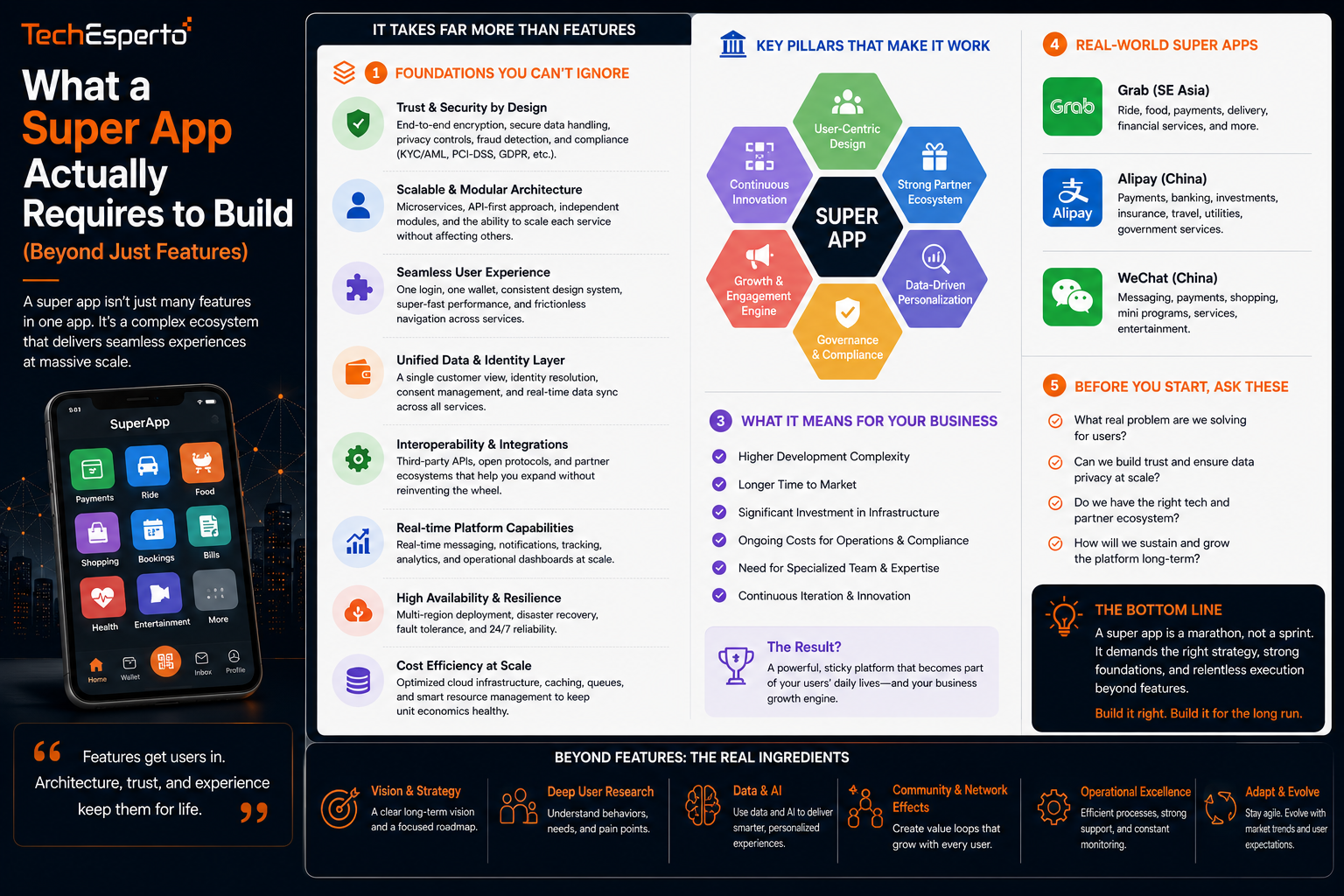
What a Super App Actually Requires to Build (Beyond Just Features)
Super app development requirements are usually discussed in terms of which services to bundle together, payments, messaging, bookings, marketplace features, when the harder problem is actually architectural: building a system that can support multiple, largely independent services under one roof without becoming unmanageable as each one grows. This post looks past the feature list to what a super app genuinely requires from an engineering and operational standpoint before development even begins.
Why Super Apps Are an Architecture Problem First
A super app is not simply a large app with many features. It is closer to several distinct applications operating within a shared shell, sharing user identity, payments infrastructure, and navigation, while each individual service, such as ride booking or a marketplace, needs to evolve independently without breaking the others. Treating this as one monolithic build rather than a modular system is one of the most common reasons super app projects become difficult to maintain as they grow.
Modular Architecture as a Core Requirement
Independent Service Modules
Each major function within a super app benefits from being built as a largely independent module with its own logic and data model, connected through defined interfaces rather than tightly coupled shared code. This allows one module, such as a payments feature, to be updated or scaled without requiring changes across unrelated modules like messaging or bookings.
While individual modules stay independent, certain infrastructure needs to be shared consistently across all of them, including user identity, authentication, and a unified payment system. Designing this shared layer correctly from the outset is critical, since retrofitting shared infrastructure after multiple modules have already been built independently is significantly harder than establishing it early.
Scalability Requirements Specific to Super Apps
Handling Uneven Growth Across Modules
Different services within a super app rarely grow at the same rate. A ride-booking feature might see rapid usage growth while a newer marketplace feature grows slowly, and the underlying architecture needs to support scaling one module’s infrastructure independently without over-provisioning resources for features with much lower demand.
Data Consistency Across Modules
Keeping user data, such as profile information or payment methods, consistent across every module as the user moves between them requires careful data architecture, since inconsistent data between modules creates a confusing and unreliable experience even if each individual module functions correctly on its own.
Operational Requirements Often Overlooked
Beyond the technical architecture, a super app requires operational processes that many teams underestimate during planning. Each module often needs its own dedicated development team as the app grows, requiring coordination processes to prevent conflicting changes to shared infrastructure. Customer support also becomes more complex, since a single support interaction might touch multiple modules, requiring support tooling that gives visibility across the entire user account rather than siloed per-feature. This kind of complexity is why super app projects typically benefit from a dedicated development team structured around individual modules rather than a single generalized team responsible for the entire application.
Choosing the Right Technical Foundation
Given the need for independent modules that still integrate through shared infrastructure, cross-platform app development approaches are often used for the shell and shared UI components, while backend services for each module can be architected independently to scale according to their own specific demands. This combination allows a single super app to present a unified experience to users while the underlying system remains flexible enough to evolve one piece at a time.
Key Takeaways
Super app development is fundamentally an architecture challenge involving modular, independently scalable services connected through shared infrastructure, not simply a large feature list. Shared infrastructure, including identity and payments, needs to be designed early rather than retrofitted after multiple modules already exist. Different modules typically grow at different rates, requiring architecture that supports independent scaling. And operational requirements, including team structure and cross-module customer support, are often underestimated but critical to a super app functioning well as it grows.
Frequently Asked Questions
Should a super app be built as one large codebase or multiple separate ones?
Most successful super apps use a modular approach, where individual services operate largely independently but connect through shared infrastructure like identity and payments, rather than one tightly coupled codebase.
What is the biggest technical risk in super app development?
Underinvesting in shared infrastructure design early on is one of the biggest risks, since retrofitting consistent identity and payment systems after multiple independent modules already exist is significantly harder than building it correctly from the start.
Do all modules in a super app need to scale at the same rate?
No, and the architecture should account for this, allowing individual modules experiencing rapid growth to scale independently without over-provisioning resources for lower-demand features.
How many development teams does a super app typically require?
This depends on the number of distinct modules, but many super apps benefit from dedicated teams per major module, coordinated through defined processes for changes affecting shared infrastructure.
Is a super app more expensive to build than a standard app?
Generally yes, due to the added architectural complexity of supporting multiple independent, scalable modules under a shared infrastructure layer, compared to a single-purpose application.