


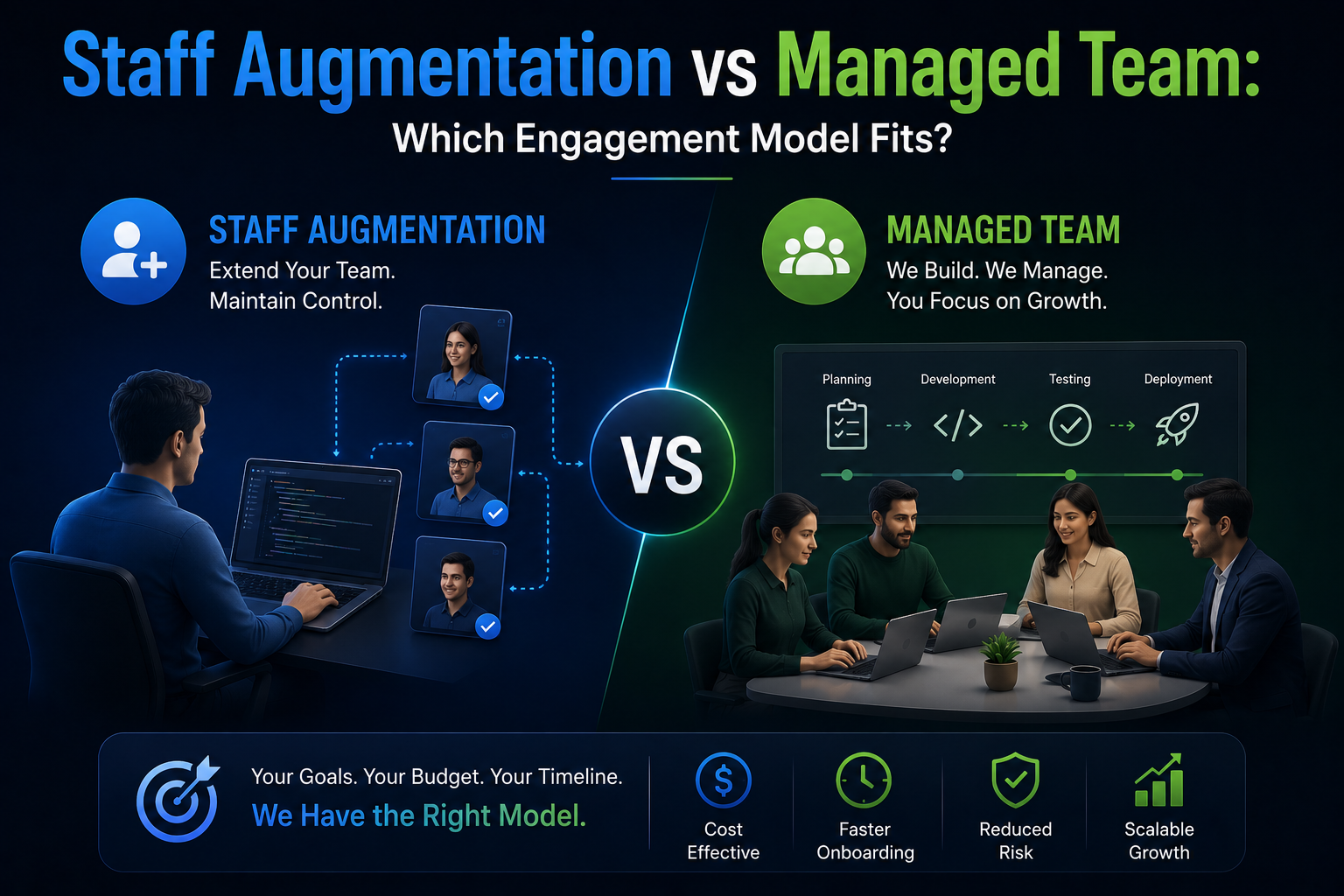
Staff Augmentation vs Managed Team: Which Engagement Model Fits
Choosing between staff augmentation vs a managed team comes down to how much day-to-day management responsibility you want to retain versus hand off, since both models add outsourced development capacity but structure oversight, accountability, and integration into your existing team very differently. Businesses that pick the wrong structure for their situation often end up either micromanaging a team that was supposed to operate independently, or lacking the oversight they actually needed for a project requiring close, hands-on direction. This post compares these two engagement models specifically, so you can choose the structure that fits how your organization actually wants to work.
What Staff Augmentation Actually Means
Understanding this model’s specific structure clarifies when it’s the right fit.
Individual Developers Joining Your Team
Staff augmentation adds one or more individual developers directly into your existing team and workflow, working under your day-to-day direction alongside your internal staff, essentially functioning as temporary team members.
You Retain Management Responsibility
With staff augmentation, your organization retains responsibility for day-to-day task assignment, code review, and overall project direction, using the augmented developers’ skills and capacity within your existing management structure.
Best Suited to Teams With Existing Technical Leadership
This model works well when you already have product and technical leadership in place internally and simply need additional hands-on development capacity, rather than needing someone else to manage the work itself.
What a Managed Team Actually Means
This model shifts more responsibility to the outsourcing partner, changing the nature of the engagement significantly.
A Complete Team Working Toward Your Goals
A managed team engagement provides a complete team, often including its own project management and quality assurance, that takes ownership of delivering against your defined goals and requirements, rather than simply supplying individual capacity for you to direct.
The Partner Retains Management Responsibility
With a managed team, the outsourcing partner handles day-to-day task assignment, internal coordination, and quality control, reporting to you at a higher level around milestones and outcomes rather than requiring your direct daily oversight.
Best Suited to Teams Without Deep Internal Technical Management
This model works well when you don’t have extensive internal technical leadership to direct day-to-day development work, or when you specifically want to offload that management responsibility to focus your own attention elsewhere.
Key Differences That Should Drive Your Choice
Beyond the basic structural difference, several practical considerations should inform which model fits your specific situation.
Your Available Management Bandwidth
Staff augmentation requires you to actively direct and manage the augmented developers’ day-to-day work, so this model demands more of your own time and management bandwidth than a managed team arrangement.
How Well-Defined Your Requirements Are
A managed team generally works well when you can define clear goals and requirements upfront, letting the partner’s own management structure handle execution details, while staff augmentation suits situations where requirements are more fluid and benefit from your direct, ongoing involvement.
Integration Depth With Your Existing Team
Staff augmentation typically creates deeper day-to-day integration with your existing internal team’s tools and processes, while a managed team often operates somewhat more independently, coordinating at defined touchpoints rather than continuous, direct collaboration.
Choosing Between These Models for Your Project
The right choice between staff augmentation vs a managed team depends honestly on how much management bandwidth you have available and whether your existing team structure calls for additional hands-on capacity or a more independently operating team. Our engagement models page covers both structures in detail, and our dedicated development team offerings can be configured either way depending on your specific needs.
Key Takeaways
Staff augmentation adds individual developers under your direct day-to-day management, suiting organizations with existing technical leadership needing additional hands-on capacity. A managed team takes ownership of execution against your defined goals, suiting organizations without extensive internal technical management or those wanting to offload day-to-day oversight. Your available management bandwidth and how well-defined your requirements are should drive this choice, and staff augmentation generally creates deeper day-to-day integration while a managed team operates somewhat more independently.
Frequently Asked Questions
Do I need internal technical leadership to use staff augmentation effectively?
Generally yes, since staff augmentation requires you to actively direct the augmented developers’ day-to-day work, so having internal technical leadership to provide that direction is important for this model to work well.
Can I switch between staff augmentation and a managed team model later?
Yes, many outsourcing partners can adjust the engagement structure as your needs change, though switching does involve some transition period as management responsibility shifts between your organization and the partner.
Which model gives me more control over daily work?
Staff augmentation gives you more direct, daily control over task assignment and priorities, while a managed team gives the outsourcing partner more autonomy in execution, reporting to you at a higher, milestone-based level.
Is a managed team more expensive than staff augmentation?
Managed team engagements often include additional project management and quality assurance built into the arrangement, which can affect the overall cost structure compared to staff augmentation’s more direct developer capacity, though the right comparison depends on your specific management overhead either way.
Which model is better for a project with unclear, evolving requirements?
Staff augmentation often suits fluid, evolving requirements better, since your direct, ongoing involvement allows continuous adjustment, while a managed team generally works best with clearer upfront goals guiding the partner’s independent execution.
How do I decide which engagement model is right for my situation?
The right choice depends on your available management bandwidth and how well-defined your project requirements are, so a detailed conversation about your specific situation is the most reliable way to decide.