


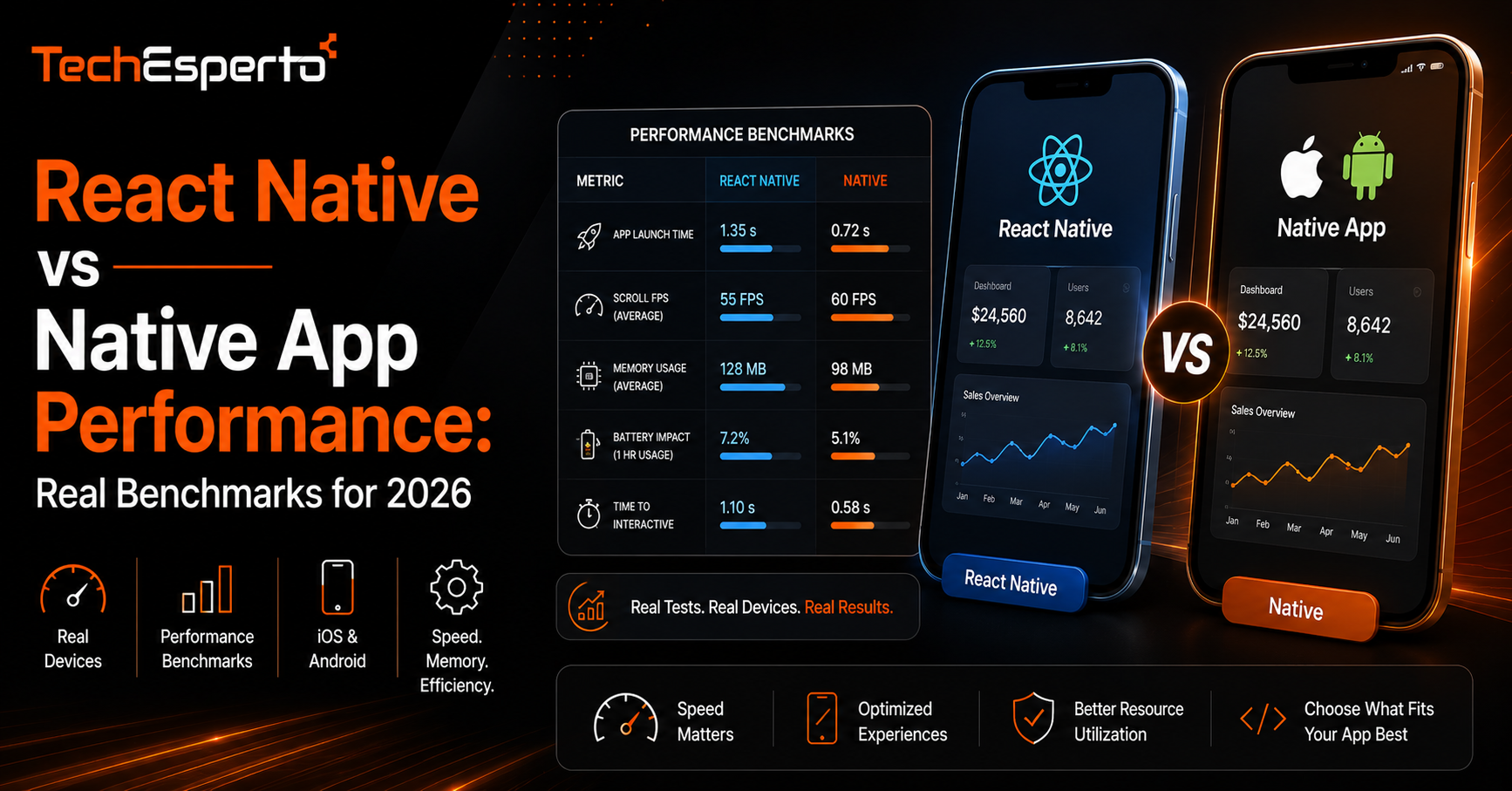
React Native vs Native App Performance: Real Benchmarks for 2026
React Native vs native app performance is a comparison that gets debated constantly, often with outdated assumptions carried over from years ago when the gap between the two was much wider. This post looks at where React Native genuinely lags behind native development today, where the difference has become negligible, and how to judge whether performance should actually be the deciding factor for your specific app rather than a general rule of thumb.
Why This Comparison Keeps Coming Up
Every few years, a business planning a mobile app faces the same fork in the road: build separately for iOS and Android using native code, or build once using a cross-platform framework like React Native. Performance is usually the first concern raised, often based on impressions from years ago rather than the current state of the framework, which has matured considerably since its early releases.
Startup Time and Load Performance
Native apps generally have a measurable edge in cold start time, since they compile directly into platform-specific machine code without an additional JavaScript bridge layer to initialize. React Native apps have narrowed this gap significantly with the introduction of the new architecture and Hermes engine, but a small difference typically remains, usually in the range of tens of milliseconds rather than anything a user would consciously notice in isolation.
Animation and UI Responsiveness
Where Native Still Has an Edge
Complex, highly custom animations, particularly ones involving heavy gesture interaction or custom rendering, still tend to run more smoothly when built natively, since native code has direct access to platform rendering pipelines without any abstraction layer in between.
Where React Native Has Closed the Gap
For the vast majority of standard UI interactions, including transitions, scrolling, and typical gesture handling, React Native’s performance is functionally indistinguishable from native in real-world use, particularly with the newer architecture’s improved handling of native module communication. Most apps do not push animation complexity to the level where the remaining gap becomes visible to an end user.
Battery and Resource Usage
Native apps generally have a slight efficiency advantage in battery and memory usage, since there is no JavaScript runtime running alongside the native layer. In practice, this difference is usually small enough that it does not meaningfully affect user-perceived battery drain for typical business apps, though it can become more relevant for apps doing continuous background processing or heavy real-time data work, such as fitness tracking or live location apps.
When the Performance Gap Actually Matters
The honest answer is that for most business applications, including ecommerce apps, service booking platforms, and internal enterprise tools, the performance difference between React Native and native development is not large enough to be the deciding factor. It becomes a real consideration specifically for apps with heavy custom animation, apps requiring intensive background processing, or apps where every millisecond of responsiveness has a measurable business impact, such as in gaming or advanced camera-based applications. Outside of those categories, the decision is usually better made based on development speed, team expertise, and long-term maintenance cost rather than a performance benchmark that will not be visible to most users. A deeper breakdown of these tradeoffs beyond performance alone is covered in this comparison of native versus cross-platform app development.
What This Means for Development Cost and Timeline
Because React Native shares a large portion of its codebase across iOS and Android, projects typically move faster and cost less than building fully separate native apps for each platform. For businesses where the performance gap does not apply to their specific use case, this makes React Native app development the more efficient path to a working product on both platforms. Businesses set on maximizing platform-specific performance regardless of cost sometimes choose to build separately for Android and iOS, accepting the higher development and maintenance overhead of two independent codebases in exchange for full native performance.
Key Takeaways
Native apps retain a small edge in cold start time, complex custom animation, and battery efficiency, but the gap has narrowed considerably with React Native’s newer architecture. For most standard business applications, the performance difference is not large enough to be user-noticeable or business-critical. The performance gap matters most for apps with heavy custom animation or continuous background processing, not typical business use cases. And development speed and cost, rather than raw performance, are usually the more relevant factors in the decision for most projects.
Frequently Asked Questions
Is React Native still slower than native apps in 2026?
There is still a measurable but generally small difference in specific areas like cold start time and complex animation, though it has narrowed significantly with recent architectural improvements to the framework.
Does React Native performance affect battery life noticeably?
For most typical business apps, the difference is small enough not to be user-noticeable. It becomes more relevant for apps doing continuous background processing or intensive real-time data work.
Should performance alone decide between React Native and native development?
For most business applications, no. Development speed, budget, and long-term maintenance needs are usually more relevant factors than a performance gap that will not be visible in typical everyday use.
Are games a good fit for React Native?
Graphically intensive games generally perform better built natively, since they push animation and rendering demands beyond what most business apps require, an area where native development still holds a clearer advantage.
Has React Native’s new architecture actually improved real-world performance?
Yes, the new architecture and Hermes engine have measurably improved native module communication and reduced overhead compared to earlier versions of the framework, narrowing the gap with native development further.