


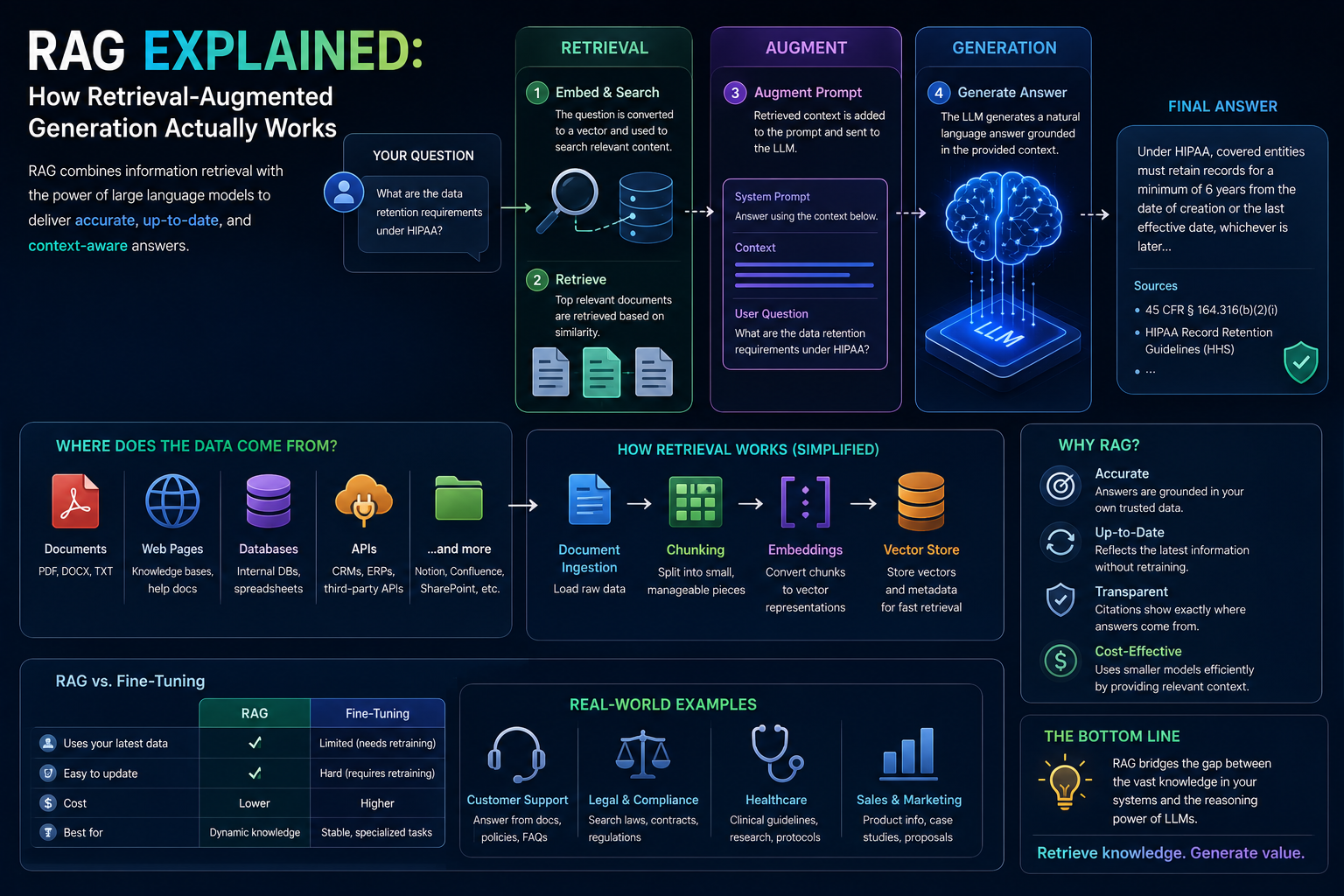
RAG Explained: How Retrieval-Augmented Generation Actually Works
RAG, short for retrieval-augmented generation, is the technique that lets an AI system answer questions using your specific data, documentation, product information, internal knowledge, rather than relying solely on the general knowledge a language model learned during its original training, which typically doesn’t include your private or recently updated information at all. Understanding how RAG works matters for any business evaluating an AI application that needs to be accurate about specific, current information, since without it, an AI feature is essentially limited to general knowledge and can’t reliably answer questions about your particular business, products, or data. This post explains RAG in plain language, why it matters, and where it fits into a broader AI application.
The Problem RAG Solves
Understanding why RAG exists starts with understanding a fundamental limitation of language models on their own.
Language Models Don’t Know Your Specific Data
A language model’s knowledge comes from its training data, which is fixed at a point in time and doesn’t include your company’s private documentation, current product catalog, or anything created after training concluded, meaning it simply cannot answer questions about that information without additional help.
Training a Custom Model Isn’t Usually the Answer
Retraining or fine-tuning a model to include your specific data is possible but expensive, slow to update, and generally overkill for the common need of answering questions using current, specific information, which is exactly the gap RAG fills more practically.
How Retrieval-Augmented Generation Actually Works
At a conceptual level, RAG follows a consistent pattern regardless of the specific application.
Step One: Retrieving Relevant Information
When a question comes in, the system first searches a knowledge base, your documentation, product data, past content, to find the pieces of information most relevant to that specific question, using search techniques designed to find conceptually related content, not just exact keyword matches.
Step Two: Providing That Information as Context
The retrieved information gets included alongside the original question when it’s sent to the language model, effectively giving the model the specific facts it needs to answer accurately, rather than relying on its general training alone.
Step Three: Generating a Grounded Response
The language model then generates its response using both its general language capabilities and the specific retrieved information, producing an answer that’s grounded in your actual data rather than a generic response based only on general training.
Why RAG Matters for Business AI Applications
Beyond the technical mechanism, RAG has practical implications for how useful and trustworthy an AI application actually is.
Keeping Information Current
Since RAG retrieves information at the moment of the question rather than baking it into the model itself, updating your underlying knowledge base automatically improves future answers, without needing to retrain or replace the model.
Reducing Confidently Incorrect Answers
Grounding responses in actual retrieved information meaningfully reduces, though doesn’t entirely eliminate, the risk of the model generating confident-sounding but factually wrong answers, since it has real, specific information to draw from rather than guessing based on general patterns.
Enabling Business-Specific AI Applications
RAG is what makes it possible to build a chatbot that accurately answers questions about your specific products, policies, or documentation, rather than being limited to general knowledge that has no connection to your particular business.
Where RAG Fits Into a Broader AI Application
RAG is one component of a well-designed AI application, not the entire solution on its own.
RAG Plus Guardrails and Evaluation
Even with RAG grounding responses in real information, additional guardrails and evaluation processes matter for monitoring output quality and catching cases where retrieval or generation still produces problematic results.
RAG Plus Conversation Management
For chatbot-style applications, RAG works alongside conversation memory and context management to maintain a coherent multi-turn conversation while still grounding individual responses in retrieved information.
Building a RAG-Powered Application
Implementing RAG well requires thoughtful design around how information gets indexed and retrieved, not just connecting a knowledge base to a language model and expecting good results automatically. Our generative AI development team builds retrieval-augmented applications specifically designed around how your data is structured and how users actually ask questions, and our AI chatbot development work applies this directly to conversational applications.
Key Takeaways
RAG solves the fundamental limitation that language models don’t have access to your specific, current business data on their own. The process involves retrieving relevant information from your knowledge base, then providing it as context alongside the original question to generate a grounded response. RAG keeps AI answers current without requiring model retraining, and meaningfully reduces, though doesn’t eliminate, the risk of confidently incorrect responses by grounding output in real retrieved information rather than general training alone.
Frequently Asked Questions
Is RAG the same as fine-tuning a model?
No. Fine-tuning adjusts the model itself using additional training data, which is slower and more expensive to update, while RAG retrieves relevant information at the moment of the question, making it easier and faster to keep current as your underlying data changes.
Does RAG guarantee accurate answers every time?
No. RAG significantly reduces the risk of confidently incorrect answers by grounding responses in real retrieved information, but it doesn’t eliminate the possibility entirely, which is why evaluation and guardrails remain important parts of a well-designed application.
What kind of data can be used with RAG?
Nearly any text-based knowledge base, documentation, product catalogs, past support tickets, internal wikis, can serve as the retrieval source for a RAG system, provided it’s properly organized and indexed for effective search.
How often does the underlying knowledge base need to be updated?
This depends on how frequently your actual information changes, but since RAG retrieves current information at the moment of the question, updating the knowledge base immediately improves future answers without needing to retrain any model.
Is RAG difficult to implement?
The core concept is straightforward, but building an effective RAG system well requires thoughtful design around how information is indexed and retrieved, so implementation quality varies significantly based on how carefully this design work is done.
How much does building a RAG-powered application cost?
Cost depends heavily on the size and complexity of your knowledge base and how sophisticated the retrieval system needs to be, so a general figure is only a rough guide. A detailed cost estimate scoped to your specific application is the most reliable way to plan your budget.