


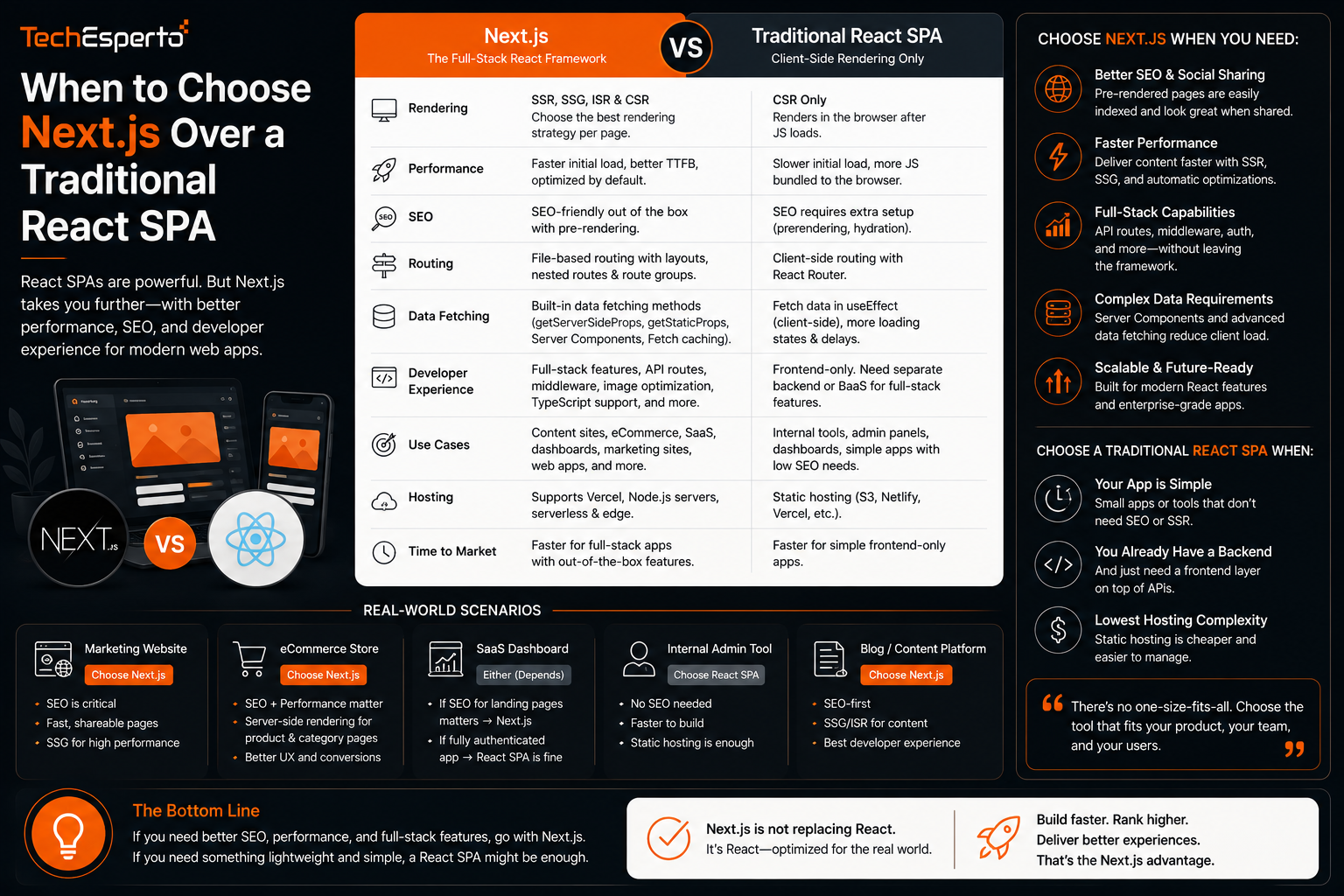
When to Choose Next.js Over a Traditional React SPA
Next.js vs React SPA is a decision that trips up a lot of teams because both approaches use React under the hood, which makes it easy to assume the choice is purely stylistic rather than one with real consequences for performance, SEO, and how the application is architected. This post breaks down what actually separates the two, when a traditional single-page application is still the right call, and when Next.js’s additional capabilities genuinely justify the added structure.
What a Traditional React SPA Actually Is
A single-page application built with React renders entirely in the browser, loading a single HTML shell and then using JavaScript to build out the interface and handle navigation without full page reloads. This approach is straightforward to reason about and works well for applications that do not depend heavily on search engine visibility, such as internal dashboards or logged-in application experiences.
What Next.js Adds on Top of React
Next.js is a framework built on React that adds server-side rendering, static site generation, and a structured routing system, among other capabilities. Rather than the browser building the entire page from scratch on every load, Next.js can render content on the server or at build time, sending a more complete page to the browser initially.
Server-Side Rendering and SEO
The most significant practical difference shows up in search engine visibility. A traditional SPA’s content is built by JavaScript after the page loads, which search engines have historically struggled to index reliably, though this has improved somewhat over time. Next.js renders meaningful content on the server before it reaches the browser, giving search engines a complete page to crawl immediately, which matters significantly for any public-facing content meant to rank in search results.
Performance and Perceived Load Time
Because Next.js can send a fully or partially rendered page to the browser rather than an empty shell waiting for JavaScript to build the interface, users typically see meaningful content faster, which affects both user experience and, in the case of public content, search ranking factors tied to page speed.
When a Traditional React SPA Still Makes Sense
Not every application benefits from Next.js’s added capabilities. Internal tools, admin dashboards, and applications that sit entirely behind a login, where search engine indexing is irrelevant, often do not need the additional complexity Next.js introduces. A traditional SPA can be simpler to build and reason about when SEO and initial load performance for anonymous visitors are not meaningful concerns for the application.
When Next.js Is the Clear Better Choice
Public-facing websites, marketing pages, ecommerce storefronts, and any content meant to be discovered through search all benefit substantially from Next.js’s rendering approach. This is particularly relevant for website development projects where organic search visibility is a core business requirement, since a traditional SPA approach puts that visibility at a structural disadvantage from the outset.
Migrating From an Existing SPA to Next.js
For businesses with an existing React SPA experiencing SEO or performance limitations, migrating to Next.js is a common path, though it requires restructuring how routing and data fetching work throughout the application rather than a simple drop-in replacement. This kind of migration is often undertaken as part of broader React JS development work, since the underlying component logic frequently carries over even though the surrounding framework structure changes significantly.
Key Takeaways
Next.js adds server-side rendering, static generation, and structured routing on top of React, giving it a significant advantage for SEO and initial load performance compared to a traditional SPA. Traditional SPAs remain a reasonable choice for internal tools and applications where search visibility is not a concern. Public-facing, search-dependent content strongly favors Next.js due to how it delivers rendered content to search engines and users. And migrating an existing SPA to Next.js is achievable but requires restructuring routing and data fetching, not just a surface-level change.
Frequently Asked Questions
Is Next.js always better than a traditional React SPA?
Not always. For applications where SEO and initial load performance for anonymous visitors are not concerns, such as internal tools, a traditional SPA can be simpler without meaningful downside.
Does Next.js require abandoning existing React components?
No, most existing React components can be reused within a Next.js project, though the surrounding routing and data fetching structure typically needs to be adapted to fit the framework’s approach.
Why do search engines struggle with traditional React SPAs?
Content in a traditional SPA is built by JavaScript after the initial page load, which search engines have historically had more difficulty indexing reliably compared to content already rendered in the page’s initial HTML.
Is Next.js more expensive to develop than a traditional SPA?
It can involve more initial architectural planning due to its rendering options and routing structure, though this is often offset by better long-term performance and SEO outcomes for public-facing applications.
Can an ecommerce site use a traditional React SPA instead of Next.js?
It is possible, but it puts the site at a disadvantage for organic search visibility, which is usually a significant concern for ecommerce businesses relying on search traffic to drive sales.