


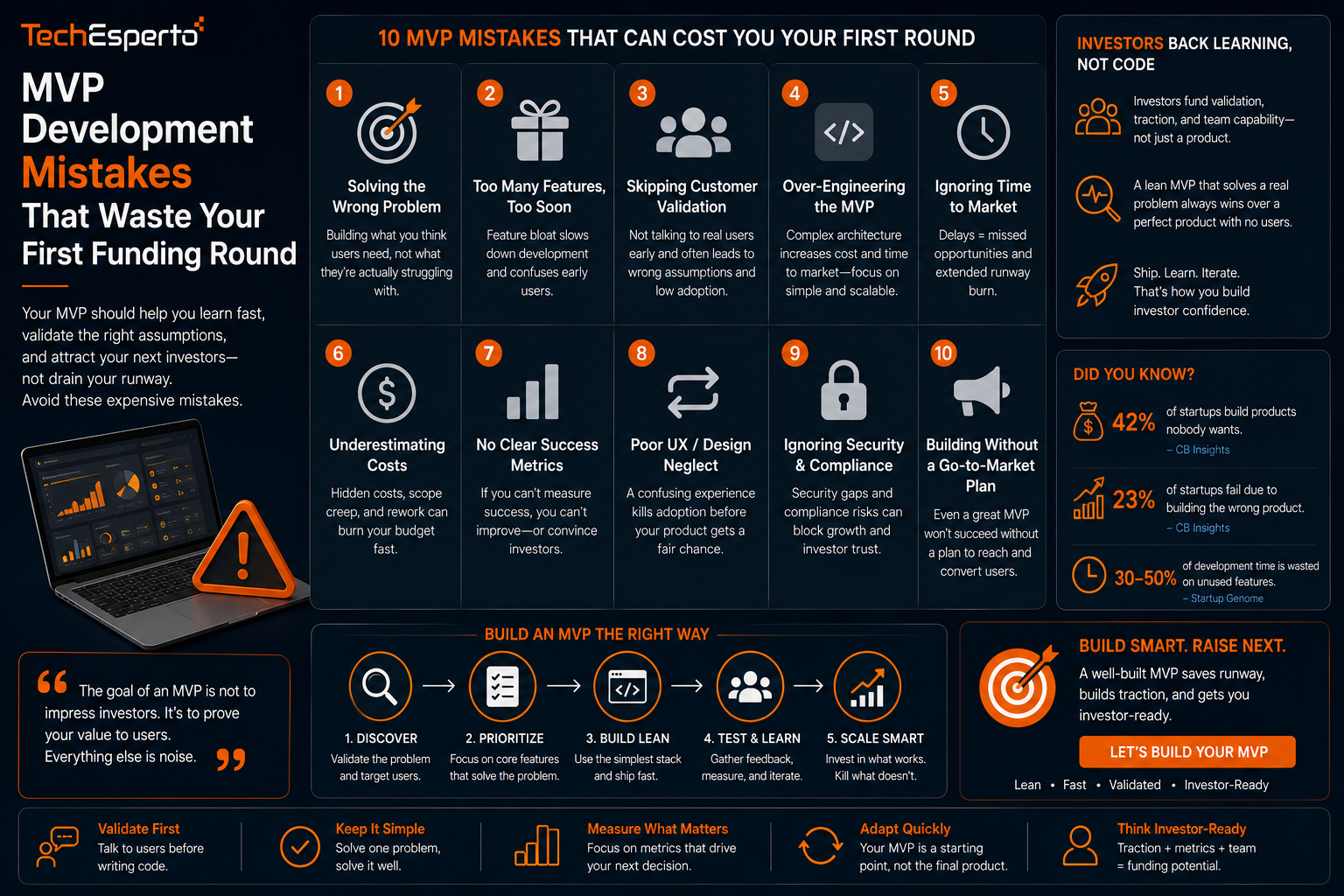
MVP Development Mistakes That Waste Your First Funding Round
MVP development mistakes are one of the most common reasons early-stage startups burn through their first round of funding without ever learning whether their core product idea actually works, since the point of an MVP is to test a hypothesis cheaply, and most of the mistakes covered here undermine that goal from the start. This post covers the recurring errors that turn what should be a lean validation exercise into an expensive, overbuilt product that still fails to answer the question it was meant to answer.
Building Too Many Features Before Validating the Core Idea
Confusing an MVP with a Full Product
The most common mistake is treating the first version of a product as a smaller version of the final vision, rather than the minimum needed to test whether the core assumption holds. This typically results in a product that took far longer and cost far more to build than necessary, while still not clearly answering whether the underlying idea has real demand.
Adding Features Based on Assumptions Rather Than Evidence
Founders often build features they assume users will want, rather than features directly needed to test the specific hypothesis the MVP exists to validate. Every feature added beyond that core hypothesis increases cost and timeline without necessarily increasing the quality of what is learned from early users.
Skipping Proper Technical Planning to Move Faster
Rushing into development without a clear technical plan often leads to an MVP built on a foundation that cannot be extended if the idea is validated and the product needs to scale. This creates a difficult choice later: continuing to build on shaky architecture, or rebuilding from scratch after already raising a next round based on early traction, which is a more expensive and disruptive path than planning the technical foundation reasonably well from the start, even within a lean MVP scope.
Choosing the Wrong Technology for Speed Alone
Some teams choose a technology stack purely because it is fast to build in initially, without considering whether it can reasonably support the product if it succeeds. This is not an argument for over-engineering an MVP, but for choosing a foundation, such as Python or a well-supported framework, that balances quick initial development with a reasonable path to scaling later if the product validates.
Ignoring User Feedback Once Development Begins
An MVP’s value comes entirely from what is learned once real users interact with it, yet some teams treat the initial build as fixed once development starts, delaying meaningful changes until a much later version. This defeats the purpose of building an MVP at all, since the fastest possible feedback loop, adjusting based on what early users actually do rather than what was originally planned, is what makes the lean approach valuable in the first place.
Underestimating the Cost of Getting It Wrong the First Time
Founders sometimes choose the cheapest possible development option without considering that a poorly built MVP, riddled with bugs or a confusing user experience, can produce misleading feedback, making a viable idea look unviable simply because the execution was poor. This is a particularly costly mistake during a startup’s first funding round, since burning through limited runway on a flawed test that produces unreliable conclusions can waste the one opportunity a founder has to validate the idea properly.
Building With the Wrong Development Partner
Choosing a development team unfamiliar with the specific demands of early-stage MVP work, namely building lean, testable functionality quickly rather than a fully featured product, often results in scope creep and budget overruns that were avoidable with the right team from the outset. Working with a team experienced specifically in MVP development tends to produce a leaner, more testable first version than a general development engagement not scoped around that specific goal.
Key Takeaways
The most costly MVP mistakes usually stem from confusing a minimum viable product with a smaller version of the full vision, adding features based on assumption rather than the specific hypothesis being tested. Skipping technical planning entirely, or choosing technology purely for initial speed without considering scalability, creates problems that surface expensively later. Ignoring early user feedback defeats the purpose of building an MVP in the first place. And choosing a development approach and partner suited specifically to lean, testable MVP work matters as much as the idea itself.
Frequently Asked Questions
How do I know if a feature belongs in my MVP or a later version?
A feature belongs in the MVP only if it is directly necessary to test the core hypothesis of the product. Anything else, however useful it may eventually be, should generally wait for a later version once the core idea is validated.
Is it worth investing in technical architecture for something meant to be minimal?
Yes, to a reasonable degree. An MVP does not need to be built for massive scale immediately, but choosing a foundation that can be extended if the idea validates avoids an expensive rebuild later.
What is the biggest sign an MVP has become overbuilt?
If the development timeline and cost have grown significantly beyond the original scope needed to test the core hypothesis, the project has likely drifted from a lean MVP into something closer to a full product build.
Should user feedback change the MVP mid-development?
It depends on the stage and the nature of the feedback, but ignoring meaningful early signals entirely until a much later version undermines the core purpose of building an MVP to learn quickly.
Does a poorly built MVP produce unreliable validation results?
Yes. A confusing or bug-heavy experience can make users respond negatively to the execution rather than the underlying idea, which can lead founders to wrongly conclude a viable concept lacks demand.