


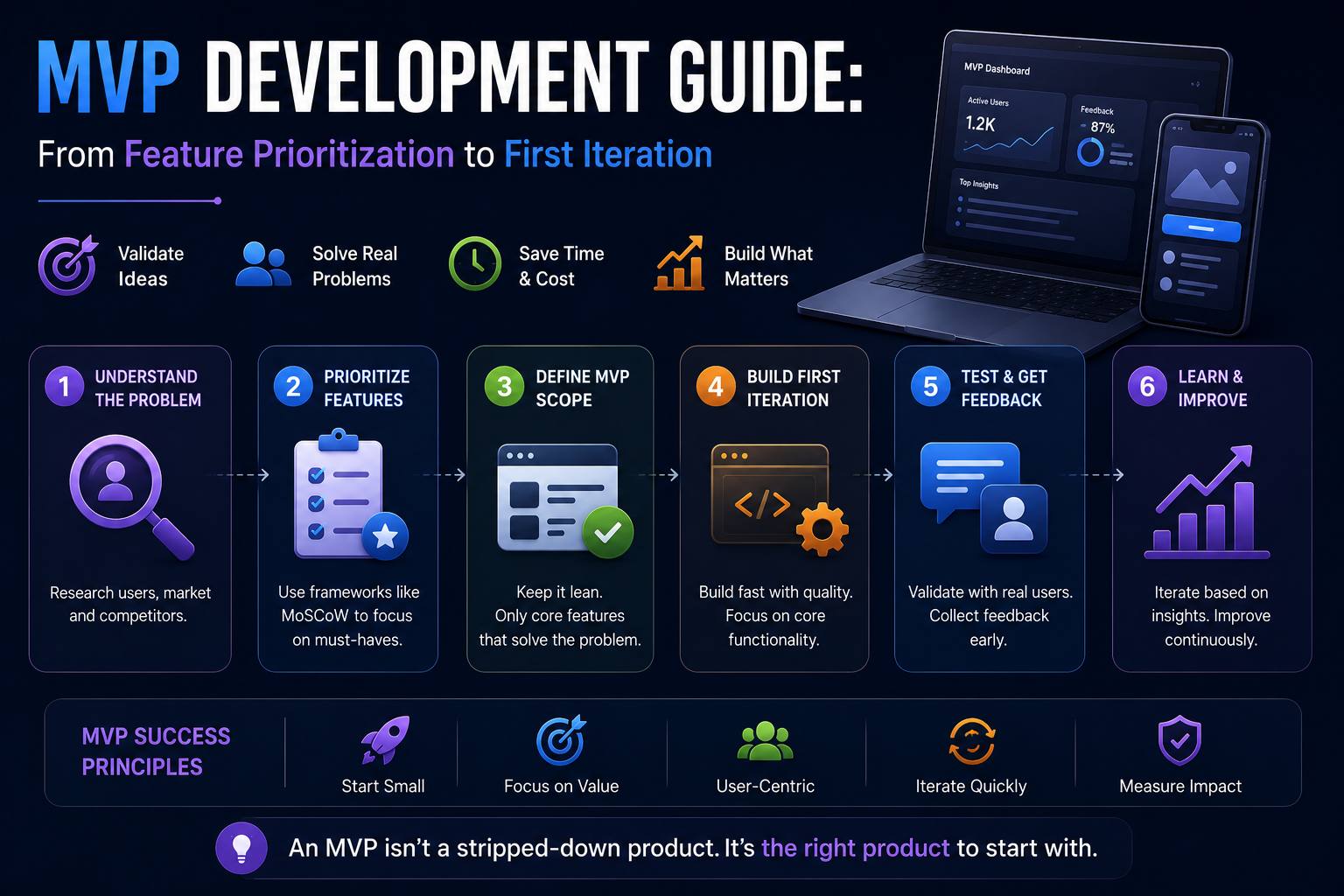
MVP Development Guide: From Feature Prioritization to First Iteration
This MVP development guide focuses on the practical execution challenges that come after you’ve validated demand and decided to build, prioritizing features under real constraints, structuring a build-measure-learn cycle, and knowing how to iterate based on actual post-launch data rather than assumptions. Many teams handle validation reasonably well but stumble during execution, either overloading the MVP with features that dilute the core hypothesis being tested, or launching without a clear plan for what to measure and how to act on early results. This guide covers the practical mechanics of building an MVP well, once you already know what you’re trying to test.
Prioritizing Features Under Real Constraints
Even with a validated idea, deciding what actually belongs in version one requires a deliberate prioritization process.
Separating Must-Haves From Nice-to-Haves
Categorizing every proposed feature by whether it’s essential to testing your core hypothesis, versus a reasonable addition that could meaningfully wait, creates the discipline needed to keep an MVP genuinely minimal rather than gradually expanding toward a full product vision.
Using a Simple Prioritization Framework
A straightforward framework, sorting features into must-have, should-have, and could-have categories, gives stakeholders a shared, concrete language for scope discussions, reducing the ambiguity that often leads to scope creep during development.
Revisiting Priorities as Constraints Change
If timeline or budget constraints shift during planning, revisiting your prioritization explicitly, rather than informally cutting whatever seems easiest at the moment, keeps the MVP’s scope aligned with testing its actual core hypothesis.
Structuring the Build Phase
Once scope is set, how the actual development work gets structured affects both speed and your ability to course-correct.
Building the Core Loop First
Prioritizing the single sequence of actions that delivers your app’s core value, sign up, use the key feature, see the result, before any secondary functionality ensures you always have something testable rather than a collection of disconnected, unfinished pieces.
Deferring Polish Until Core Functionality Works
Visual refinement and secondary features can wait until the core functionality is proven to work correctly, since polishing features that might get cut or significantly changed based on early feedback wastes effort that could go toward validating the core hypothesis faster.
Building in Analytics From the Start
Instrumenting key user actions from the very first build, not adding analytics as an afterthought once the MVP is already live, ensures you have the data needed to evaluate the MVP’s performance from day one rather than discovering gaps in your data weeks later.
Launching and Measuring
Getting the MVP live is only useful if you have a clear plan for what to measure and how to interpret the results.
Defining Success Metrics Before Launch
Deciding in advance what evidence would indicate the MVP is succeeding, and what would indicate it needs significant adjustment, prevents the common trap of interpreting ambiguous early results optimistically simply because of the investment already made.
Giving the MVP Enough Time to Generate Signal
Evaluating too early, before enough real usage has accumulated to produce meaningful data, risks making decisions based on statistical noise rather than genuine user behavior patterns.
Separating Usage Data From Direct Feedback
Both what users actually do, measured through analytics, and what they say when asked directly provide valuable but different kinds of signal, and a thorough evaluation considers both rather than relying on just one.
Iterating Based on Real Results
What happens after your first round of MVP data comes in determines whether the validation and build effort actually pays off.
Distinguishing Between Iteration and Pivot
Understanding whether your results suggest refining the current approach, adjusting specific features or messaging, versus fundamentally rethinking the core value proposition helps you respond appropriately rather than either over-reacting to normal early friction or under-reacting to a genuinely failed hypothesis.
Prioritizing the Next Round of Development
Using the same prioritization discipline from your initial MVP scope to decide what to build next, based on actual evidence from the first release rather than the original feature wishlist, keeps subsequent development focused and efficient.
Executing Your MVP Well
A validated idea only translates into a successful product through disciplined execution, careful feature prioritization, a focused build phase, clear measurement, and thoughtful iteration based on real results rather than assumptions. Our MVP development team can help execute this process from initial scope through post-launch iteration.
Key Takeaways
Disciplined feature prioritization, separating genuine must-haves from features that can wait, is what keeps an MVP’s scope aligned with testing its core hypothesis. Building the core user loop first and deferring polish ensures you always have something testable throughout development. Defining success metrics and instrumenting analytics before launch, not after, gives you the data needed for an honest evaluation, and distinguishing between iteration and pivot after launch determines whether you refine the current approach or rethink the core hypothesis entirely.
Frequently Asked Questions
How do I decide what counts as a must-have feature for my MVP?
A feature genuinely qualifies as a must-have only if excluding it would prevent you from meaningfully testing your core hypothesis, not simply because it seems useful or was part of your original vision for the full product.
Should I build analytics into my MVP from the start, or add it later?
From the start. Instrumenting key user actions before launch ensures you have the data needed to evaluate performance from day one, since gaps in early analytics data are difficult or impossible to recover retroactively.
How long should I wait before evaluating my MVP’s results?
There’s no universal timeline, but evaluating before enough real usage has accumulated risks making decisions based on statistical noise rather than genuine patterns, so patience matched to your specific usage volume matters more than a fixed evaluation date.
What’s the difference between iterating and pivoting?
Iterating means refining your current approach, specific features, messaging, based on feedback, while pivoting means fundamentally rethinking your core value proposition because evidence suggests the original hypothesis doesn’t hold, and distinguishing between the two requires honest evaluation of what your results actually show.
Should I prioritize polish or core functionality first in my MVP build?
Core functionality first. Polishing features that might get cut or significantly changed based on early feedback wastes effort that could instead go toward validating your core hypothesis faster.
How do I get help executing my MVP well?
The right execution approach depends on your specific validated hypothesis and constraints, so a detailed conversation about your project is the most reliable way to plan a disciplined build.