


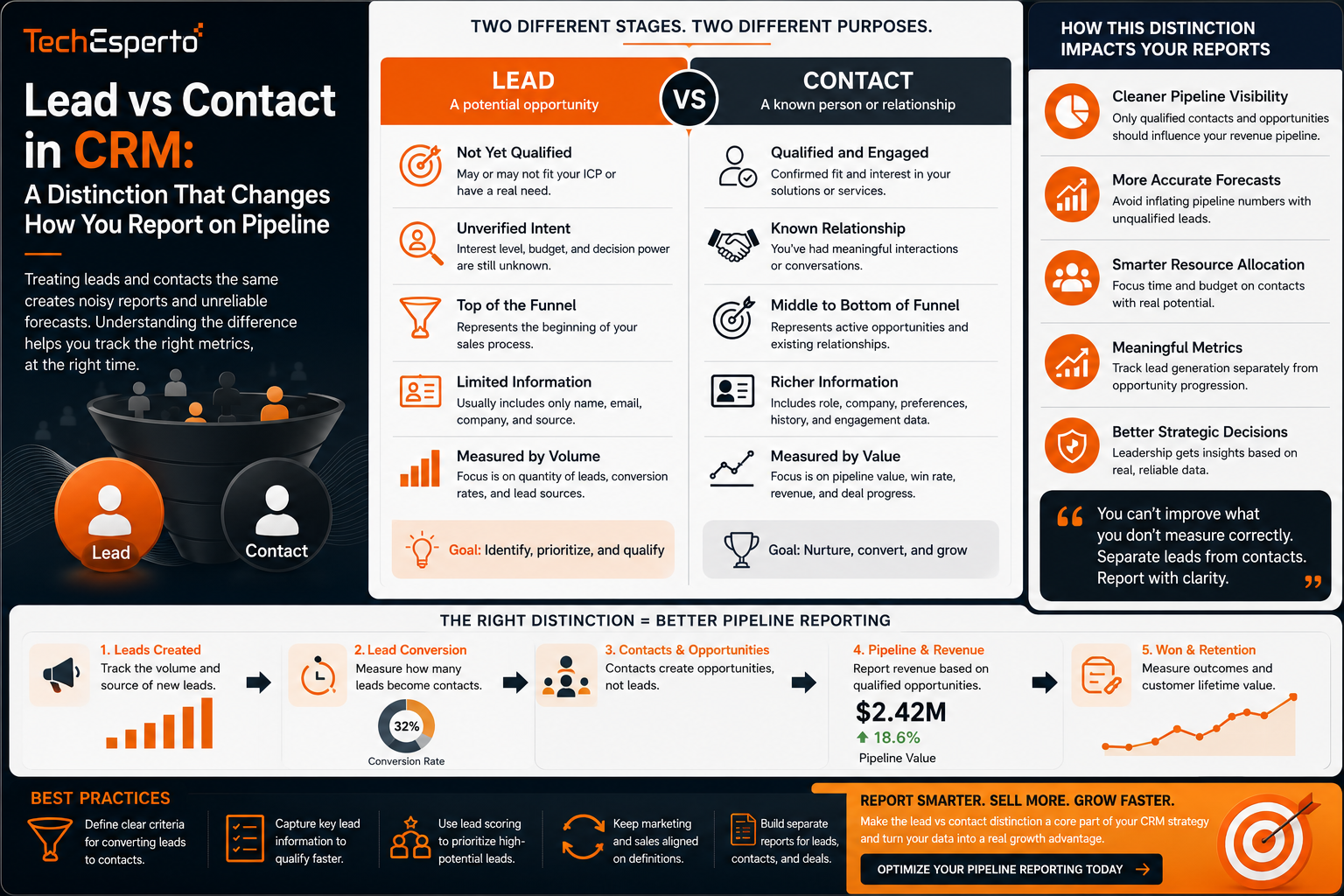
Lead vs Contact in CRM: A Distinction That Changes How You Report on Pipeline
Lead vs contact in CRM sounds like a minor terminology distinction until a business tries to answer a basic question, such as how many leads actually converted into customers last quarter, and discovers the two categories have been used interchangeably for years, making that number impossible to calculate accurately. This post explains what actually separates a lead from a contact, why the distinction matters for reporting, and how to fix a CRM where the two have been blurred together.
What Separates a Lead From a Contact
A lead represents a person or organization that has shown some initial interest but has not yet been qualified or engaged in an active sales process. A CRM contact, by contrast, typically represents someone already tied to an active or existing business relationship, whether as part of an open deal, an existing customer, or a qualified prospect actively being worked. The distinction is really about where someone sits in the relationship, not just what data fields happen to be filled in.
Why This Distinction Matters for Reporting
Conversion Rate Accuracy
If leads and contacts are not clearly separated, calculating a lead-to-customer conversion rate becomes unreliable, since the starting population is ambiguous. A business cannot accurately measure how well its top-of-funnel efforts are performing if it cannot cleanly identify what counted as a lead versus what was already a qualified contact from the start.
Pipeline Stage Clarity
Blurring leads and contacts together also muddies the sales pipeline, since a pipeline is meant to track qualified opportunities moving through defined stages. Mixing in unqualified leads that were never formally converted distorts pipeline value and stage-by-stage conversion metrics, making forecasts less reliable.
How the Blurring Typically Happens
This usually happens gradually rather than through a single decision. A sales rep manually creates a contact record for someone who technically should have gone through lead qualification first, because it felt faster in the moment. Over time, without a clear and enforced process, the CRM ends up with a mix of properly qualified contacts and records that skipped the lead stage entirely, making any reporting built on that distinction unreliable.
Fixing a CRM Where the Distinction Has Broken Down
Correcting this requires first auditing existing records to identify which ones should genuinely be treated as leads versus qualified contacts, based on actual criteria such as whether a real sales conversation has occurred. From there, enforcing a clear qualification process, ideally supported by automated rules that convert a lead to a contact only when specific criteria are met, prevents the distinction from eroding again going forward. This is often addressed as part of broader CRM reporting and analytics work, since clean reporting depends entirely on the underlying data being structured consistently in the first place.
Building Reporting That Reflects the Distinction Correctly
Once leads and contacts are cleanly separated, reporting can accurately show lead volume, lead-to-contact conversion rate, and pipeline value built only from genuinely qualified records. This gives a far more honest picture of funnel performance than a report built on data where the two categories were treated as interchangeable, and it makes it possible to actually diagnose where the funnel is underperforming, whether that is lead generation, qualification, or the sales process itself.
Key Takeaways
A lead represents early, unqualified interest, while a contact represents someone already tied to an active relationship or qualified opportunity, and treating the two as interchangeable breaks conversion and pipeline reporting. This blurring usually happens gradually through inconsistent manual data entry rather than a single decision. Fixing it requires auditing existing records and enforcing a clear, ideally automated, qualification process going forward. And clean separation between the two categories is what makes accurate funnel and pipeline reporting possible in the first place.
Frequently Asked Questions
Does every CRM platform distinguish between leads and contacts by default?
Most CRM platforms include separate lead and contact modules by default, but whether that distinction is actually maintained depends on how consistently the qualification process is followed in practice.
What criteria should determine when a lead becomes a contact?
This varies by business, but common criteria include a completed qualifying conversation, confirmed budget or authority, or explicit interest in moving forward with a defined next step in the sales process.
Can historical CRM data be cleaned up to fix a broken lead-to-contact distinction?
Yes, though it requires a manual or semi-automated audit of existing records to reclassify them accurately based on actual qualification criteria rather than how they happen to be labeled currently.
Does automating lead-to-contact conversion improve reporting accuracy?
Yes, automated conversion rules based on defined qualification criteria prevent the gradual, inconsistent manual entry that typically causes the distinction to blur over time.
Why does conversion rate reporting break down when leads and contacts are not properly separated?
Because the starting population for the calculation becomes ambiguous, making it impossible to accurately measure what percentage of genuine leads actually converted into qualified opportunities or customers.