


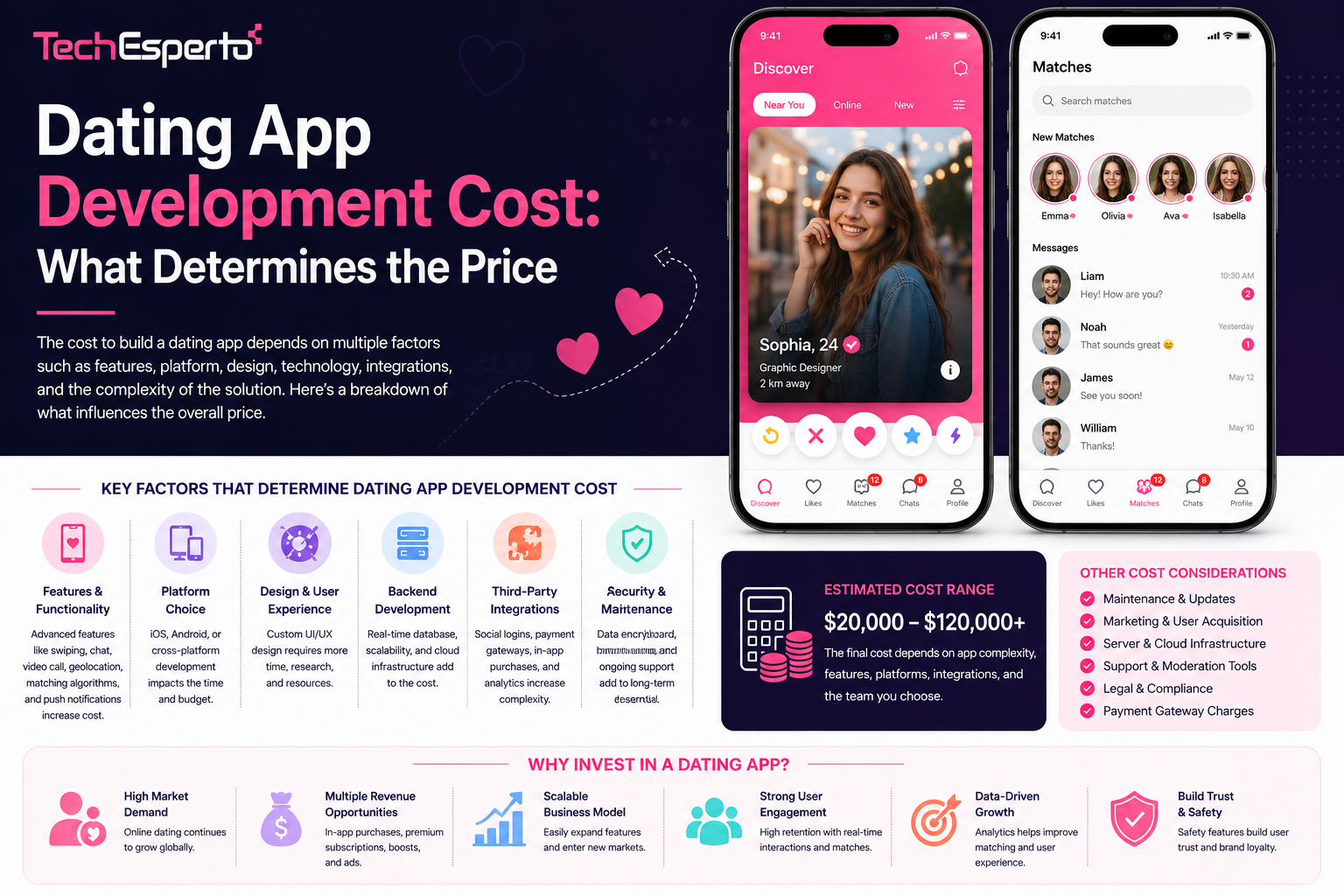
Dating App Development Cost: What Determines the Price
Dating App Development Cost: What Determines the Price
Dating app development cost typically ranges from $40,000 to $80,000 for an MVP with core profile and matching features, $80,000 to $200,000 for a full platform with matching engine and messaging, and $200,000 or more for enterprise-scale, high-volume systems. Actual cost depends on matching complexity, verification requirements, and expected user scale.
Founders planning a dating or matching app often need a realistic cost picture before committing to development, especially given the safety and verification features this category requires. TechEsperto Solutions builds dating apps as part of its broader dating app development practice, and this guide breaks down what actually drives cost up or down for matching platforms.
What Determines Dating App Development Cost
Dating app development cost is shaped by factors that go beyond typical consumer app development, since safety, verification, and matching algorithm sophistication all require meaningful engineering investment. The complexity of the matching algorithm matters significantly, since simple location and preference-based matching costs less than more sophisticated compatibility scoring systems. Identity verification requirements, ranging from basic photo confirmation to more rigorous ID verification, add cost depending on the rigor required for the platform’s target audience. Content moderation and safety tooling, including automated image screening and human review workflows, add development scope that scales with expected user volume. Messaging infrastructure, supporting real-time communication after a match occurs, also affects cost depending on whether media sharing and other rich messaging features are included.
Matching Algorithm Complexity
Simple location and preference-based matching costs less than sophisticated compatibility scoring systems.
Identity Verification Rigor
Verification requirements range from basic photo confirmation to more rigorous ID verification depending on audience.
Content Moderation and Safety Tooling
Automated image screening and human review workflows add development scope that scales with user volume.
Messaging Infrastructure Complexity
Real-time messaging with media sharing capability adds cost beyond basic text-only communication.
Geographic and Demographic Scope
Supporting multiple regions or demographic-specific features adds complexity around localization and compliance.
Premium Feature Set Breadth
The number of premium features offered, such as boosts or super likes, affects overall development scope.
Cost by Development Approach
Dating and matching platforms typically fall into one of three general investment levels, reflecting different degrees of feature completeness and scale. An MVP approach focuses on core profile creation, basic matching, and essential safety features to validate a niche or regional dating concept before expanding further. A full platform approach builds out the matching engine, messaging, and premium features with a more complete feature set suited to an established or well-funded launch. An enterprise-scale approach supports high user volume, advanced matching algorithms, and broader moderation infrastructure across a wider audience. Choosing the right starting point depends on how validated the target audience and matching approach already are.
MVP or Single-Module Build ($40,000 to $80,000)
An MVP focuses on core profile creation, basic matching, and essential safety features for a niche or regional launch.
Full Platform Build ($80,000 to $200,000)
A full platform includes the matching engine, messaging, and premium features for an established launch.
Enterprise-Scale Build ($200,000+)
Enterprise-scale systems support high user volume with advanced matching algorithms and broader moderation infrastructure.
Choosing the Right Starting Point
The right approach depends on how validated the target audience and matching approach already are.
Phased Development Strategy
Many founders start with an MVP in a focused niche and add premium features and verification rigor as the platform grows.
Budget Allocation Across Phases
Allocating budget across an initial MVP and later expansion phases helps manage risk while building toward a fuller platform.
Cost by App Component
Within a dating platform, different components represent different shares of overall development effort. The profile and matching system typically requires significant investment, since the core discovery experience defines the platform’s value proposition. Messaging infrastructure needs investment proportional to the richness of communication features included, from simple text to media sharing and read receipts. Safety and moderation tools, including reporting, blocking, and content review dashboards, represent a category-specific investment that carries more weight here than in many other app types given the direct person-to-person contact involved. The admin and analytics dashboard, while less visible to users, requires investment to give operators visibility into platform health and safety metrics.
Profile and Matching System Investment
The matching system requires significant investment since the core discovery experience defines the platform’s value.
Messaging Infrastructure Investment
Messaging investment scales with the richness of communication features, from text-only to media sharing.
Safety and Moderation Tooling Investment
Safety features carry more weight in this category than many others given direct person-to-person contact.
Identity Verification Investment
Verification investment scales with the rigor required, from basic photo checks to formal ID verification.
Admin and Analytics Dashboard Investment
Admin tools require investment to give operators visibility into platform health and safety metrics.
Premium Feature Development Investment
Premium features like profile boosts require dedicated development investment separate from core matching.
Key Cost Drivers and Add-Ons
Beyond core app components, several specific features tend to meaningfully affect overall development cost for dating platforms. More sophisticated matching algorithms, incorporating compatibility scoring beyond basic location and preference filters, add development complexity and cost. Rigorous identity verification, particularly ID-based verification required for age-restricted or adult platforms, adds cost tied to third-party verification service integration. Video profile or video chat features, increasingly common in this category, add infrastructure cost beyond text and photo-based profiles. Premium subscription tiers with multiple feature levels add configuration complexity beyond a simple free-versus-paid structure. Understanding which of these features are essential for initial launch versus deferrable helps manage budget effectively.
Advanced Matching Algorithm Sophistication
Compatibility scoring beyond basic filters adds algorithmic complexity and development cost.
Rigorous Identity or Age Verification
ID-based verification, particularly for age-restricted platforms, adds cost tied to third-party service integration.
Video Profile and Video Chat Features
Video features add infrastructure cost beyond standard text and photo-based profiles.
Multi-Tier Premium Subscriptions
Multiple premium tiers with different feature combinations add configuration and development complexity.
Multi-Language and Regional Localization
Supporting multiple languages and regional preferences adds development and content maintenance scope.
Event or Activity-Based Matching Features
Features matching users around shared events or activities add functionality beyond open-ended browsing.
Ongoing Costs After Launch
Development cost is only part of the total investment required to operate a dating platform, since ongoing costs continue after launch and carry particular weight given safety obligations in this category. Cloud infrastructure costs scale with user base and messaging volume, growing as the platform gains traction. Content moderation operations, including human review of flagged content and accounts, represent an ongoing operational cost that scales with user volume in this category more than in many others. Identity verification service fees are often charged per verification and represent a recurring cost tied to new user signups. App maintenance, including safety feature updates and moderation tool improvements, requires continued developer time after the initial build.
Cloud Infrastructure and Hosting Costs
Infrastructure costs scale with user base and messaging volume, growing as the platform gains traction.
Content Moderation Operations
Human review of flagged content and accounts represents an ongoing cost that scales with user volume.
Identity Verification Service Fees
Verification services are often charged per verification, a recurring cost tied to new user signups.
App Maintenance and Safety Updates
Ongoing maintenance and safety feature improvements require continued developer time after launch.
Customer Support and Trust and Safety Operations
Support and trust and safety staffing represent a significant ongoing operational cost in this category.
Marketing and User Acquisition
Marketing costs to build initial user density in a target market represent significant ongoing investment.
How to Reduce Development Costs Without Cutting Corners
Founders looking to manage dating app development costs have several legitimate options that do not compromise safety standards. Starting with a focused MVP targeting a specific niche or region, rather than building for a broad general audience from day one, is the most effective way to control initial cost while also solving the user density challenge common to this category. Using established third-party identity verification and content moderation services, rather than building this infrastructure from scratch, saves significant development time. Deferring advanced features like sophisticated compatibility scoring or video chat to a post-launch phase lets founders validate the core matching concept before investing further. Investing appropriately in safety features from the start, rather than treating them as optional, avoids costly rework and reputational risk later.
Start with a Focused Niche or Regional MVP
Launching with a specific niche or region controls cost while also addressing the user density challenge in this category.
Use Established Verification and Moderation Services
Leveraging existing identity verification and content moderation providers saves significant development time.
Defer Advanced Matching and Video Features
Sophisticated compatibility scoring and video chat can be added once the core matching concept proves demand.
Invest in Safety Features from the Start
Building safety and moderation tools in from day one avoids costly rework and reputational risk later.
Prioritize Core Matching Reliability Over Feature Breadth
Investing in matching accuracy and safety tooling matters more early on than a broad feature set.
Plan for Phased Budget Allocation
Allocating budget across an initial launch and planned expansion phases helps manage overall investment risk.
FAQs
How much does dating app development typically cost?
Dating app development typically costs between $40,000 and $80,000 for an MVP with core profile and matching features, and $80,000 to $200,000 for a full platform including the matching engine and messaging. Enterprise-scale, high-volume systems start at $200,000 and scale with verification and moderation requirements.
What is the biggest cost driver in dating app development?
Matching algorithm complexity, identity verification requirements, and content moderation and safety tooling tend to be the largest cost drivers in this category, given the safety obligations specific to person-to-person matching platforms.
Can I reduce cost by launching with fewer features?
Yes, starting with a focused MVP targeting a specific niche or region with core matching and safety features is the most effective way to control initial development cost, with additional features added once the concept is validated.
Are there ongoing costs beyond initial development?
Yes, ongoing costs include cloud infrastructure, content moderation operations, identity verification service fees, and continued app maintenance for safety features, all separate from the initial development investment.
Does identity verification significantly increase development cost?
Yes, identity verification does add cost, particularly for more rigorous ID-based verification required by age-restricted or adult platforms, since this typically requires integration with specialized third-party verification services.
How can TechEsperto Solutions help estimate my specific project cost?
TechEsperto Solutions provides a detailed cost estimate after a scoping call covering your target audience, matching approach, and safety requirements, since exact pricing depends on these project-specific factors.Dating app development cost typically ranges from $40,000 to $80,000 for an MVP with core profile and matching features, $80,000 to $200,000 for a full platform with matching engine and messaging, and $200,000 or more for enterprise-scale, high-volume systems. Actual cost depends on matching complexity, verification requirements, and expected user scale.
Founders planning a dating or matching app often need a realistic cost picture before committing to development, especially given the safety and verification features this category requires. TechEsperto Solutions builds dating apps as part of its broader dating app development practice, and this guide breaks down what actually drives cost up or down for matching platforms.
What Determines Dating App Development Cost
Dating app development cost is shaped by factors that go beyond typical consumer app development, since safety, verification, and matching algorithm sophistication all require meaningful engineering investment. The complexity of the matching algorithm matters significantly, since simple location and preference-based matching costs less than more sophisticated compatibility scoring systems. Identity verification requirements, ranging from basic photo confirmation to more rigorous ID verification, add cost depending on the rigor required for the platform’s target audience. Content moderation and safety tooling, including automated image screening and human review workflows, add development scope that scales with expected user volume. Messaging infrastructure, supporting real-time communication after a match occurs, also affects cost depending on whether media sharing and other rich messaging features are included.
Matching Algorithm Complexity
Simple location and preference-based matching costs less than sophisticated compatibility scoring systems.
Identity Verification Rigor
Verification requirements range from basic photo confirmation to more rigorous ID verification depending on audience.
Content Moderation and Safety Tooling
Automated image screening and human review workflows add development scope that scales with user volume.
Messaging Infrastructure Complexity
Real-time messaging with media sharing capability adds cost beyond basic text-only communication.
Geographic and Demographic Scope
Supporting multiple regions or demographic-specific features adds complexity around localization and compliance.
Premium Feature Set Breadth
The number of premium features offered, such as boosts or super likes, affects overall development scope.
Cost by Development Approach
Dating and matching platforms typically fall into one of three general investment levels, reflecting different degrees of feature completeness and scale. An MVP approach focuses on core profile creation, basic matching, and essential safety features to validate a niche or regional dating concept before expanding further. A full platform approach builds out the matching engine, messaging, and premium features with a more complete feature set suited to an established or well-funded launch. An enterprise-scale approach supports high user volume, advanced matching algorithms, and broader moderation infrastructure across a wider audience. Choosing the right starting point depends on how validated the target audience and matching approach already are.
MVP or Single-Module Build ($40,000 to $80,000)
An MVP focuses on core profile creation, basic matching, and essential safety features for a niche or regional launch.
Full Platform Build ($80,000 to $200,000)
A full platform includes the matching engine, messaging, and premium features for an established launch.
Enterprise-Scale Build ($200,000+)
Enterprise-scale systems support high user volume with advanced matching algorithms and broader moderation infrastructure.
Choosing the Right Starting Point
The right approach depends on how validated the target audience and matching approach already are.
Phased Development Strategy
Many founders start with an MVP in a focused niche and add premium features and verification rigor as the platform grows.
Budget Allocation Across Phases
Allocating budget across an initial MVP and later expansion phases helps manage risk while building toward a fuller platform.
Cost by App Component
Within a dating platform, different components represent different shares of overall development effort. The profile and matching system typically requires significant investment, since the core discovery experience defines the platform’s value proposition. Messaging infrastructure needs investment proportional to the richness of communication features included, from simple text to media sharing and read receipts. Safety and moderation tools, including reporting, blocking, and content review dashboards, represent a category-specific investment that carries more weight here than in many other app types given the direct person-to-person contact involved. The admin and analytics dashboard, while less visible to users, requires investment to give operators visibility into platform health and safety metrics.
Profile and Matching System Investment
The matching system requires significant investment since the core discovery experience defines the platform’s value.
Messaging Infrastructure Investment
Messaging investment scales with the richness of communication features, from text-only to media sharing.
Safety and Moderation Tooling Investment
Safety features carry more weight in this category than many others given direct person-to-person contact.
Identity Verification Investment
Verification investment scales with the rigor required, from basic photo checks to formal ID verification.
Admin and Analytics Dashboard Investment
Admin tools require investment to give operators visibility into platform health and safety metrics.
Premium Feature Development Investment
Premium features like profile boosts require dedicated development investment separate from core matching.
Key Cost Drivers and Add-Ons
Beyond core app components, several specific features tend to meaningfully affect overall development cost for dating platforms. More sophisticated matching algorithms, incorporating compatibility scoring beyond basic location and preference filters, add development complexity and cost. Rigorous identity verification, particularly ID-based verification required for age-restricted or adult platforms, adds cost tied to third-party verification service integration. Video profile or video chat features, increasingly common in this category, add infrastructure cost beyond text and photo-based profiles. Premium subscription tiers with multiple feature levels add configuration complexity beyond a simple free-versus-paid structure. Understanding which of these features are essential for initial launch versus deferrable helps manage budget effectively.
Advanced Matching Algorithm Sophistication
Compatibility scoring beyond basic filters adds algorithmic complexity and development cost.
Rigorous Identity or Age Verification
ID-based verification, particularly for age-restricted platforms, adds cost tied to third-party service integration.
Video Profile and Video Chat Features
Video features add infrastructure cost beyond standard text and photo-based profiles.
Multi-Tier Premium Subscriptions
Multiple premium tiers with different feature combinations add configuration and development complexity.
Multi-Language and Regional Localization
Supporting multiple languages and regional preferences adds development and content maintenance scope.
Event or Activity-Based Matching Features
Features matching users around shared events or activities add functionality beyond open-ended browsing.
Ongoing Costs After Launch
Development cost is only part of the total investment required to operate a dating platform, since ongoing costs continue after launch and carry particular weight given safety obligations in this category. Cloud infrastructure costs scale with user base and messaging volume, growing as the platform gains traction. Content moderation operations, including human review of flagged content and accounts, represent an ongoing operational cost that scales with user volume in this category more than in many others. Identity verification service fees are often charged per verification and represent a recurring cost tied to new user signups. App maintenance, including safety feature updates and moderation tool improvements, requires continued developer time after the initial build.
Cloud Infrastructure and Hosting Costs
Infrastructure costs scale with user base and messaging volume, growing as the platform gains traction.
Content Moderation Operations
Human review of flagged content and accounts represents an ongoing cost that scales with user volume.
Identity Verification Service Fees
Verification services are often charged per verification, a recurring cost tied to new user signups.
App Maintenance and Safety Updates
Ongoing maintenance and safety feature improvements require continued developer time after launch.
Customer Support and Trust and Safety Operations
Support and trust and safety staffing represent a significant ongoing operational cost in this category.
Marketing and User Acquisition
Marketing costs to build initial user density in a target market represent significant ongoing investment.
How to Reduce Development Costs Without Cutting Corners
Founders looking to manage dating app development costs have several legitimate options that do not compromise safety standards. Starting with a focused MVP targeting a specific niche or region, rather than building for a broad general audience from day one, is the most effective way to control initial cost while also solving the user density challenge common to this category. Using established third-party identity verification and content moderation services, rather than building this infrastructure from scratch, saves significant development time. Deferring advanced features like sophisticated compatibility scoring or video chat to a post-launch phase lets founders validate the core matching concept before investing further. Investing appropriately in safety features from the start, rather than treating them as optional, avoids costly rework and reputational risk later.
Start with a Focused Niche or Regional MVP
Launching with a specific niche or region controls cost while also addressing the user density challenge in this category.
Use Established Verification and Moderation Services
Leveraging existing identity verification and content moderation providers saves significant development time.
Defer Advanced Matching and Video Features
Sophisticated compatibility scoring and video chat can be added once the core matching concept proves demand.
Invest in Safety Features from the Start
Building safety and moderation tools in from day one avoids costly rework and reputational risk later.
Prioritize Core Matching Reliability Over Feature Breadth
Investing in matching accuracy and safety tooling matters more early on than a broad feature set.
Plan for Phased Budget Allocation
Allocating budget across an initial launch and planned expansion phases helps manage overall investment risk.
FAQs
How much does dating app development typically cost?
Dating app development typically costs between $40,000 and $80,000 for an MVP with core profile and matching features, and $80,000 to $200,000 for a full platform including the matching engine and messaging. Enterprise-scale, high-volume systems start at $200,000 and scale with verification and moderation requirements.
What is the biggest cost driver in dating app development?
Matching algorithm complexity, identity verification requirements, and content moderation and safety tooling tend to be the largest cost drivers in this category, given the safety obligations specific to person-to-person matching platforms.
Can I reduce cost by launching with fewer features?
Yes, starting with a focused MVP targeting a specific niche or region with core matching and safety features is the most effective way to control initial development cost, with additional features added once the concept is validated.
Are there ongoing costs beyond initial development?
Yes, ongoing costs include cloud infrastructure, content moderation operations, identity verification service fees, and continued app maintenance for safety features, all separate from the initial development investment.
Does identity verification significantly increase development cost?
Yes, identity verification does add cost, particularly for more rigorous ID-based verification required by age-restricted or adult platforms, since this typically requires integration with specialized third-party verification services.
How can TechEsperto Solutions help estimate my specific project cost?
TechEsperto Solutions provides a detailed cost estimate after a scoping call covering your target audience, matching approach, and safety requirements, since exact pricing depends on these project-specific factors.