


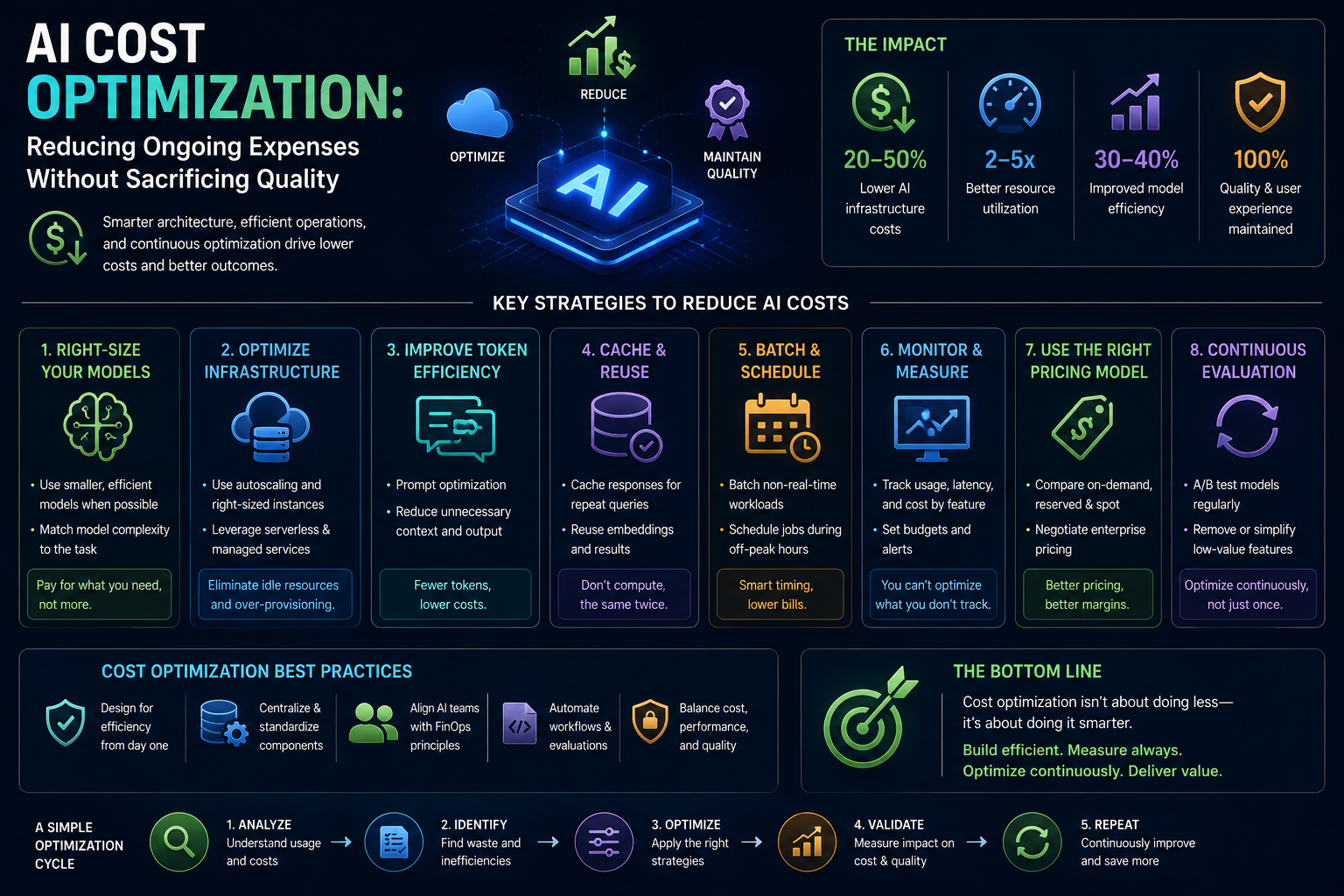
AI Cost Optimization: Reducing Ongoing Expenses Without Sacrificing Quality
AI cost optimization becomes a genuine priority once an AI feature is live and usage-based model costs start accumulating in proportion to actual adoption, at which point the techniques that reduce ongoing expense without meaningfully sacrificing output quality become directly relevant to a product’s margins. Unlike a one-time development cost, AI usage costs are an ongoing, variable expense that scales with success, which means a popular AI feature that isn’t optimized can quietly become a significant, recurring cost center. This post covers practical techniques for optimizing ongoing AI costs after launch, from model selection to caching to prompt efficiency.
Choosing the Right Model for Each Task
Not every task within an application needs the most capable, and most expensive, available model.
Matching Model Capability to Task Complexity
Simple, well-defined tasks, classification, basic formatting, straightforward extraction, often perform just as well with smaller, less expensive models as with the most capable available option, so reserving premium models for genuinely complex tasks reduces cost without sacrificing quality where it matters.
Using a Tiered Model Approach
Many applications benefit from routing different types of requests to different models based on complexity, using a lightweight, inexpensive model for simple requests and reserving a more capable, costlier model for requests that genuinely need it.
Regularly Reassessing Model Choices
As new, more cost-efficient models become available, periodically reassessing whether your current model choice still represents the best cost-to-quality tradeoff prevents settling into an outdated, unnecessarily expensive default.
Reducing Unnecessary Token Usage
Since usage costs scale with the amount of text processed, reducing unnecessary content sent to the model directly reduces cost.
Trimming Unnecessary Context
Sending only the context genuinely relevant to a specific request, rather than including excessive conversation history or retrieved content by default, reduces cost per request without necessarily sacrificing response quality.
Optimizing Retrieval for Relevance
For retrieval-augmented applications, improving the precision of what gets retrieved, so only genuinely relevant content gets included, reduces both cost and the risk of irrelevant information confusing the model’s response.
Caching Common Responses
For requests that are frequently repeated or highly similar, caching previous responses and serving them directly, rather than generating a fresh response every time, can meaningfully reduce cost for high-volume, repetitive request patterns.
Optimizing Prompt Design
How a prompt is structured affects both output quality and the token cost of each request.
Writing Concise, Effective Prompts
Overly verbose prompts increase token cost without necessarily improving output quality, so refining prompts toward the most concise version that still reliably produces good results reduces cost incrementally across every request.
Avoiding Redundant Instructions
Prompts that repeat the same instructions multiple times, often accumulated through iterative editing without cleanup, waste tokens unnecessarily and are worth periodically reviewing and simplifying.
Monitoring and Managing Usage Proactively
Ongoing visibility into usage patterns is what makes proactive cost optimization possible in the first place.
Building Real-Time Cost Monitoring
Tracking usage costs in real time, broken down by feature or user segment, reveals where costs are concentrated and highlights the specific areas where optimization effort will have the most impact.
Setting Usage Limits Where Appropriate
For features where uncontrolled usage could create runaway costs, implementing reasonable usage limits protects against unexpected cost spikes while still allowing genuine, normal usage to proceed without friction.
Building Cost Optimization Into Ongoing Operations
AI cost optimization works best as an ongoing practice, not a one-time review, since usage patterns, available models, and application features all continue to evolve after initial launch. Our generative AI development team builds cost monitoring and optimization practices into AI applications from the start, rather than treating them as an afterthought once costs become a problem.
Key Takeaways
Matching model capability to actual task complexity, rather than defaulting to the most capable available model for everything, is one of the most effective AI cost optimization techniques. Reducing unnecessary context and improving retrieval precision lowers token cost without sacrificing output quality. Concise, well-designed prompts reduce cost incrementally across every request, and real-time usage monitoring is what makes proactive, targeted cost optimization possible rather than discovering cost problems only in a monthly bill.
Frequently Asked Questions
Does using a cheaper AI model always reduce quality?
Not necessarily for every task. Simple, well-defined tasks often perform just as well with smaller, less expensive models, so the right approach is matching model capability to actual task complexity rather than assuming cheaper always means worse.
How much can caching actually reduce AI costs?
The impact depends heavily on how repetitive your request patterns are, but for applications with genuinely common, similar requests, caching can meaningfully reduce cost by avoiding repeated generation of essentially the same response.
Is prompt optimization worth the effort for small cost savings per request?
Yes, generally, since prompt-level savings compound across every single request at scale, meaning even modest per-request savings can add up to meaningful total cost reduction for a high-volume application.
Should I set usage limits on AI features?
For features where uncontrolled usage could create runaway costs, reasonable usage limits provide important protection, though they should be set generously enough not to create friction for genuine, normal usage patterns.
How often should I reassess my AI model choices?
Periodically, since new, more cost-efficient models become available over time, and reassessing whether your current choice still represents the best cost-to-quality tradeoff prevents settling into an outdated, unnecessarily expensive default.
How do I get help optimizing costs for my existing AI application?
Cost optimization opportunities depend heavily on your specific application’s usage patterns and current architecture, so a detailed review of your specific situation is the most reliable way to identify meaningful savings.