


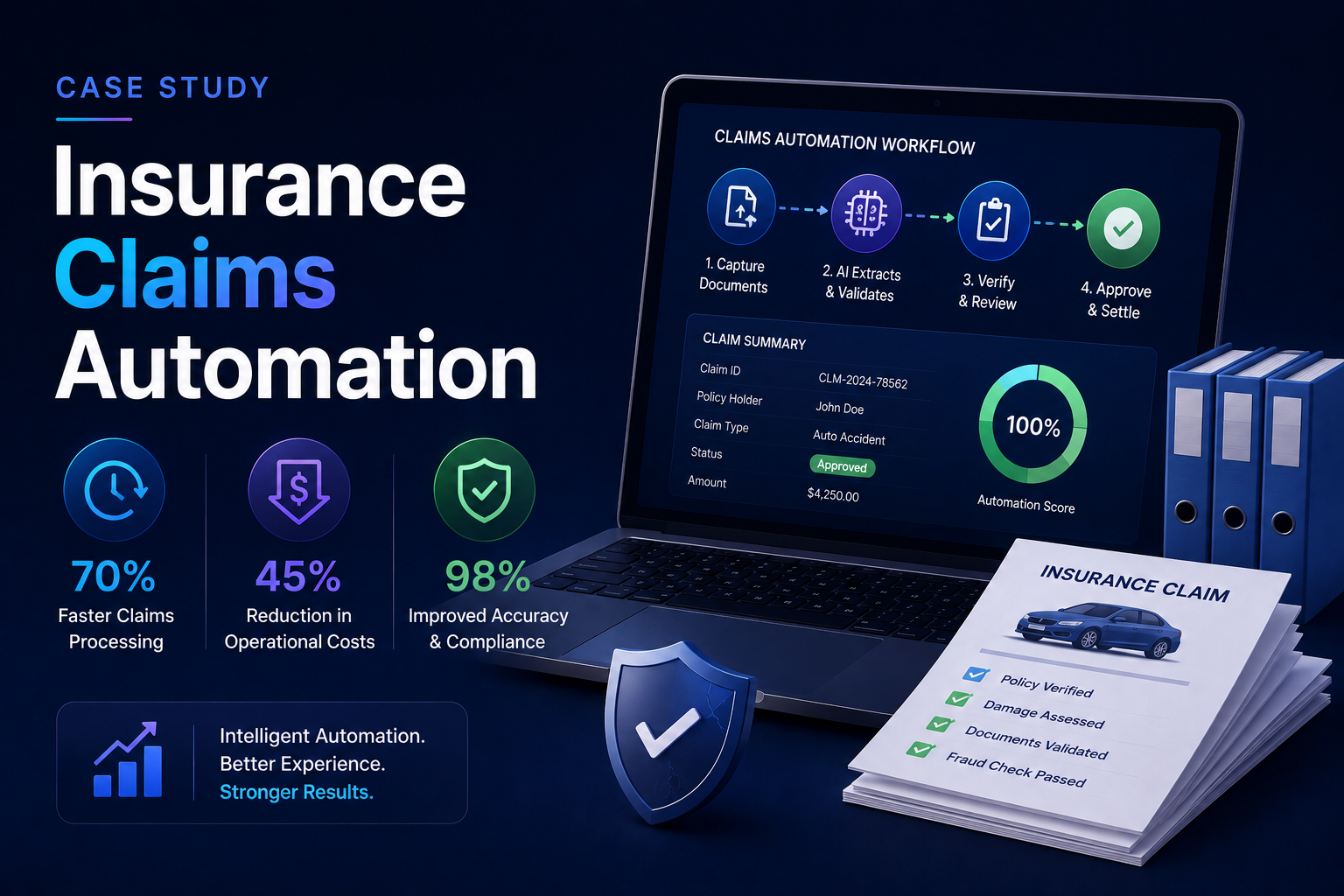
Case Study: Insurance Claims Automation
A regional insurance provider was struggling with slow, manual claims processing that frustrated policyholders and consumed significant staff time reviewing routine documentation. Our insurance app development team built an AI-powered claims automation platform that dramatically sped up processing while improving accuracy and consistency. This case study covers the client’s challenge, our approach, and the operational results the platform delivered after rollout.
The Challenge
The client’s claims team was manually reviewing every submitted document, from photos of damage to handwritten forms, creating a processing bottleneck that delayed payouts and frustrated policyholders waiting on claim resolutions.
Slow Manual Document Review
Claims adjusters were spending significant time manually reviewing forms, receipts, and supporting documents for each claim, creating a processing backlog during high-volume periods.
Inconsistent Claims Assessment
Manual review introduced variability in how similar claims were assessed depending on which adjuster handled them, creating fairness concerns and inconsistent processing times.
Rising Operational Costs at Scale
As claim volume grew, the client faced pressure to either hire proportionally more claims staff or find a way to process claims more efficiently with existing resources.
Our Approach
We designed and built an AI-powered document processing and claims automation pipeline that handled routine claims automatically while flagging complex cases for human review, addressing the core bottlenecks in the client’s existing process.
Automated Document Data Extraction
We built document processing that automatically extracted key data from claims forms, receipts, and photos, eliminating manual data entry for the majority of straightforward claims. Our AI document processing capabilities powered this extraction layer.
Consistent Risk & Damage Assessment
We implemented automated assessment logic that applied consistent criteria to routine claims, reducing the variability that came from purely manual, adjuster-dependent review.
Confidence-Based Human Review Routing
We built confidence scoring that automatically routed complex or unusual claims to human adjusters, while straightforward claims moved through the automated pipeline without unnecessary delay.
Integration with Existing Claims Systems
We integrated the new automation pipeline with the client’s existing claims management system, avoiding a disruptive full system replacement while still delivering the efficiency gains automation provided.
The Results
Following rollout, the client saw substantial improvements across processing speed, cost, and consistency:
- Significantly faster average processing time for routine claims, with many resolved in a fraction of the previous timeline
- Reduced manual review workload for claims adjusters, freeing their time to focus on complex cases requiring genuine judgment
- More consistent claims assessment outcomes across similar claim types
- The ability to handle growing claim volume without a proportional increase in claims processing staff
The client’s operations team highlighted that policyholders noticed the difference directly, with faster resolutions reducing the volume of status-check calls to customer service during the claims process.
Why This Approach Worked
Rather than trying to automate every claim regardless of complexity, the confidence-based routing let straightforward claims move through quickly while ensuring complex cases still received the careful human judgment they required. This balance delivered efficiency gains without sacrificing the accuracy and fairness the client’s claims process depended on.