


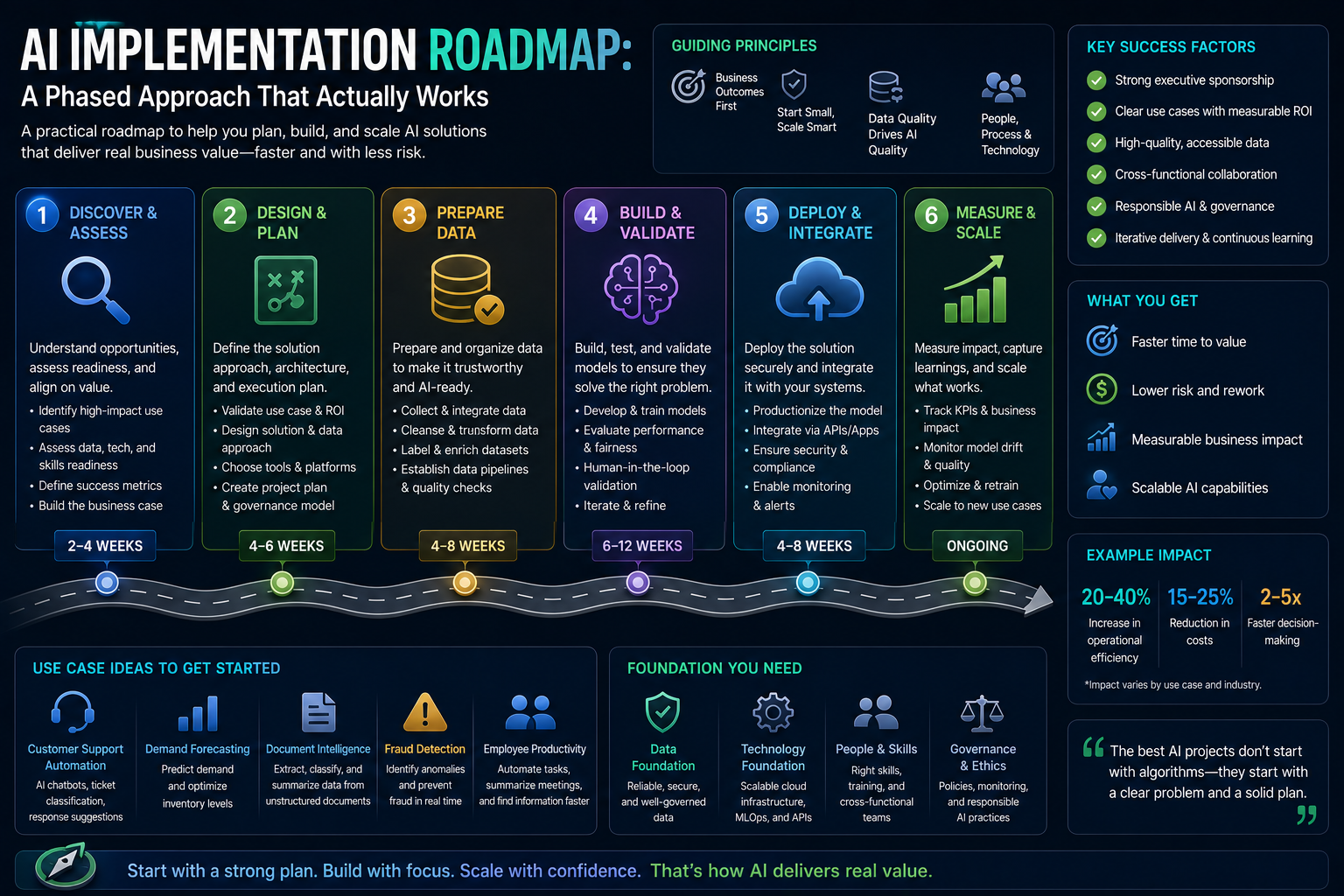
AI Implementation Roadmap: A Phased Approach That Actually Works
An AI implementation roadmap succeeds when it sequences adoption deliberately, starting with a well-scoped pilot, learning from real results, then scaling based on evidence, rather than attempting a broad, organization-wide AI transformation all at once before anyone has proven what actually works within the specific organization. Many AI initiatives stall or underdeliver not because the technology fails, but because the rollout tried to move too fast across too many use cases simultaneously, without the organizational learning and change management that a more deliberate pace allows. This post walks through a practical, phased approach to building an AI implementation roadmap that actually gets adopted, not just deployed.
Phase One: Pilot Selection and Scoping
The first phase determines the foundation everything else builds on, so getting this selection right matters disproportionately.
Choosing a Well-Bounded Pilot Use Case
A good first pilot addresses a specific, well-understood problem with clear success criteria, rather than an ambitious, loosely defined initiative spanning multiple departments or unclear objectives.
Setting Realistic Success Metrics
Defining in advance what evidence would indicate the pilot succeeded, and what would indicate it needs adjustment, prevents the common trap of interpreting ambiguous early results as success simply because momentum has already been invested.
Assembling the Right Cross-Functional Team
Even a technical pilot benefits from involvement beyond the technical team, the actual users or stakeholders affected by the AI application, since their buy-in and feedback shape whether the pilot’s lessons actually transfer to broader adoption.
Phase Two: Learning From the Pilot
Before scaling anything, the organization needs to genuinely absorb what the pilot revealed, both technically and organizationally.
Evaluating Technical Performance Honestly
Assessing whether the pilot actually met its defined success metrics, rather than reframing ambiguous results as success after the fact, gives the organization an honest foundation for deciding what to scale.
Understanding Organizational Response
How the team actually using or affected by the AI application responded, resistance, enthusiasm, workflow disruption, reveals change management lessons that are just as important as technical performance metrics.
Identifying What Needs to Change Before Scaling
Pilots often reveal specific technical or process adjustments needed before broader rollout, and addressing these before scaling prevents compounding the same issues across a much larger deployment.
Phase Three: Scaling Based on Evidence
Once a pilot has demonstrated genuine value and revealed necessary adjustments, scaling should proceed deliberately rather than all at once.
Expanding to Similar Use Cases First
Applying lessons from a successful pilot to closely related use cases, rather than jumping to a fundamentally different application, lets the organization build on proven patterns rather than starting from scratch each time.
Building Reusable Infrastructure
As multiple AI applications get built, investing in reusable infrastructure, shared retrieval systems, evaluation tooling, common guardrail patterns, becomes increasingly valuable rather than building each new application entirely from scratch.
Managing Organizational Change at Scale
Broader rollout affects more people than a contained pilot, so change management, training, clear communication about what’s changing and why, deserves proportionally more attention as adoption scales.
Phase Four: Ongoing Governance and Improvement
AI implementation isn’t a one-time project; it requires ongoing attention as applications mature and organizational needs evolve.
Establishing Clear Ownership
Each AI application needs a clear internal owner responsible for monitoring performance and initiating improvements over time, since AI systems can quietly degrade in usefulness without active attention.
Building Feedback Loops
Ongoing mechanisms for users to report issues or unexpected behavior, paired with a process for actually acting on that feedback, keep AI applications improving rather than stagnating after initial launch.
Building Your Organization’s AI Roadmap
A deliberate, phased AI implementation roadmap trades short-term speed for genuine, lasting adoption, learning from a contained pilot before committing to broader organizational change. Our AI consulting services team can help design a roadmap sequenced to your organization’s specific readiness and priorities, and our generative AI development team can help execute each phase.
Key Takeaways
A well-scoped, clearly bounded pilot with defined success metrics is the foundation a successful AI implementation roadmap builds on. Honestly evaluating both technical performance and organizational response before scaling prevents compounding unresolved issues across a larger rollout. Scaling should proceed to closely related use cases first, building on proven patterns and reusable infrastructure rather than starting from scratch each time, and ongoing governance, clear ownership, ongoing feedback loops, keeps AI applications improving after initial launch rather than stagnating.
Frequently Asked Questions
How long should a pilot phase last before deciding whether to scale?
There’s no universal timeline, but a pilot should run long enough to generate meaningful, evaluable data against its defined success metrics, which varies based on the specific use case and how quickly relevant usage data accumulates.
What’s the biggest mistake organizations make with AI implementation roadmaps?
Attempting broad, organization-wide AI adoption simultaneously across many use cases, without first learning from a contained pilot, is one of the most common reasons AI initiatives stall or underdeliver relative to their investment.
Should the same team handle both the pilot and the broader scaling phase?
Involving the pilot team in scaling helps preserve institutional knowledge about what worked and what needed adjustment, though scaling often requires additional resources and stakeholders beyond the original pilot team.
How do I know if my organization is ready to move from pilot to broader scaling?
Evidence the pilot met its defined success metrics, combined with a clear understanding of what adjustments are needed before broader rollout, together indicate readiness to scale, rather than proceeding based on general enthusiasm alone.
Who should own an AI application after it’s been scaled?
A clearly identified internal owner responsible for monitoring performance and initiating improvements over time helps prevent the gradual quality drift that affects most AI systems without active, ongoing attention.
How do I build a realistic AI implementation roadmap for my organization?
The right sequencing and pace depends on your organization’s specific readiness, priorities, and existing AI experience, so a detailed AI consultation is the most reliable way to build a roadmap suited to your actual situation.