


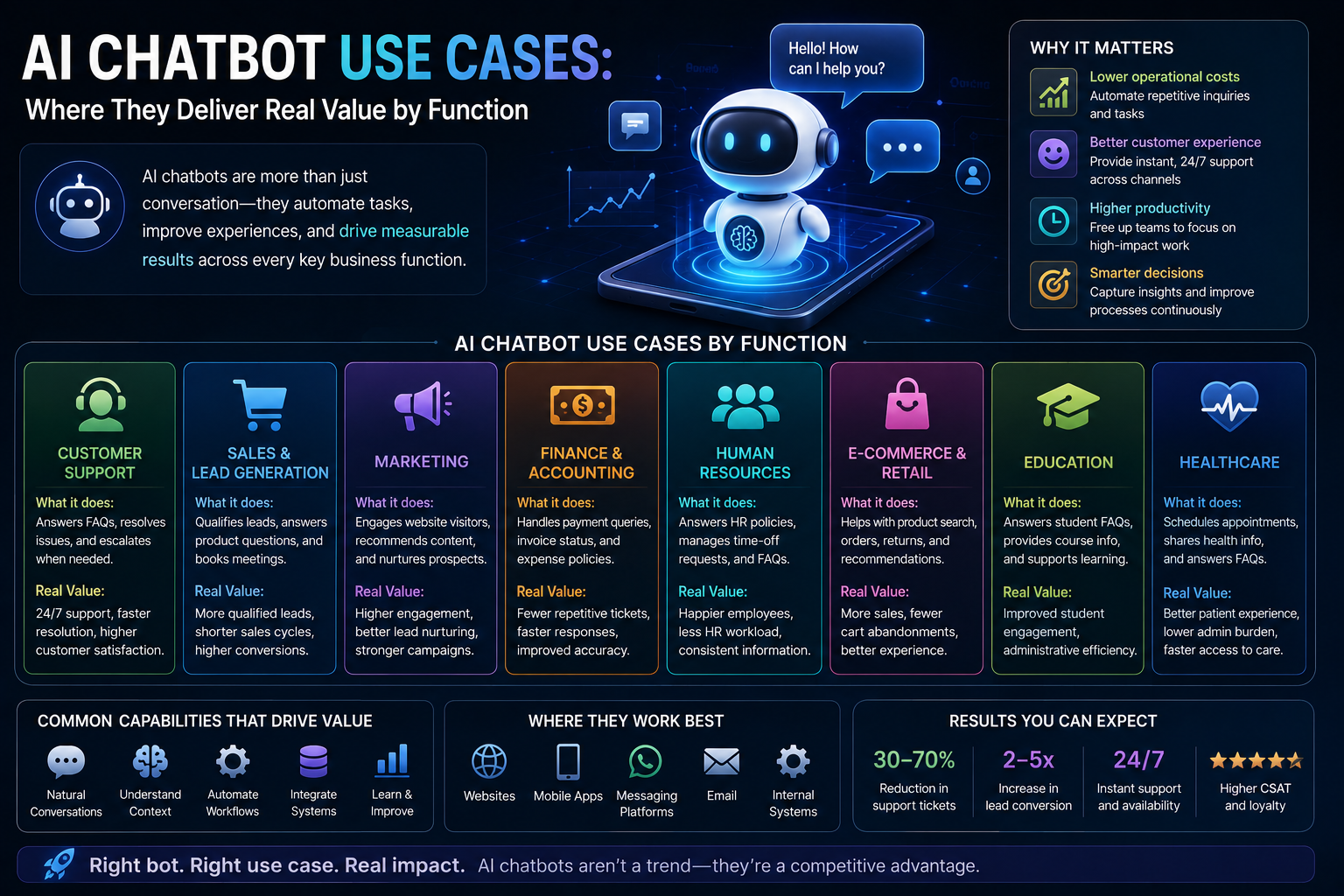
AI Chatbot Use Cases: Where They Deliver Real Value by Function
AI chatbot use cases span far more business functions than customer support alone, and understanding where they deliver genuine value by function, sales, internal operations, customer support, helps clarify which application actually fits your business need rather than assuming every chatbot serves the same generic purpose. A chatbot handling pre-sales product questions requires a different design and success measure than one handling internal IT support tickets, even though both rely on similar underlying technology. This post covers AI chatbot use cases organized by business function, so you can identify which application matches your specific operational need.
Customer Support Chatbots
Customer support remains the most common and mature application of AI chatbots in business today.
Handling Routine, Repetitive Questions
Order status, return policies, and account questions represent a high volume of predictable, repetitive inquiries that a well-scoped chatbot can resolve directly, freeing human agents for more complex cases.
Providing 24/7 Availability
Unlike human-staffed support, a chatbot can provide instant responses outside business hours, which matters particularly for businesses serving customers across multiple time zones or with urgent, time-sensitive questions.
Escalating Appropriately to Human Agents
The most effective support chatbots recognize their own limits and escalate cleanly to a human agent when a question falls outside their scope, rather than trapping frustrated customers in an unhelpful loop.
Sales and Pre-Purchase Chatbots
Chatbots supporting the sales process serve a genuinely different function than post-purchase support.
Answering Product Questions
A chatbot grounded in accurate product information can answer detailed pre-purchase questions instantly, reducing the friction that causes potential customers to abandon a purchase decision while waiting for a human response.
Qualifying and Routing Leads
For business-to-business sales specifically, a chatbot can gather initial qualifying information from a prospective customer and route them to the appropriate sales representative, saving time on both sides of the conversation.
Guiding Product Discovery
For businesses with complex or extensive catalogs, a conversational chatbot can help customers narrow down options based on their specific needs, functioning similarly to a knowledgeable in-store associate.
Internal Operations Chatbots
Beyond customer-facing applications, chatbots increasingly support internal business functions.
Employee Self-Service for HR and IT
A chatbot answering common employee questions about benefits, policies, or basic IT troubleshooting reduces the burden on internal support teams for routine, repetitive requests.
Internal Knowledge Base Assistance
Employees often waste meaningful time searching scattered internal documentation for answers; a chatbot grounded in that documentation through retrieval-augmented generation can surface relevant information far faster than manual search.
Onboarding Support for New Employees
A chatbot that can answer common new-hire questions and point to relevant resources helps reduce the burden on managers and HR during the onboarding process, particularly for organizations with regular hiring volume.
Choosing the Right Chatbot Use Case for Your Business
The right starting point depends on where your business faces the most repetitive, high-volume inquiries, whether that’s customer support tickets, pre-sales questions, or internal employee requests, since a chatbot scoped around genuine pain points delivers measurably more value than one built around a generic, unfocused use case. Our AI chatbot development team can help identify and scope the right application for your specific operational needs.
Key Takeaways
AI chatbot use cases span customer support, sales, and internal operations, each with distinct design and success considerations rather than a single generic application. Customer support chatbots deliver the most mature, well-understood value through handling repetitive inquiries and providing after-hours availability. Sales chatbots serve a genuinely different function, answering pre-purchase questions and qualifying leads, and internal operations chatbots increasingly reduce burden on HR, IT, and onboarding processes by surfacing information faster than manual search.
Frequently Asked Questions
Which chatbot use case delivers the fastest return on investment?
Customer support chatbots handling high-volume, repetitive inquiries tend to deliver among the fastest, most measurable returns, since ticket volume reduction and response time improvements can be tracked directly.
Can the same chatbot handle both sales and support functions?
It’s possible, but chatbots scoped to a single, clear function generally perform better than ones trying to handle fundamentally different use cases simultaneously, since the knowledge base and conversation design needs differ meaningfully between sales and support contexts.
Are internal operations chatbots as valuable as customer-facing ones?
Yes, though the value shows up differently, as time saved and reduced burden on internal teams rather than direct revenue impact, which can make the business case less immediately visible but still genuinely worthwhile.
How do I know which chatbot use case is right for my business first?
Identifying where your business currently faces the most repetitive, high-volume inquiries, whether in customer support, sales, or internal operations, is the most reliable starting point for scoping your first chatbot application.
Do all chatbot use cases require the same technical approach?
The underlying technology is often similar, but the knowledge base, conversation design, and success metrics differ significantly by function, so each use case should be scoped and designed around its specific context rather than using a one-size-fits-all template.
How much does building a chatbot for my specific use case cost?
Cost depends heavily on your specific function, knowledge base requirements, and integration needs, so a general figure is only a rough guide. A detailed cost estimate scoped to your use case is the most reliable way to plan your budget.