


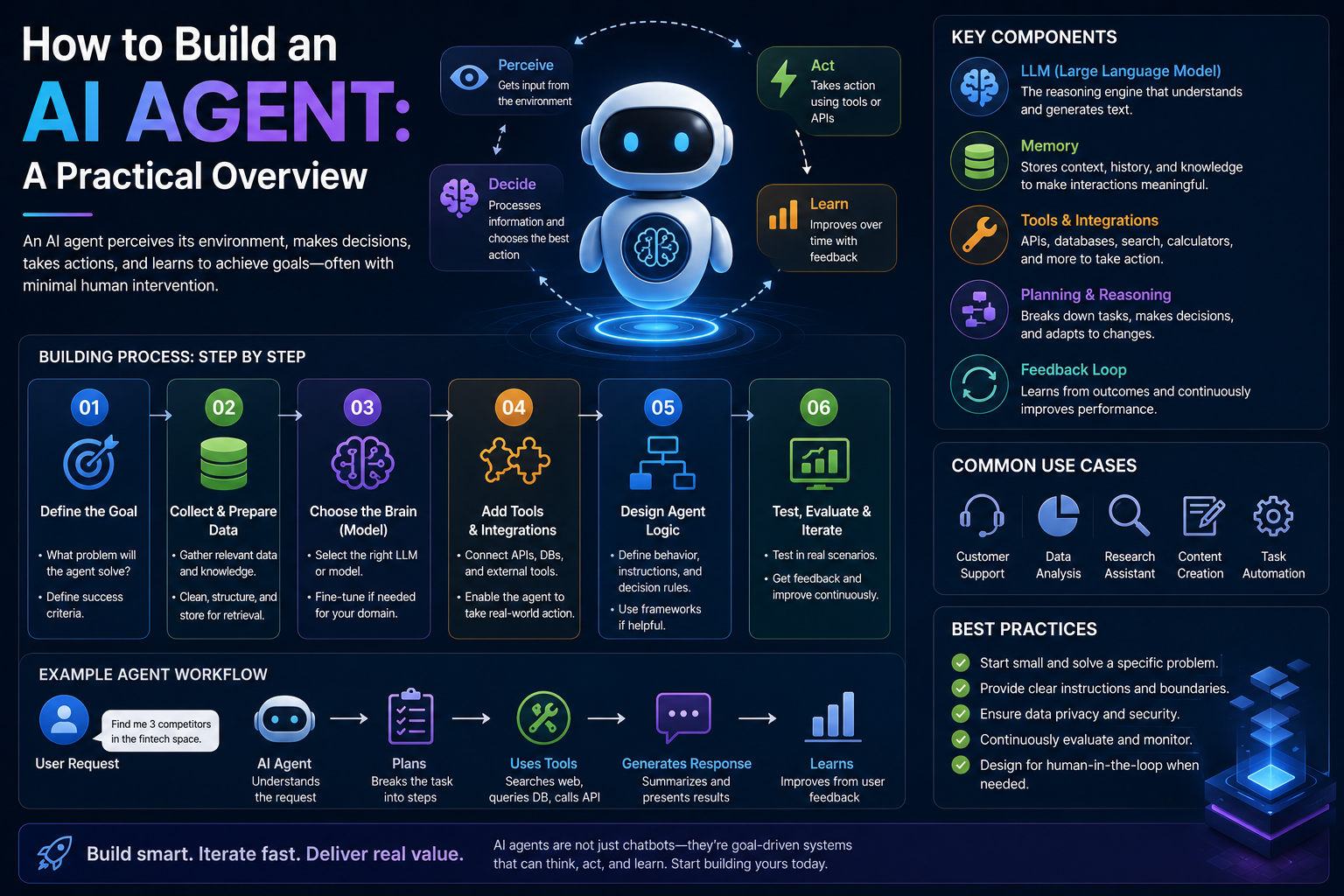
How to Build an AI Agent: A Practical Overview
Learning how to build an AI agent means understanding a meaningfully different architecture than a standard chatbot, since an agent needs to plan a sequence of steps, decide which tools or actions to use at each step, and adjust its approach based on results along the way, rather than simply responding to a single question with a single answer. This capability, breaking a goal down and executing multiple steps toward it, is what makes agents genuinely useful for tasks like research, booking, or data processing that a simple conversational interface can’t handle on its own. This post covers what an AI agent actually is, the core components involved in building one, and the guardrails that keep an agent reliable rather than unpredictable.
What Makes an AI Agent Different From a Chatbot
Understanding the architectural distinction clarifies when an agent is the right tool versus when a simpler conversational interface would do.
Planning and Task Decomposition
An agent needs to break a broader goal, book a trip, research a topic, process a batch of data, into a specific sequence of smaller steps, then execute those steps in the right order, which requires planning logic beyond a single question-and-answer exchange.
Tool Use and Action-Taking
Agents typically have access to specific tools or actions, searching the web, querying a database, calling an external API, and need to decide which tool fits each step of the plan, rather than just generating conversational text.
Adapting Based on Intermediate Results
A well-designed agent adjusts its plan based on what happens at each step, if a search returns unexpected results, the agent needs to reconsider its approach rather than blindly continuing a rigid, predetermined sequence.
Core Components of an AI Agent
Building a genuinely useful agent involves several distinct technical components working together.
The Planning and Reasoning Layer
This component breaks the overall goal into steps and decides the sequence of actions needed, typically using the underlying language model’s reasoning capability combined with structured prompting designed specifically for planning tasks.
Tool and API Integrations
The specific tools an agent can use, search, calculations, database queries, external service calls, need to be clearly defined and integrated, since an agent can only take actions through tools that have actually been built and connected.
Memory and State Management
For multi-step tasks, the agent needs to track what it has already done and what results it has gathered along the way, requiring some form of memory or state management that persists across the steps of a single task.
Building in Reliability and Guardrails
Because agents take actions rather than just generating text, reliability and safety guardrails matter more here than in a standard chatbot application.
Limiting Scope of Available Actions
Restricting an agent to a specific, well-defined set of tools and actions relevant to its intended purpose reduces the risk of unpredictable or unintended behavior compared to giving an agent unrestricted access to broad capabilities.
Human Approval for High-Stakes Actions
For actions with real consequences, financial transactions, sending communications, irreversible changes, requiring human approval before the agent executes that specific step adds an important safety checkpoint without eliminating the agent’s overall usefulness.
Monitoring and Logging Agent Behavior
Detailed logging of an agent’s planning and actions makes it possible to understand what happened when something goes wrong, and to identify patterns worth improving, which is harder to do retroactively without logging built in from the start.
Common Use Cases for AI Agents
Understanding where agents deliver genuine value helps clarify when this architecture is worth the added complexity compared to a simpler AI feature.
Research and Information Gathering
Agents that can search multiple sources, synthesize findings, and compile a coherent summary handle research tasks that would otherwise require significant manual effort to complete.
Multi-Step Booking and Coordination
Tasks involving multiple steps, checking availability, comparing options, completing a booking, are a natural fit for agent architecture, since they genuinely require the sequential planning and tool use agents are built for.
Getting Started With AI Agent Development
Building a reliable AI agent requires more architectural planning than a standard chatbot, given the added complexity of planning, tool integration, and safety guardrails, but delivers meaningfully more capability for tasks that genuinely require multiple steps. Our AI agent development team can help scope the right architecture and guardrails for your specific use case.
Key Takeaways
AI agents differ from standard chatbots by planning multi-step sequences and taking actions through integrated tools, rather than simply responding conversationally to individual questions. Core components include planning logic, tool integrations, and memory management to track progress across a task’s multiple steps. Reliability guardrails, limited action scope, human approval for high-stakes steps, detailed logging, matter more for agents than for standard AI features given their ability to take real actions, and agents deliver the most value for genuinely multi-step tasks like research and coordination.
Frequently Asked Questions
When should I build an AI agent instead of a simple chatbot?
An agent makes sense when your use case genuinely requires multiple sequential steps and tool use, research, booking, coordination, rather than a single question-and-answer interaction, which a standard chatbot handles well enough on its own.
Are AI agents safe to give real-world actions to take?
They can be, with appropriate guardrails, limiting the scope of available actions, requiring human approval for high-stakes steps, and thorough logging, rather than giving an agent unrestricted access to broad capabilities without oversight.
How does an agent decide which tool to use at each step?
The planning and reasoning layer, typically built on the underlying language model combined with structured prompting, evaluates the current step’s goal and selects from the specific tools that have been integrated and made available to the agent.
What happens if an agent’s plan doesn’t work as expected?
A well-designed agent adjusts its approach based on intermediate results, reconsidering its plan if a step doesn’t produce the expected outcome, rather than blindly continuing a rigid, predetermined sequence regardless of what actually happens.
Do AI agents require more development effort than a standard chatbot?
Generally yes, given the added complexity of planning logic, tool integrations, and safety guardrails, so agent architecture is worth the investment specifically for use cases that genuinely require multi-step task execution.
How much does it cost to build a custom AI agent?
Cost depends heavily on how many tools and integrations the agent needs, the complexity of its planning logic, and required guardrails, so a general figure is only a rough guide. A detailed cost estimate scoped to your specific use case is the most reliable way to plan your budget.