


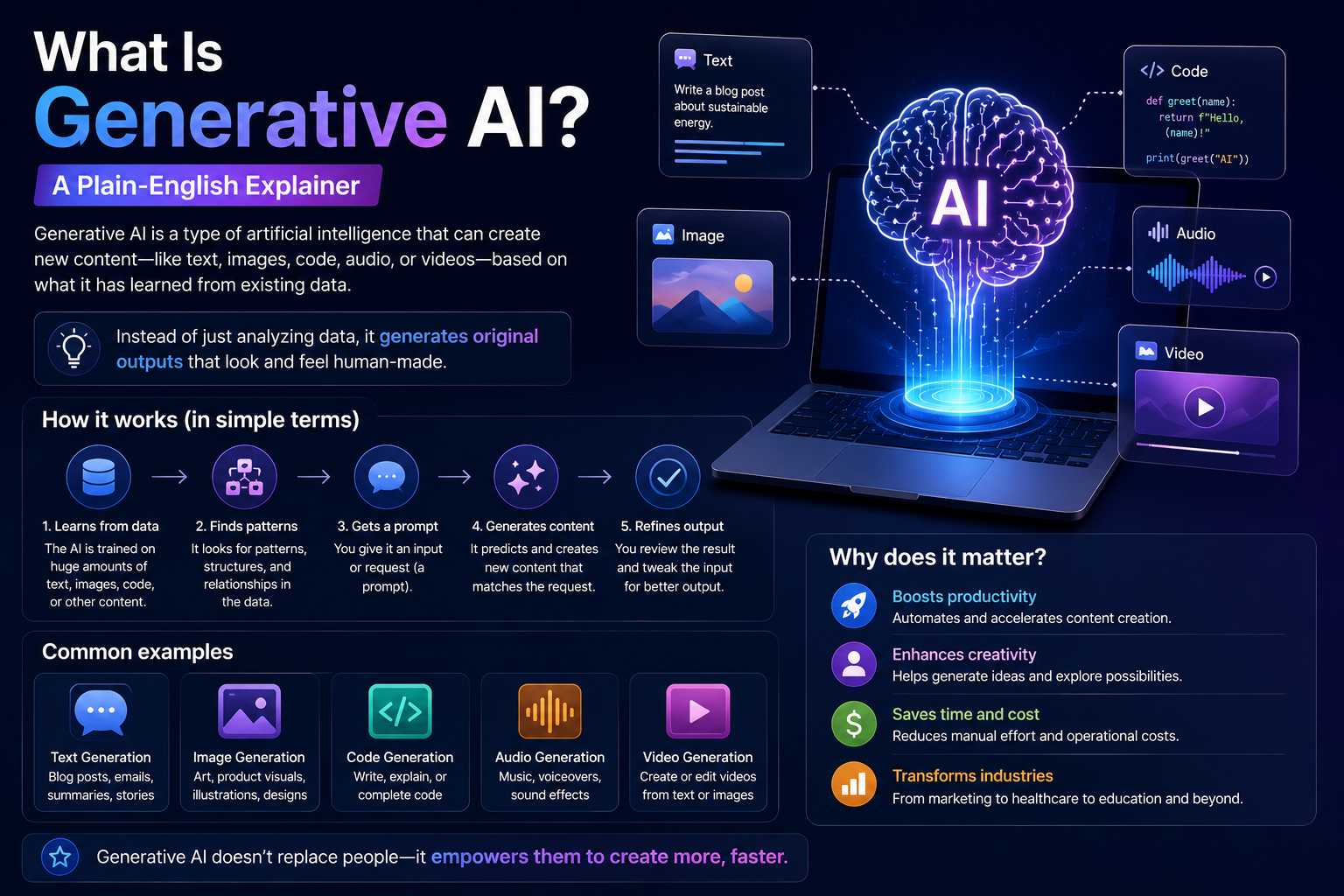
What Is Generative AI? A Plain-English Explainer
Generative AI is a category of artificial intelligence that creates new content, text, images, code, rather than simply analyzing or classifying existing data, which is the key distinction that separates it from most earlier forms of AI businesses have used for years. Understanding what generative AI actually does, and just as importantly what it doesn’t reliably do yet, matters for any business evaluating whether and how to use it, since a lot of public discussion swings between overhyped claims and dismissive skepticism without landing on a grounded, practical understanding. This post explains what generative AI is in plain language, how it actually works at a conceptual level, and what businesses can realistically expect from it today.
What Makes AI “Generative”
Understanding the term itself helps clarify what distinguishes this category of AI from other applications.
Creating New Content vs. Analyzing Existing Data
Traditional AI applications often focus on analyzing existing data to make predictions or classifications, will this customer churn, is this transaction fraudulent, while generative AI creates new content, a written paragraph, an image, a block of code, that didn’t exist before the request was made.
Learning Patterns From Large Amounts of Data
Generative AI models learn patterns from enormous amounts of existing text, images, or code during training, then use those learned patterns to generate new, plausible content in response to a specific prompt or request.
Why This Matters Practically
This distinction matters because generative AI opens up entirely new categories of business application, drafting content, answering open-ended questions, generating code, that traditional predictive AI wasn’t designed to handle.
How Generative AI Actually Works, Conceptually
Without getting into deep technical detail, understanding the basic mechanism helps set realistic expectations.
Pattern Prediction, Not True Understanding
At a conceptual level, generative AI models predict the most statistically plausible next piece of content based on patterns learned during training, which produces remarkably coherent and useful output but isn’t the same as genuine understanding or reasoning in the human sense.
Why Output Can Be Inconsistent
Because generation is based on statistical pattern prediction rather than verified facts, generative AI can produce confident-sounding but incorrect output, which is why human review remains important for any use case where accuracy genuinely matters.
The Role of Context and Prompting
The quality and relevance of generative AI output depends heavily on the context and instructions provided, which is why well-designed applications invest real effort in providing the right context rather than treating the underlying model as a magic black box.
What Generative AI Can Realistically Do Today
Setting expectations accurately means understanding both genuine strengths and current limitations.
Genuine Strengths
Generative AI excels at producing a useful first draft quickly, summarizing lengthy content, and handling open-ended conversational interactions in a way that feels natural, making it valuable for content drafting, customer support, and research assistance.
Current Limitations
Generative AI can produce confidently incorrect information, struggles with tasks requiring precise, verified accuracy without additional grounding, and generally works best with human review built into the workflow rather than fully autonomous, unsupervised use for high-stakes decisions.
How Businesses Are Using Generative AI Today
Real-world business applications tend to cluster around a handful of practical, well-scoped use cases.
Content and Communication Drafting
Drafting marketing copy, internal documentation, and customer communications for human review and refinement is one of the most direct, low-risk applications of generative AI available today.
Customer-Facing Conversational Interfaces
AI-powered chatbots handling routine customer questions, when connected to accurate, up-to-date business information through retrieval-augmented generation, provide genuine value while reducing support team workload.
Getting Started With Generative AI
Understanding what generative AI actually is and isn’t sets the right foundation for evaluating where it genuinely fits your business, rather than either dismissing it or expecting it to autonomously handle high-stakes decisions without oversight. Our generative AI development team can help identify practical, well-scoped applications for your specific business, and our AI consulting services can help map a broader adoption roadmap.
Key Takeaways
Generative AI creates new content based on patterns learned from large amounts of training data, distinguishing it from traditional predictive AI applications. Output quality depends heavily on context and prompting, and the underlying mechanism means confidently incorrect output is possible, making human review important for accuracy-sensitive use cases. Genuine current strengths include content drafting, summarization, and conversational interfaces, while high-stakes, fully autonomous decision-making remains an area requiring more caution today.
Frequently Asked Questions
Is generative AI the same as artificial intelligence in general?
No. Generative AI is a specific category within the broader field of AI, focused on creating new content rather than the wider range of tasks AI can perform, like classification, prediction, or optimization.
Can generative AI understand what it’s writing about?
Not in the human sense of genuine understanding. It predicts statistically plausible content based on patterns learned during training, which produces coherent, useful output but isn’t equivalent to conscious comprehension or verified reasoning.
Why does generative AI sometimes produce incorrect information?
Because output is based on statistical pattern prediction rather than verified facts, the model can generate confident-sounding content that isn’t actually accurate, which is why human review matters for use cases where correctness is important.
Do I need technical expertise to use generative AI in my business?
Basic use through existing consumer tools requires little technical expertise, but building genuinely useful, business-specific applications, especially ones grounded in your own data, typically benefits from experienced technical guidance.
Is generative AI safe to use for customer-facing applications?
It can be, when scoped carefully with appropriate guardrails and, where accuracy matters, grounded in verified business information through retrieval-augmented generation rather than relying purely on the model’s general training.
How do I know if generative AI is right for my specific business?
The right application depends on your specific goals, data, and risk tolerance, so a detailed AI consultation is the most reliable way to evaluate genuine fit rather than guessing from general information.