


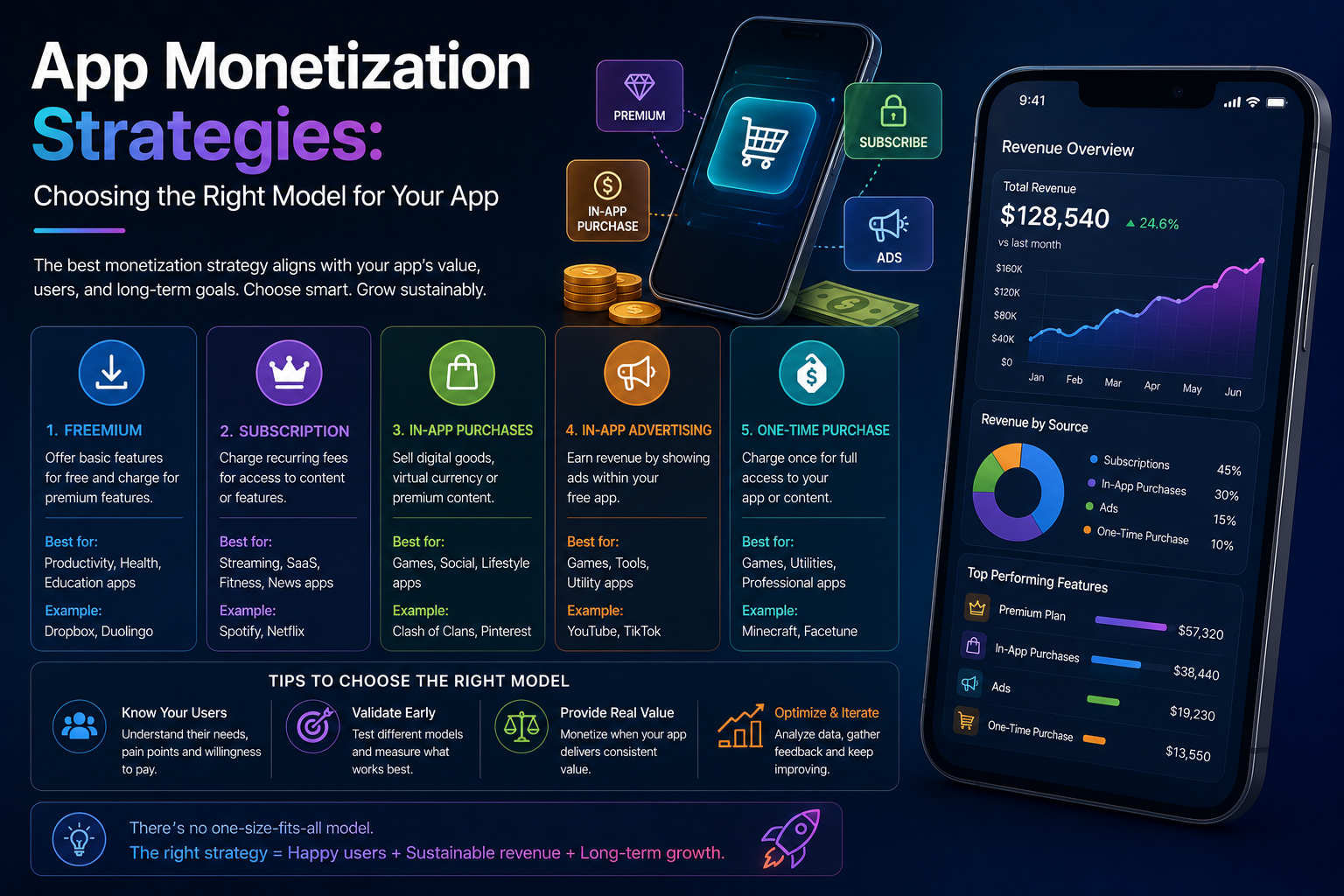
App Monetization Strategies: Choosing the Right Model for Your App
App monetization strategies aren’t interchangeable, the right choice depends heavily on your app’s specific use pattern, how often people open it, how much ongoing value it delivers, and what your users are actually willing to pay for, rather than defaulting to whichever model happens to be popular in your general app category. Many apps struggle commercially not because the underlying product lacks value, but because the monetization model doesn’t match how people actually use the app, charging upfront for something people want to try first, or relying on ads in an app where interruption genuinely damages the core experience. This post walks through the major app monetization strategies, when each one fits, and how to think about combining models effectively.
Subscription Models
Subscriptions have become the dominant monetization model for apps delivering ongoing, recurring value.
When Subscriptions Make Sense
Apps delivering continuous value over time, content libraries, productivity tools, ongoing services, fit subscription models well, since users are paying for continued access rather than a one-time transaction.
Tiered Subscription Structures
Offering multiple subscription tiers, a basic and premium level, for example, lets you capture value from a range of user types without excluding price-sensitive users entirely from a free or lower tier.
Reducing Subscription Churn
Since subscription revenue depends on retention as much as initial sign-ups, features that reinforce ongoing value, progress tracking, personalization, regular content updates, directly support long-term subscription revenue.
Freemium Models
Freemium lets users experience real value for free before being asked to pay, which can be a powerful acquisition tool when structured well.
Structuring a Compelling Free Tier
The free tier needs to deliver genuine value on its own, not feel deliberately crippled, while still leaving a clear, compelling reason for users to upgrade, a balance that requires careful product thinking rather than an arbitrary feature cutoff.
Choosing What to Gate Behind Payment
Gating features that align with your most engaged users’ actual needs, rather than gating features somewhat randomly, produces a more natural, less frustrating upgrade path for users who are genuinely getting value from the app.
Measuring Free-to-Paid Conversion
Tracking how many free users convert to paid, and at what point in their usage journey, helps refine both the free tier’s scope and the messaging around upgrading.
In-App Purchases
In-app purchases work well for apps where users want to pay for specific, discrete items or capabilities rather than ongoing access.
Consumable vs. Non-Consumable Purchases
Consumable purchases, items used up and repurchased, suit apps like games with virtual currency, while non-consumable purchases, permanent unlocks, suit one-time feature additions that don’t need repurchasing.
Avoiding Pay-to-Win Perception
For apps with any competitive or social element, purchases perceived as giving unfair advantages can damage user trust and engagement, so purchase design needs to be evaluated carefully against how it affects the broader user experience, not just direct revenue.
Advertising Models
Advertising can generate revenue without requiring any payment from users, but it requires enough usage volume and the right app context to work well.
When Ads Fit the User Experience
Advertising tends to work best in apps where brief interruptions don’t significantly damage the core experience, casual games, content browsing, rather than apps requiring sustained focus or professional use where interruption genuinely frustrates users.
Balancing Ad Frequency and Retention
Excessive ad frequency generates more short-term revenue but can meaningfully damage retention and lifetime value, so ad frequency decisions should be evaluated against their effect on long-term engagement, not just immediate revenue per session.
Combining Monetization Models
Many successful apps don’t rely on a single monetization model exclusively, combining approaches to capture value from different user segments.
Freemium With Optional In-App Purchases
A free tier with optional in-app purchases lets casual users engage without payment while capturing revenue from more invested users willing to pay for specific enhancements.
Ad-Supported Free Tier With Ad-Free Subscription
Offering an ad-free experience as a subscription upgrade over an ad-supported free tier gives users a clear, tangible reason to subscribe beyond feature access alone.
Choosing the Right Model for Your App
The right monetization strategy follows from your specific app’s use pattern and value delivery, not from copying whichever model is currently popular in your general category. Our mobile app development team can help evaluate which monetization approach, or combination of approaches, fits your specific app and user base.
Key Takeaways
App monetization strategy should follow from how your specific app delivers value and how often users engage with it, not from defaulting to a popular model in your general category. Subscriptions fit apps delivering ongoing, recurring value, while in-app purchases suit discrete, one-time capability or item purchases. Advertising works best in apps where brief interruptions don’t damage the core experience, and many successful apps combine multiple monetization models to capture value from different user segments simultaneously.
Frequently Asked Questions
Should every app charge users money to use it?
No. Many successful apps use advertising or freemium models specifically because charging upfront would prevent users from experiencing the app’s value before deciding whether it’s worth paying for.
How do I decide what to include in a free tier versus paywall?
Gating features that align with what your most engaged users actually need, rather than gating somewhat randomly, produces a more natural upgrade path than an arbitrary feature cutoff that frustrates users without a clear logic.
Can I combine subscriptions with in-app purchases in the same app?
Yes, this is a common and often effective approach, offering ongoing subscription value alongside optional one-time purchases for specific enhancements, capturing revenue from different user segments simultaneously.
How much advertising is too much in a free app?
There’s no universal number, but ad frequency that noticeably damages user retention and engagement is generally not worth the short-term revenue gain, so this tradeoff should be evaluated against actual retention data rather than assumed.
What’s the biggest mistake apps make with monetization?
Choosing a monetization model that doesn’t match the app’s actual use pattern, such as charging upfront for an app people want to try first, or relying on ads in an app where interruption genuinely damages the core experience, is one of the most common and costly mistakes.
How do I build the right monetization model into my app from the start?
The right approach depends on your specific app and target users, so a detailed conversation about your product is the most reliable way to determine the right monetization strategy before development begins.