


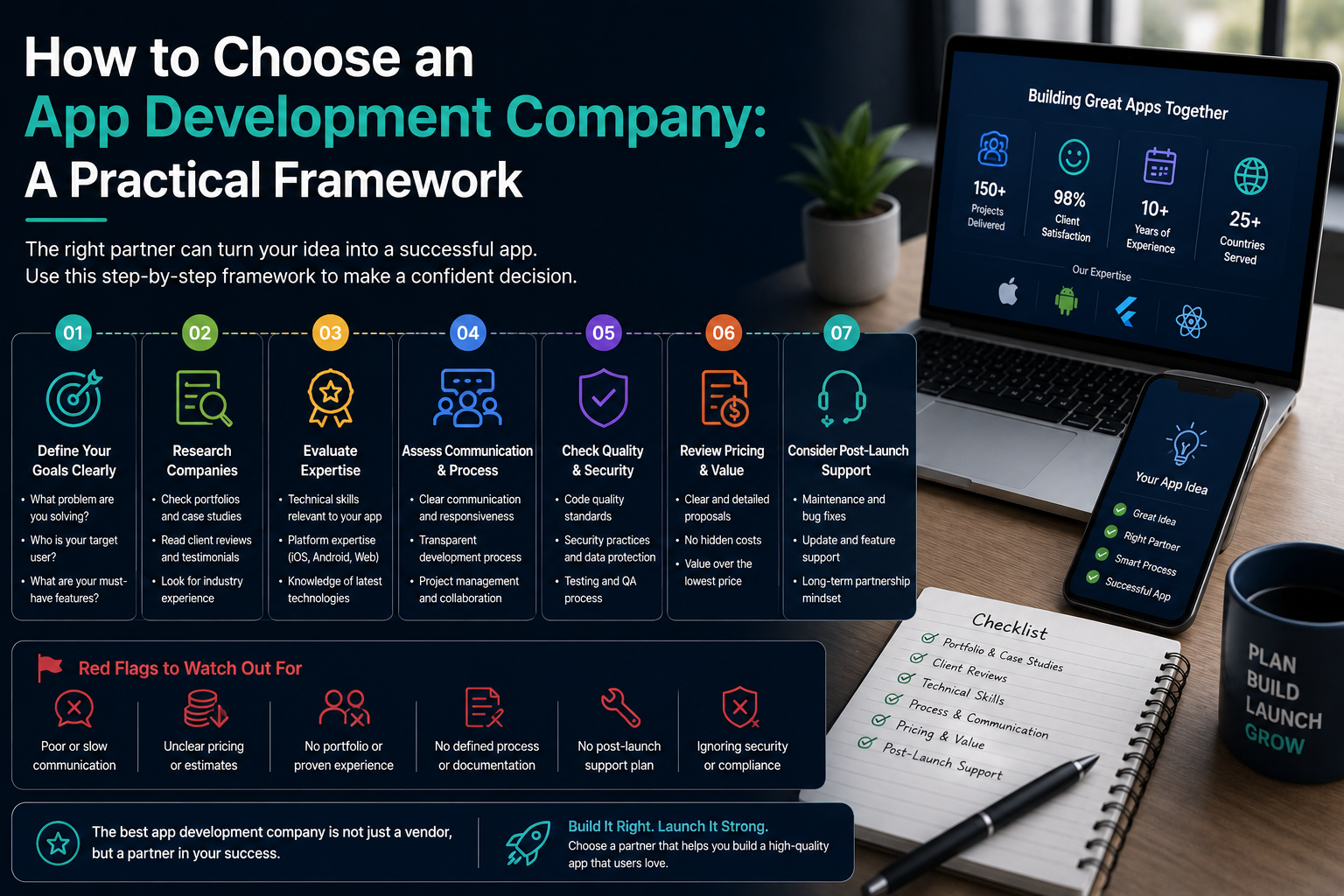
How to Choose an App Development Company: A Practical Framework
Learning how to choose an app development company matters more than most founders initially realize, since the wrong choice doesn’t just cost money, it can cost months of wasted time and a product that needs significant rework before it’s actually usable. With so many development companies competing for the same projects, comparing them purely on quoted price misses the factors that actually predict whether a project will go smoothly, portfolio relevance, communication practices, and how honestly a company scopes your specific idea. This post walks through a practical framework for evaluating app development companies, so you can make a confident choice rather than picking based on price alone.
Evaluating Portfolio Relevance
A company’s past work reveals far more about likely fit than their marketing materials or sales pitch.
Looking for Similar Project Types
A portfolio showing apps genuinely similar to yours in complexity and category, real-time features, marketplace logic, AI integration, is a stronger signal of relevant capability than a large but generic portfolio spanning unrelated project types.
Checking for Actually Shipped, Live Apps
Confirming that portfolio examples are real, currently live apps you can actually download and try, not just design mockups or concept work, gives you genuine evidence the company can carry a project through to a finished, working product.
Asking About Specific Challenges Solved
Asking a company to walk through a specific technical challenge they solved on a past project reveals far more about real capability than a general description of their services.
Assessing Communication Practices
How a company communicates during the sales process is often a preview of how they’ll communicate throughout your actual project.
Response Time and Clarity During Initial Contact
How quickly and clearly a company responds to your initial inquiries offers a useful, if imperfect, signal of what communication will look like once you’re a paying client and problems inevitably arise.
Willingness to Give Honest Scope Feedback
A company willing to push back on unrealistic scope or timeline expectations, rather than agreeing to everything to win the project, is generally a stronger long-term partner than one that tells you only what you want to hear.
Clarity Around Engagement Structure
A company that clearly explains how they structure engagements, dedicated teams, project-based delivery, communication cadence, gives you a much better sense of what working together will actually feel like.
Understanding Different Engagement Models
The right company should offer engagement structures that genuinely fit different project needs, not a one-size-fits-all approach.
Project-Based vs. Dedicated Team Engagements
A company offering both project-based delivery for defined scopes and dedicated team arrangements for ongoing work signals flexibility to match your actual needs, rather than forcing every client into the same structure.
Transparency Around Pricing Structure
Clear explanation of how pricing works, fixed project pricing, hourly rates, dedicated team retainers, and what’s included versus billed separately, helps avoid surprising costs partway through a project.
Red Flags Worth Watching For
Certain patterns during the evaluation process are worth taking seriously as warning signs.
Unwillingness to Provide References
A company reluctant to connect you with past clients, even informally, is worth treating with caution, since genuinely satisfied clients are usually a company’s strongest selling point, not a liability they’d want to hide.
Vague or Overly Optimistic Estimates
Estimates that seem unrealistically low or timelines that seem too fast given your actual scope are worth scrutinizing carefully, since these often indicate either inexperience with your project type or a strategy to win the project and renegotiate later.
Pressure to Commit Immediately
Genuine confidence in a company’s work generally doesn’t require pressuring a prospective client into an immediate decision, so noticeable urgency or pressure tactics during the sales process are worth taking as a signal to slow down.
Making a Confident Decision
Choosing an app development company well comes down to weighing portfolio relevance, communication quality, and engagement flexibility together, rather than defaulting to whichever company quoted the lowest price. Our why choose us page and engagement models page cover how we approach these exact evaluation criteria, so you can assess fit for yourself before committing to a project.
Key Takeaways
Portfolio relevance to your specific project type matters more than overall portfolio size or general reputation. Communication quality during the sales process is a meaningful preview of what working together will actually feel like throughout a project. A company offering flexible engagement models signals genuine adaptability to your specific needs, and red flags like reluctance to provide references or unrealistically optimistic estimates deserve serious scrutiny before committing.
Frequently Asked Questions
Is the lowest quoted price usually the best choice?
Not necessarily. The lowest price sometimes reflects genuine efficiency, but it can also indicate inexperience with your specific project type or a strategy to win the project before renegotiating scope or cost later, so price should be weighed alongside portfolio relevance and communication quality.
How many past clients should I ask to speak with as references?
Speaking with even one or two genuine past clients, ideally with projects similar to yours, can reveal meaningful information about communication quality and how the company handles challenges that arise during a project.
What questions should I ask about a company’s portfolio?
Asking about specific technical challenges they solved on a similar past project, and what they’d do differently in hindsight, reveals far more useful information than a general walkthrough of their services list.
Should I be concerned if a company pushes back on my initial scope?
Generally no. A company willing to give honest feedback on unrealistic scope or timeline expectations is usually a stronger long-term partner than one that agrees to everything without pushback, since the latter often leads to problems surfacing mid-project instead.
How important is it that a company offers multiple engagement models?
It’s a meaningful positive signal, since it suggests the company can genuinely adapt its structure to your specific needs rather than forcing every client into the same one-size-fits-all engagement type regardless of fit.
How do I get a fair, honest estimate for my specific project?
The most reliable way to get an honest estimate is a detailed scoping conversation with a company willing to ask real questions about your project rather than offering a generic number upfront.