


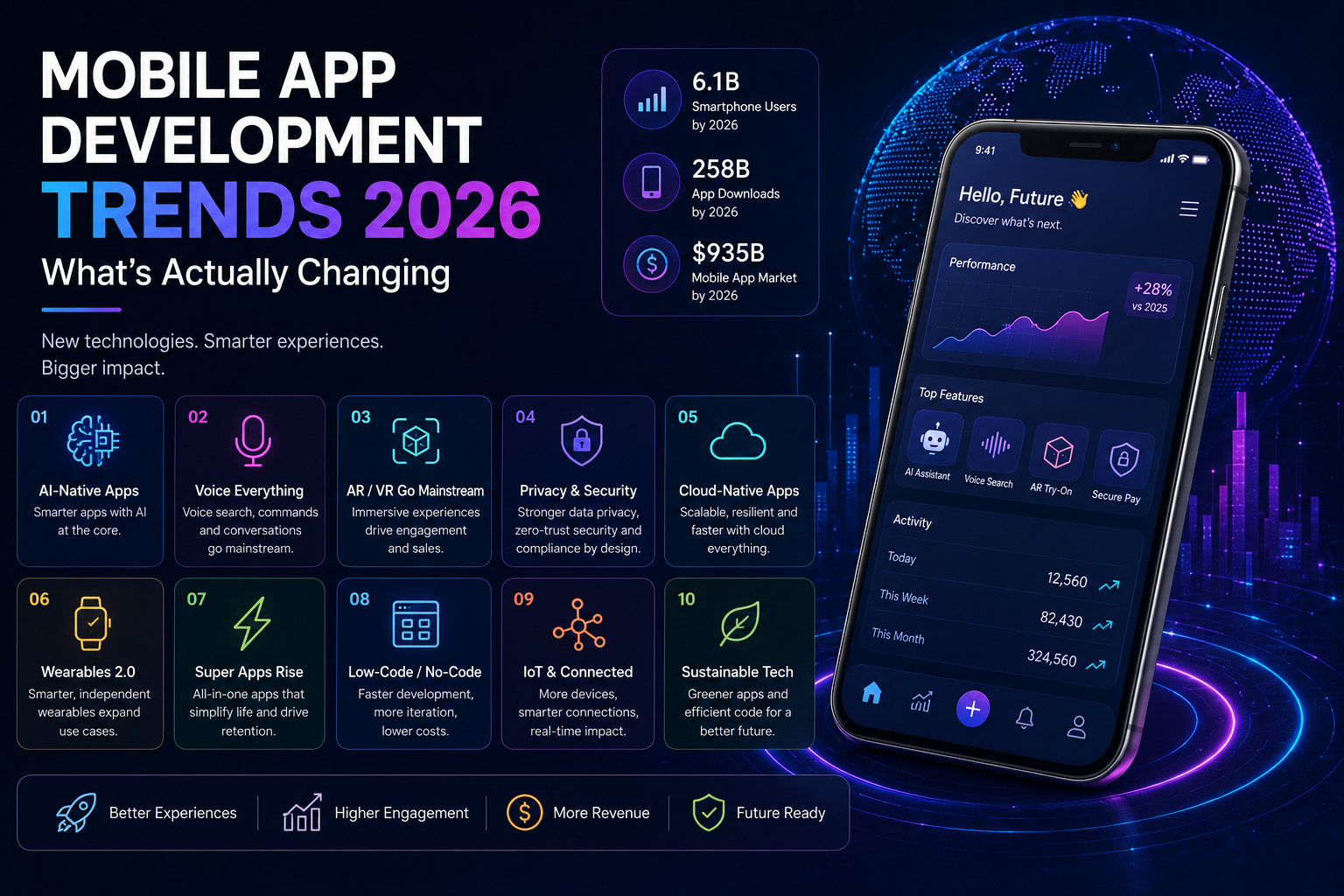
Mobile App Development Trends 2026: What’s Actually Changing
Mobile app development trends in 2026 are less about flashy new interface styles and more about a handful of substantive shifts, AI moving from a bolt-on feature to core product architecture, cross-platform frameworks becoming the default rather than the exception, and “super app” style consolidation gaining traction beyond the markets where it first took hold. Understanding which trends reflect genuine shifts in how apps get built versus which are temporary hype matters directly for founders and product teams deciding where to invest development effort right now. This post covers the mobile app development trends actually shaping decisions in 2026, and what each one means practically for a new or evolving app.
AI as Core Architecture, Not a Bolt-On Feature
The most significant shift in mobile development isn’t a specific feature, it’s where AI sits in the overall product architecture.
AI-Native Product Design
Rather than adding an AI chatbot to an existing app as an afterthought, more teams are designing the core product experience around AI capabilities from the start, personalized content, conversational interfaces, predictive functionality, built into the foundation rather than layered on top.
Retrieval-Augmented Personalization
Apps increasingly use retrieval-augmented generation to ground AI features in a user’s specific data and history, producing genuinely personalized experiences rather than generic AI output disconnected from the individual user’s context.
AI Agents Handling Multi-Step Tasks
Beyond simple chat interfaces, apps are beginning to incorporate AI agents capable of handling multi-step tasks on a user’s behalf, booking, research, coordination, rather than requiring the user to manually complete each step themselves.
Cross-Platform Development as the Default Choice
What was once a tradeoff decision has become the standard starting point for most new mobile products.
Cross-Platform Frameworks Maturing Further
Cross-platform frameworks have closed much of the performance gap with native development for the majority of use cases, making them the default choice for most consumer and business apps rather than a compromise accepted only for cost reasons.
Native Reserved for Specific High-Performance Needs
Native development is increasingly reserved for apps with genuinely demanding performance requirements or deep platform-specific feature needs, rather than being the default assumption for any serious mobile product.
Super Apps and Platform Consolidation
The single-purpose app model is facing real pressure from a consolidation trend that started in other markets and is spreading further.
Multiple Services Within One App
Rather than requiring users to download separate apps for related services, ride-hailing, payments, messaging, shopping, more platforms are consolidating multiple services within a single super app experience.
Reduced User Acquisition Costs Through Bundling
Super app models let platforms cross-sell services to an existing user base rather than acquiring new users separately for each service, a meaningfully more efficient growth model than launching disconnected single-purpose apps.
Privacy and Data Transparency as Product Features
Privacy considerations have moved from a compliance checkbox to an active differentiator in how apps present themselves to users.
Clearer Data Use Communication
Apps are increasingly presenting data use and privacy information in clear, digestible language directly within onboarding flows, rather than relegating it to dense legal text users skip past.
On-Device Processing Where Possible
Where feasible, more apps are processing sensitive data directly on-device rather than sending it to external servers, reducing both privacy exposure and, in some cases, latency for the user.
What These Trends Mean for Your Next App
These shifts suggest that AI architecture decisions, platform strategy, and privacy-conscious design should be considered from the earliest planning stages of a new app, not added as afterthoughts once the core product is already built. Our generative AI development and Flutter app development teams build with these trends already reflected in our standard approach, rather than treating them as optional additions.
Key Takeaways
AI is increasingly built into core product architecture from the start rather than added as a bolt-on feature after launch. Cross-platform development has become the default choice for most new mobile products, with native development reserved for specific high-performance needs. Super app-style consolidation is spreading as platforms recognize the efficiency of cross-selling services to an existing user base, and privacy-conscious, transparent data practices have become an active product differentiator rather than a compliance afterthought.
Frequently Asked Questions
Should every new app include AI features in 2026?
Not necessarily every app, but AI architecture decisions are worth considering early in planning even if the initial release doesn’t include AI-powered features, since retrofitting AI into an app not designed with it in mind is more disruptive than planning for it upfront.
Is native development becoming obsolete?
No, but its use case is narrowing to apps with genuinely demanding performance requirements or deep platform-specific needs, while cross-platform frameworks have become the practical default for most consumer and business apps.
Does building a super app make sense for a new startup?
Generally not from day one. Super app consolidation tends to make more sense for platforms that have already established a strong single-service user base and are looking to expand, rather than as a starting strategy for a brand-new product.
How does on-device AI processing affect app performance?
On-device processing can reduce latency for certain tasks since data doesn’t need to travel to an external server, though it requires the device to have sufficient processing capability, which is a tradeoff worth evaluating against your target user base’s typical hardware.
Are these trends relevant to a simple utility app, or only complex products?
Cross-platform development and privacy-conscious design are relevant to nearly any new app, while AI-native architecture and super app consolidation are more relevant to products with a clear, specific use case for those particular trends.
How do I incorporate these trends into my specific app idea?
The right approach depends on your specific product goals and target users, so a detailed conversation about your idea is the most reliable way to determine which trends genuinely apply to your build.