


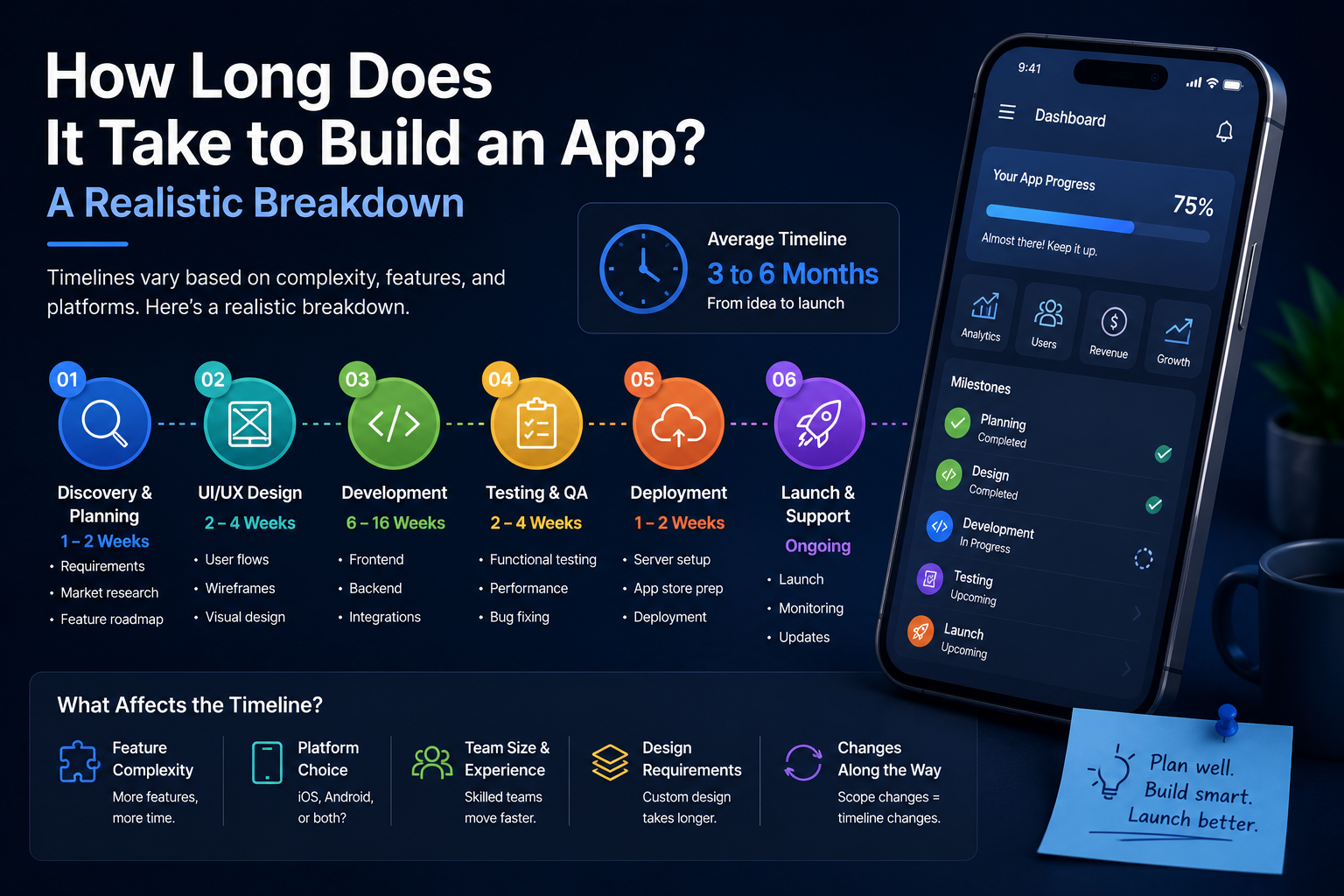
How Long Does It Take to Build an App? A Realistic Breakdown
How long it takes to build an app depends far more on specific project characteristics, feature complexity, platform choice, team size, than on any single universal number, which is why generic answers to this question tend to be either misleadingly optimistic or so vague they’re not useful for actual planning. A simple utility app with a handful of screens and a multi-vendor marketplace with real-time features both technically qualify as “an app,” but their realistic timelines differ by months, sometimes longer. This post breaks down what actually drives app development timeline, so you can estimate realistically for your specific project rather than anchoring on a generic industry number.
The Factors That Actually Drive Timeline
Understanding which variables move timeline the most helps you estimate more accurately for your specific project.
Feature Complexity
Real-time functionality, complex backend logic, and third-party integrations each add meaningfully more development time than straightforward content display or basic forms, so timeline should scale with your actual feature list, not a flat assumption based on app category alone.
Platform Choice
Building for a single platform generally takes less time than building natively for both iOS and Android simultaneously, though cross-platform frameworks narrow this gap considerably by sharing a large portion of the codebase across platforms.
Team Size and Structure
A larger team can compress calendar time to some degree, but coordination overhead increases with team size, so adding people doesn’t reduce total timeline proportionally, and can sometimes slow things down if added without a clear division of work.
Realistic Timelines by Project Type
While every project is different, certain patterns hold reasonably consistently across common app categories.
Simple Utility Apps
Apps with straightforward functionality, basic content display, simple forms, minimal backend logic, tend to have the shortest realistic timelines, since there’s less inherent complexity to design, build, and test.
Apps With Real-Time Features
Apps involving live location tracking, real-time chat, or live data synchronization generally take meaningfully longer, since this functionality requires more sophisticated backend infrastructure and more thorough testing under real-world network conditions.
Multi-Sided Marketplaces
Apps coordinating multiple user types, customers, merchants, drivers, in a marketplace or on-demand model typically have the longest realistic timelines among common app categories, given the coordination logic and testing complexity across multiple simultaneous user roles.
What Extends Timeline Beyond the Initial Estimate
Certain patterns consistently push actual delivery beyond the originally planned timeline.
Scope Creep During Development
Adding features mid-development that weren’t part of the original plan is one of the most common causes of timeline slippage, since each addition compounds with testing and integration work beyond just the feature itself.
Underestimated Integration Complexity
Third-party integrations, payment gateways, mapping services, external APIs, frequently take longer than initially estimated, since issues with external systems and documentation gaps aren’t always visible until integration work is actually underway.
Insufficient Testing Time
Compressing the testing phase to hit an aggressive launch date often backfires, since issues caught late require more disruptive fixes than the same issues caught earlier with adequate testing time built into the schedule.
Setting a Realistic Timeline for Your Project
The most reliable way to set a realistic timeline is to scope your actual feature list in detail first, then estimate against that specific scope rather than against a generic industry average that may not reflect your particular combination of features and platform choices. Our mobile app development team scopes timeline estimates against your specific requirements rather than offering generic ranges disconnected from your actual project.
Key Takeaways
App development timeline is driven primarily by feature complexity, platform choice, and team structure, not a single universal number that applies across all apps. Real-time features and multi-sided marketplace coordination logic consistently extend timeline beyond simpler, single-purpose apps. Scope creep and underestimated integration complexity are the most common causes of timeline slippage beyond an initial estimate, and setting realistic timeline expectations starts with a detailed feature scope, not a generic assumption.
Frequently Asked Questions
Does adding more developers always speed up app development?
Not proportionally. Larger teams introduce coordination overhead, communication, code review, integration work, which means adding people doesn’t reduce timeline at the same rate it might seem to on paper, and can sometimes slow progress if not managed carefully.
Why do real-time features take so much longer to build?
Real-time functionality, live tracking, chat, data sync, requires more sophisticated backend infrastructure and significantly more thorough testing under varied network conditions than straightforward request-response app logic.
How much does using a cross-platform framework reduce timeline compared to native development?
It varies by project, but cross-platform frameworks generally reduce total development time meaningfully for apps needing both iOS and Android support, since a large portion of the codebase is shared rather than built twice.
What’s the most common reason app development timelines slip?
Scope creep, adding features mid-development that weren’t part of the original plan, is one of the most consistent causes of timeline slippage, since each addition compounds with testing and integration work beyond the feature itself.
Should I compress testing time to hit a tight launch deadline?
Generally not recommended. Compressing testing tends to push problems into production, where they’re more disruptive and costly to fix than catching them during an adequately scoped testing phase before launch.
How long will it take to build my specific app?
Timeline depends heavily on your specific feature scope, platform choice, and integrations, so a general figure is only a rough guide. A detailed cost and timeline estimate scoped to your specific project is the most reliable way to plan.