


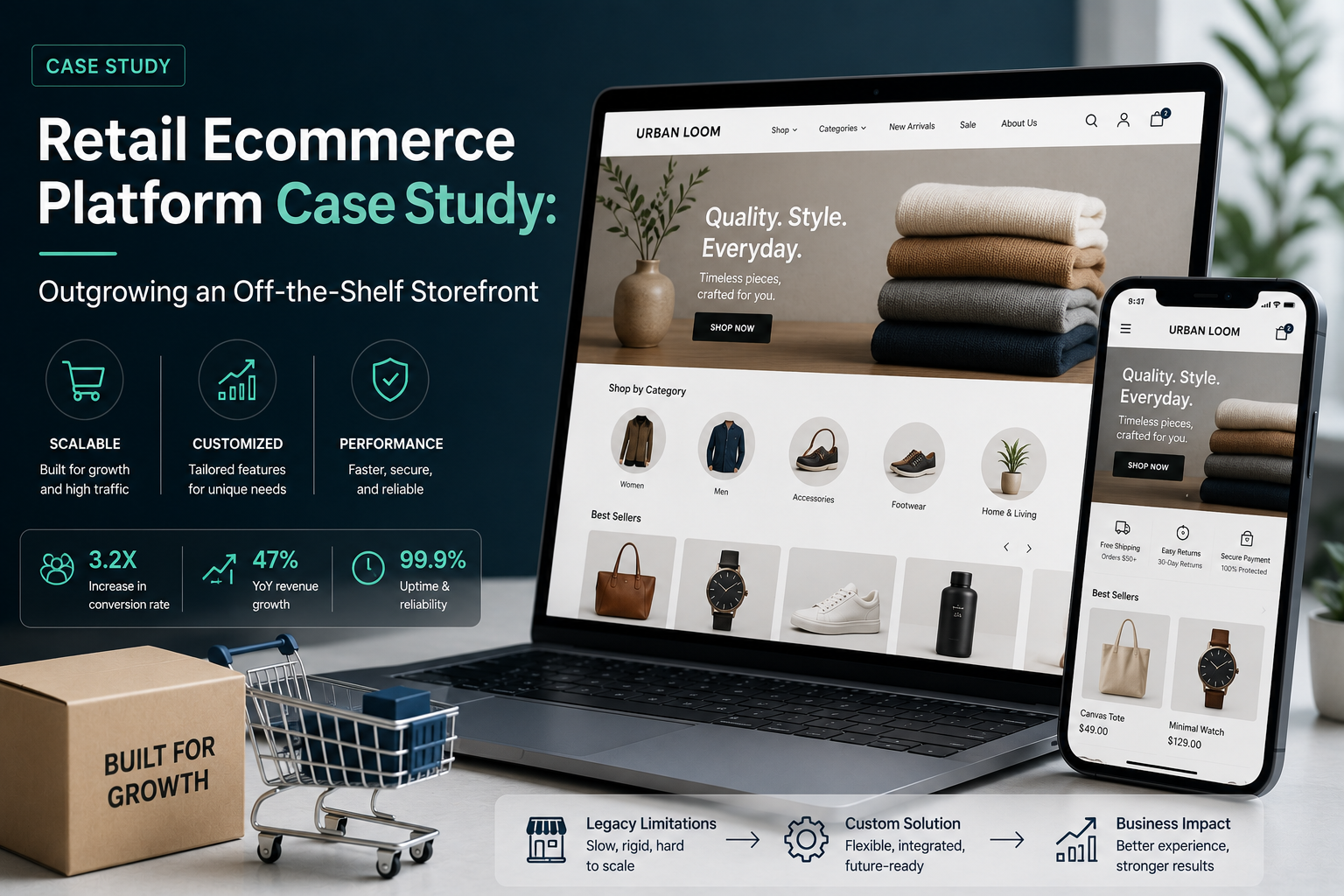
Retail Ecommerce Platform Case Study: Outgrowing an Off-the-Shelf Storefront
A growing retail brand had outgrown its off-the-shelf ecommerce platform, which couldn’t handle the brand’s complex product configuration options or keep inventory accurately synced with its in-store point-of-sale system. This case study covers how we built a custom ecommerce platform designed around the brand’s specific catalog and inventory needs, and the impact it had on conversion and operational accuracy.
The Challenge
The brand’s existing platform created specific limitations that were becoming increasingly costly as the business grew.
Complex Product Configuration Needs
The brand’s products involved multiple configurable options, size, color, material combinations, that the existing platform handled clumsily, creating a confusing and error-prone experience for shoppers trying to select the right variant.
Inventory Sync Failures Between Online and In-Store
Inventory wasn’t reliably synced between the online store and in-store point-of-sale system, leading to online orders for items that were actually out of stock, and a growing volume of frustrated customer service inquiries as a result.
Limited Customization Within Platform Constraints
The existing platform’s template constraints limited how much the brand could customize the shopping experience to match its actual customer journey, capping potential improvements to conversion.
Our Approach
We built a custom platform specifically designed around the brand’s product complexity and existing operational systems.
Building Flexible Product Configuration
We designed a product configuration system that handled the brand’s specific combination of variant options cleanly, presenting shoppers with a clear, guided selection experience rather than a confusing grid of options.
Integrating Real-Time Inventory Sync
We connected the new platform directly to the brand’s point-of-sale system, ensuring online inventory reflected real-time in-store stock levels accurately, eliminating the overselling problem that had been generating customer complaints.
Designing a Custom Checkout Flow
Freed from template constraints, we built a checkout flow specifically optimized around the brand’s actual customer behavior patterns, reducing unnecessary steps that had been contributing to cart abandonment.
The Results
Following launch, the brand saw measurable improvements in both customer experience and operational accuracy.
Reduced Overselling Incidents
Real-time inventory sync between online and in-store systems eliminated the overselling problem that had previously generated a steady stream of customer service escalations.
Improved Checkout Conversion
The custom, streamlined checkout flow reduced cart abandonment and improved overall conversion compared to the previous template-based experience.
Smoother Product Selection Experience
The new product configuration system reduced customer confusion around variant selection, reflected in fewer support inquiries related to sizing and product options.
What This Means for Similar Businesses
This result reflects a pattern common across retail brands that outgrow off-the-shelf platforms: once product complexity or operational integration needs exceed what a template platform can handle well, custom development becomes the more cost-effective path forward, not despite the higher upfront investment, but because of the ongoing operational costs it eliminates. If your brand is facing similar platform limitations, our ecommerce development team can help evaluate whether custom development fits your specific situation.
Key Takeaways
Complex product configuration needs often exceed what off-the-shelf ecommerce platforms can handle cleanly, creating confusing shopper experiences. Real-time inventory sync between online and in-store systems is essential for any retailer selling through both channels simultaneously. Custom checkout flows optimized around actual customer behavior can meaningfully improve conversion compared to generic template experiences, and the decision to move to custom development should be driven by genuine platform limitations, not a general preference for customization.
Frequently Asked Questions
How do I know if my business has outgrown an off-the-shelf ecommerce platform?
Signs include product complexity the platform handles poorly, recurring inventory sync issues between online and in-store systems, and template constraints that prevent meaningful improvements to conversion-critical parts of the shopping experience.
Does custom ecommerce development always cost more than staying on an existing platform?
Upfront cost is generally higher, but for businesses facing genuine platform limitations, the ongoing operational costs and lost conversion from those limitations can make custom development more cost-effective over time.
How does real-time inventory sync between online and in-store systems actually work?
The ecommerce platform connects directly to the point-of-sale system’s inventory data, updating stock levels as sales happen in either channel, so customers never see products as available online that are actually out of stock in-store.
What makes checkout flow customization worth the investment?
Even small amounts of friction in checkout measurably reduce conversion, so a checkout flow built specifically around a brand’s actual customer behavior, rather than a generic template flow, can meaningfully improve results.
Can this type of platform migration happen without disrupting ongoing sales?
Yes, with careful planning. A phased migration approach, testing thoroughly and cutting over during lower-traffic periods, minimizes disruption to ongoing sales during the transition.
How much does a similar custom ecommerce platform cost?
Cost depends on your specific catalog complexity, integration requirements, and checkout customization scope, so a general figure is only a rough guide. A detailed cost estimate scoped to your brand is the most reliable way to plan your budget.