


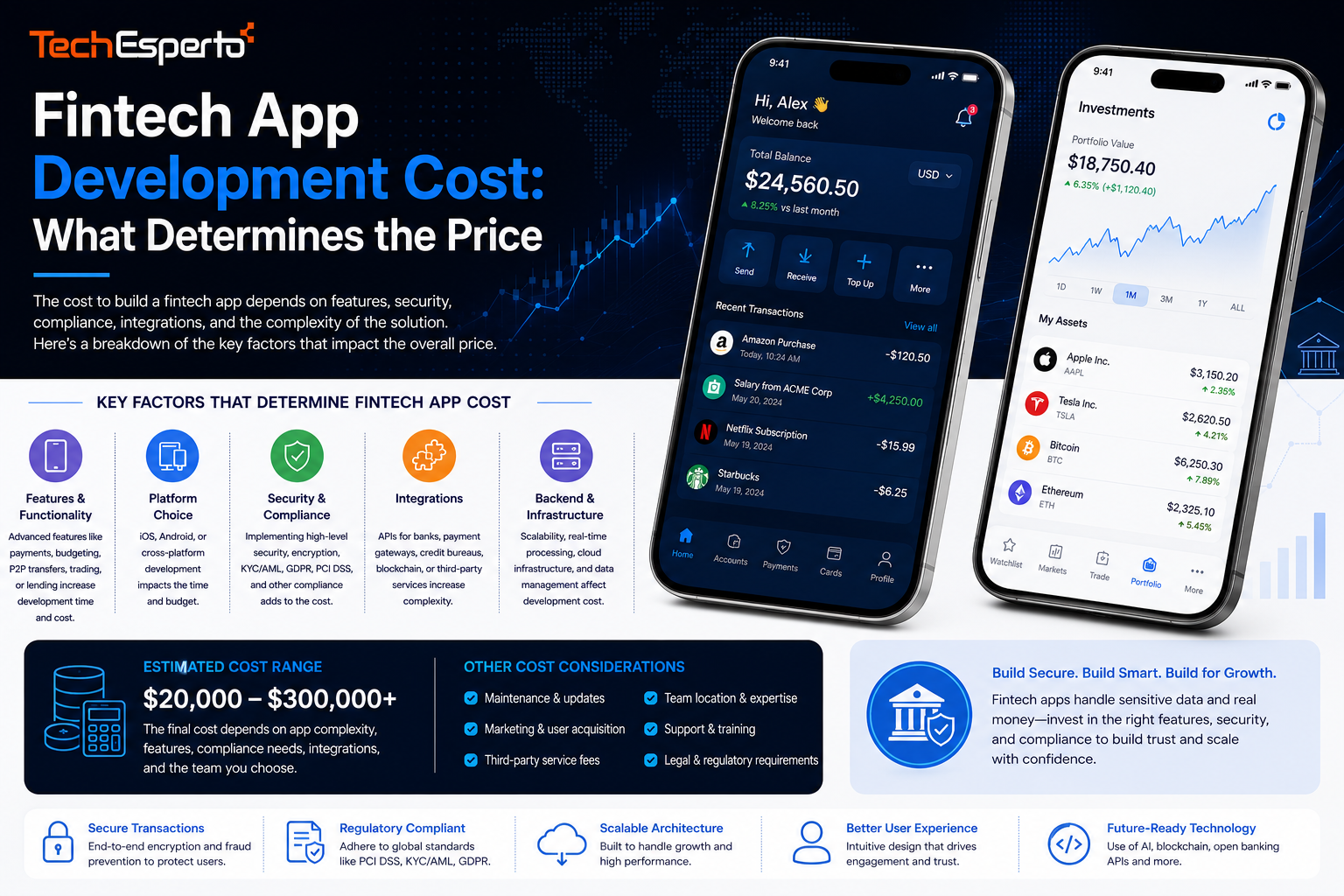
Fintech App Development Cost: What Determines the Price
Fintech app development cost typically ranges from $40,000 to $80,000 for an MVP with core account and transaction features, $80,000 to $200,000 for a full platform with customer, admin, and compliance systems, and $200,000 or more for enterprise-scale, multi-product systems. Actual cost depends heavily on regulatory requirements, security architecture, and third-party integrations.
Fintech founders and financial institutions often need a realistic cost picture before committing to a banking, insurance, trading, or payments app project. TechEsperto Solutions builds fintech apps as part of its broader fintech app development practice, and this guide breaks down what actually drives cost up or down for financial software projects.
What Determines Fintech App Development Cost
Fintech app development cost is shaped by factors that go well beyond typical consumer app development, since security architecture, regulatory compliance, and financial data accuracy all require significant engineering investment. The specific financial category matters considerably, since a banking app, insurance app, and trading app each carry different integration and compliance requirements. Security architecture, including encryption, strong authentication, and fraud detection, adds meaningful development time regardless of the specific fintech use case. Integration with core banking systems, payment rails, brokerage partners, or insurance policy administration systems can significantly affect cost depending on which systems need to be connected. Regulatory and licensing requirements, while primarily a business and legal consideration, also shape technical requirements around data handling and reporting.
Specific Fintech Category and Use Case
Banking, insurance, trading, and payments apps each carry different integration and compliance requirements.
Security and Authentication Architecture
Encryption, strong authentication, and fraud detection add engineering investment beyond typical consumer apps.
Core System Integration Complexity
Connecting to core banking, brokerage, or policy administration systems significantly affects cost.
Regulatory and Compliance Requirements
Licensing and regulatory requirements shape technical requirements around data handling and audit reporting.
Payment Rail and Transaction Processing
Supporting multiple payment methods and transaction types adds development scope tied to financial category.
Real-Time Data and Market Feed Requirements
Trading and market-data-dependent apps require additional infrastructure investment for real-time accuracy.
Cost by Development Approach
Fintech projects typically fall into one of three general investment levels, reflecting the maturity of the business model and scale of operations being supported. An MVP approach focuses on core account management, essential transactions, and baseline security features to validate a fintech concept before expanding further. A full platform approach builds out customer, admin, and compliance systems with a more complete feature set suited to an established fintech company or funded startup. An enterprise-scale approach supports multiple products, markets, or high transaction volumes with deeper integration and more sophisticated compliance infrastructure. Choosing the right starting point depends on whether the goal is validating a new financial product or scaling an already-proven business.
MVP or Single-Module Build ($40,000 to $80,000)
An MVP focuses on core account management, essential transactions, and baseline security features.
Full Platform Build ($80,000 to $200,000)
A full platform includes customer, admin, and compliance systems with a complete feature set for an established company.
Enterprise-Scale Build ($200,000+)
Enterprise-scale systems support multiple products or high transaction volumes with deeper integration and compliance infrastructure.
Choosing the Right Starting Point
The right approach depends on whether the goal is validating a new product or scaling an established business.
Phased Development for Regulated Products
Many fintech projects start with a focused MVP and add regulated features in later phases as licensing progresses.
Budget Planning Around Regulatory Timeline
Budget planning should account for regulatory review time alongside the technical development timeline.
Cost by App Component
Within a fintech platform, different components carry different weight in overall development investment. The customer-facing app typically requires significant design and usability investment, since trust and ease of use directly affect adoption for financial products. The admin and compliance dashboard, while less visible to end users, requires substantial engineering investment to support transaction monitoring, reporting, and staff workflows. Security and fraud detection infrastructure underlies the entire system rather than mapping to a single visible feature, representing a significant portion of overall investment. Integration layers connecting to core financial systems, whether banking cores, brokerage partners, or payment rails, often require specialized development expertise that affects both cost and timeline.
Customer App Investment
The customer app requires significant design investment since trust and usability directly affect adoption.
Admin and Compliance Dashboard Investment
Admin dashboards require substantial engineering investment to support transaction monitoring and reporting.
Security and Fraud Detection Investment
Security and fraud monitoring infrastructure represents a significant portion of overall investment across the system.
Core System Integration Layer Investment
Integration with banking cores, brokerage partners, or payment rails often requires specialized development expertise.
Identity Verification Investment
KYC and identity verification integration scales with the rigor required for the specific financial product.
Reporting and Audit Trail Investment
Structured audit logging and reporting tools require investment tied to regulatory reporting obligations.
Key Cost Drivers and Add-Ons
Beyond core app components, several specific features tend to meaningfully affect overall development cost for fintech platforms. Core banking or brokerage system integration is often the single largest variable cost, since connecting to different providers requires different technical approaches and varying degrees of vendor cooperation. Identity verification and KYC processes add cost tied to the rigor required, which varies by financial category and jurisdiction. Fraud detection and monitoring tools add both development and ongoing operational cost, since these systems typically require continuous tuning after launch. Multi-currency or multi-region support adds cost that scales with the number of markets served. Understanding which of these features are essential for initial launch versus deferrable helps manage budget effectively.
Core System Integration Scope
Core banking, brokerage, or policy administration integration is often the largest variable cost.
Identity Verification and KYC Rigor
Verification requirements vary by financial category and jurisdiction, affecting integration complexity.
Fraud Detection and Monitoring Tools
Fraud monitoring adds both development and ongoing operational cost given the need for continuous tuning.
Multi-Currency and Multi-Region Support
Supporting multiple currencies and regions adds cost that scales with target market breadth.
Biometric and Multi-Factor Authentication
Strong authentication methods add development scope beyond standard password-based access.
Reporting and Regulatory Filing Tools
Automated reporting tools tied to specific regulatory filing requirements add configuration and development scope.
Ongoing Costs After Launch
Development cost is only part of the total investment required to operate a fintech platform, since ongoing costs continue after launch and carry particular weight given regulatory obligations. Cloud infrastructure costs scale with transaction volume and user base, with financial-grade security configurations sometimes costing more than standard cloud hosting. Ongoing security monitoring, fraud detection tuning, and periodic security audits represent a fintech-specific cost category beyond typical app maintenance. Compliance review, legal counsel engagement, and regulatory reporting often continue on an ongoing basis rather than as one-time pre-launch costs. Third-party data and integration fees, such as market data licensing or core banking system fees, also represent recurring operational costs.
Cloud Infrastructure and Financial-Grade Hosting
Infrastructure costs scale with transaction volume, with financial-grade security configurations affecting hosting cost.
Ongoing Security Monitoring and Fraud Tuning
Fraud detection systems require continuous tuning and monitoring as an ongoing operational cost.
Compliance and Regulatory Reporting
Compliance review and regulatory reporting continue on an ongoing basis rather than as a one-time cost.
Third-Party Data and System Fees
Market data licensing or core banking system fees represent recurring operational costs beyond development.
App Maintenance and Security Updates
Ongoing maintenance and security patching require continued developer time after the initial build.
Customer Support and Dispute Resolution
Support operations for transaction disputes and account issues represent an ongoing operational cost.
How to Reduce Development Costs Without Cutting Corners
Fintech founders looking to manage development costs have several legitimate options that do not compromise security or compliance standards. Starting with a focused MVP addressing one core financial product, rather than building comprehensive multi-product functionality from day one, is the most effective way to control initial cost. Partnering with an established core banking, brokerage, or payment infrastructure provider, rather than building this infrastructure independently, significantly reduces both cost and regulatory complexity. Deferring advanced features like multi-currency support or detailed analytics to later phases lets founders validate the core product before further investment. Working with a development partner experienced in fintech security and compliance from the start avoids costly rework that can result from retrofitting security architecture after initial development.
Start with a Focused Core Product
Launching with one core financial product controls initial cost while validating the business model.
Partner with Established Financial Infrastructure Providers
Using established core banking, brokerage, or payment partners reduces both cost and regulatory complexity.
Defer Advanced Features to Later Phases
Multi-currency support and detailed analytics can be added once the core product is validated.
Work with an Experienced Fintech Development Partner
Building security and compliance architecture correctly from the start avoids costly rework compared to retrofitting later.
Prioritize Core Security Over Feature Breadth
Investing in authentication, encryption, and fraud detection matters more early on than a broad feature set.
Plan for Phased Regulatory Compliance
Structuring compliance work around a phased product rollout can reduce upfront legal and licensing scope.
FAQs
How much does fintech app development typically cost?
Fintech app development typically costs between $40,000 and $80,000 for an MVP with core account and transaction features, and $80,000 to $200,000 for a full platform including customer, admin, and compliance systems. Enterprise-scale, multi-product systems start at $200,000 and scale with regulatory and integration complexity.
Why is fintech app development more expensive than a typical app?
Fintech apps require additional investment in security architecture, fraud detection, identity verification, and often core financial system integration, all of which add engineering time beyond what a typical consumer app requires given the financial and regulatory stakes involved.
Does core banking or brokerage integration significantly increase development cost?
Yes, integration with core financial systems is often one of the largest variable costs in fintech app development, since the complexity varies significantly depending on which provider and integration approach are involved.
Can I build a fintech app without full regulatory licensing initially?
Many fintech platforms partner with an already-licensed financial institution or infrastructure provider rather than pursuing independent licensing from day one, though specific requirements vary significantly by product type and jurisdiction and should be confirmed with legal counsel.
Are there ongoing compliance costs beyond development?
Yes, ongoing costs include continued compliance and legal counsel engagement, fraud detection tuning, regulatory reporting, and third-party data or system fees, all separate from the initial development investment.
How can TechEsperto Solutions help estimate my specific project cost?
TechEsperto Solutions provides a detailed cost estimate after a scoping call covering your specific fintech category, integration needs, and compliance requirements, since exact pricing depends on these project-specific factors.