


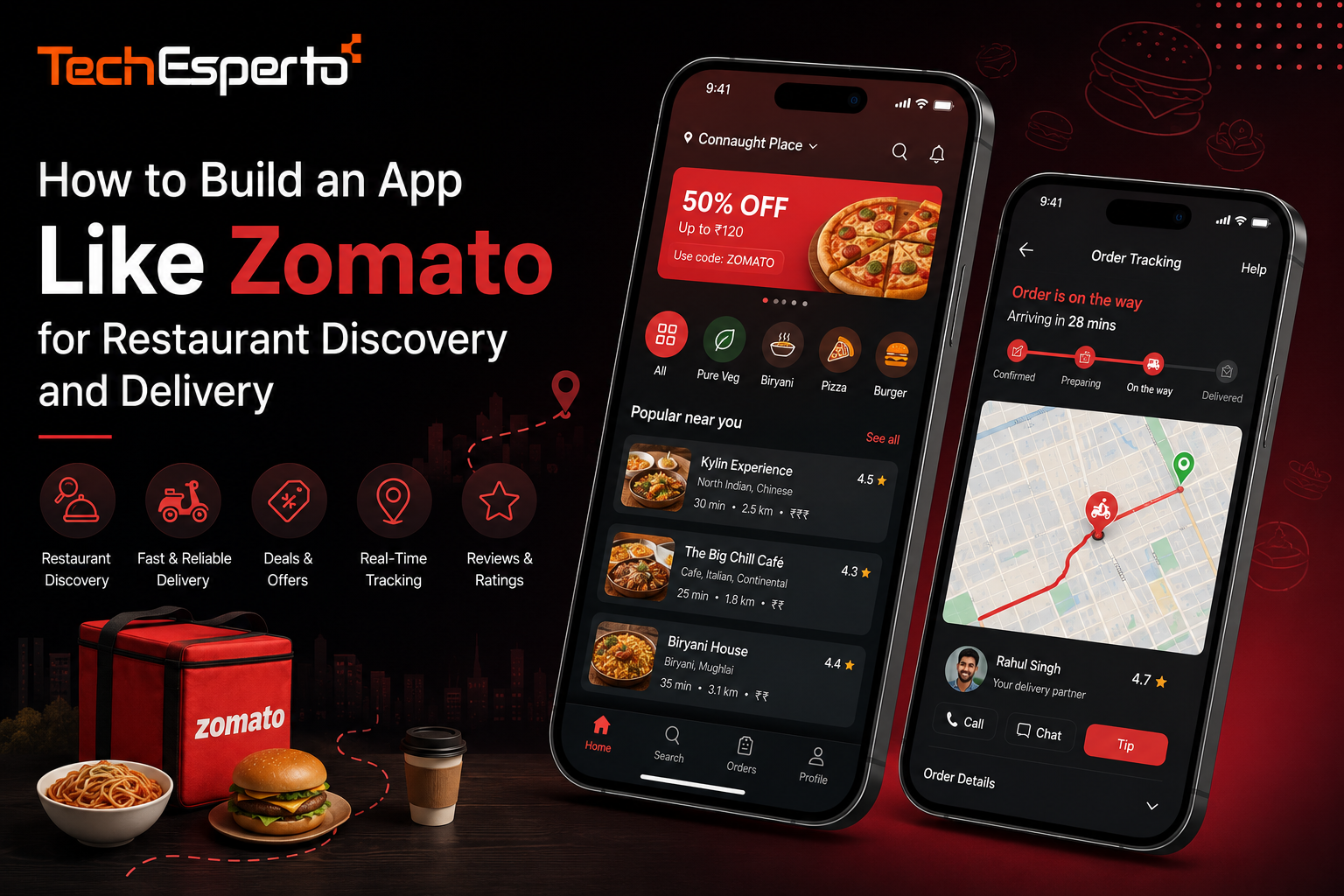
How to Build an App Like Zomato for Restaurant Discovery and Delivery
Building an app like Zomato means developing a platform combining restaurant discovery, reviews and ratings, and food delivery into one connected experience for customers, restaurants, and delivery partners. TechEsperto Solutions helps founders plan features, choose the right tech stack, and estimate development costs for a Zomato-style discovery and delivery platform.
Restaurant discovery and delivery platforms succeed by giving customers a reason to open the app even when they are not ordering delivery, using reviews and discovery content to build a habit beyond just transactional ordering. TechEsperto Solutions builds platforms like this as part of its broader on-demand app development practice, and this guide covers what it takes to plan and build a Zomato-style restaurant discovery and delivery app.
What Is a Zomato-Style Discovery and Delivery App
A Zomato-style app combines two related but distinct functions, helping customers discover and evaluate restaurants through reviews, photos, and menus, and facilitating food delivery once a customer decides where to order from. Unlike a pure delivery marketplace focused only on order fulfillment, this model treats restaurant discovery as a core feature in its own right, since many users open the app to browse reviews and decide where to eat even when they plan to dine in rather than order delivery. This dual purpose means the platform needs strong content features, like photos and reviews, alongside the operational systems needed for order assignment and delivery tracking. Building this kind of platform means planning for both a content-driven discovery experience and a transactional delivery marketplace within the same app.
Restaurant Discovery and Search
Customers browse restaurants by cuisine, location, price range, and rating to decide where to eat or order from.
Reviews, Ratings, and Photos
User-generated reviews, ratings, and photos help customers evaluate restaurants before ordering or dining in.
Menu Browsing and Ordering
Customers view detailed menus and place delivery orders directly through the app.
Restaurant Dashboard
Restaurants manage their profile, menu, and incoming delivery orders through a dedicated dashboard.
Delivery Partner App
Delivery partners accept jobs, navigate to pickup and drop-off locations, and confirm completed deliveries.
Table Reservation Features
Some platforms extend discovery features to include table reservation for dine-in customers.
Core Features You Need
A functional discovery and delivery app needs restaurant search and filtering to feel comprehensive and trustworthy, since the discovery function depends on customers believing the reviews and ratings reflect genuine experiences. Content features like photos and detailed menus need to be easy for restaurants to upload and keep current, since stale or sparse content undermines the discovery value proposition. The delivery ordering flow needs to work smoothly once a customer has decided where to order from, without requiring them to leave the discovery experience and switch to a separate ordering interface. Review moderation matters significantly here, since fake or manipulated reviews can seriously damage user trust in the discovery function that differentiates this model from a pure delivery marketplace.
Comprehensive Restaurant Search and Filters
Search and filtering by cuisine, price, location, and rating help customers find relevant restaurants quickly.
Easy Restaurant Content Management
Restaurants need simple tools to upload photos, update menus, and manage their profile content.
Integrated Ordering from Discovery
Customers should be able to move from browsing a restaurant’s profile directly into placing a delivery order.
Review and Rating Moderation
Moderation tools help maintain review authenticity and catch fake or manipulated ratings.
Real-Time Order Tracking
Customers track delivery status once an order is placed, similar to a standard delivery app.
Restaurant Response Tools
Restaurants can respond to reviews, helping build trust and address customer concerns publicly.
How the Business Model Works
Zomato-style platforms typically generate revenue through a combination of commission fees on delivery orders and advertising or promotional fees from restaurants seeking better visibility in search and discovery results. Restaurants pay commission on delivered orders similar to a standard food delivery marketplace, but the discovery function opens an additional revenue stream through promoted listings, since restaurants have a strong incentive to appear prominently in search results even for customers not currently ordering delivery. Some platforms also offer subscription programs for customers that reduce delivery fees, alongside separate subscription or premium listing tiers for restaurants wanting enhanced visibility. Table reservation features, where included, can generate additional revenue through booking fees or premium placement for reservation-enabled restaurants.
Delivery Order Commission
Restaurants pay commission on delivered orders, similar to a standard delivery marketplace model.
Promoted Restaurant Listings
Restaurants pay for enhanced visibility in search and discovery results, separate from delivery commission.
Customer Subscription Programs
Subscription tiers can offer reduced delivery fees or other perks for frequent customers.
Restaurant Premium Profile Tiers
Restaurants may pay for premium profile features like enhanced photos or highlighted menu items.
Table Reservation Booking Fees
Where reservation features are included, booking fees or premium placement can generate additional revenue.
Advertising for Non-Restaurant Brands
Some platforms sell advertising space to food and beverage brands beyond just restaurant partners.
Key Technical Components
Building a discovery and delivery platform requires a content management system that lets restaurants upload and update photos, menus, and profile information easily. Search and recommendation systems help customers find relevant restaurants based on location, preferences, and past behavior. A review and rating system, including moderation tools, maintains content authenticity and trust. Order and delivery infrastructure handles the transactional side once a customer decides to order, similar to a standard food delivery platform. All of these systems need to share data consistently, since a restaurant’s menu, ratings, and delivery availability all need to stay synchronized across the discovery and ordering experience.
Content Management for Restaurant Profiles
Restaurants use content tools to upload photos, update menus, and manage profile information.
Search and Recommendation Systems
Search and recommendation logic surfaces relevant restaurants based on location, preferences, and behavior.
Review and Rating System
The review system, including moderation tools, maintains content authenticity and user trust.
Order and Delivery Dispatch
Order and delivery infrastructure handles job assignment and tracking once a customer places an order.
Payment Processing
Payment systems handle customer charges and restaurant or delivery partner payouts.
Analytics and Reporting Tools
Analytics help restaurants understand their performance in search visibility, orders, and customer reviews.
Development Process and Timeline
Building a discovery and delivery platform typically starts with confirming the initial balance between discovery-focused features and delivery marketplace functionality, since prioritizing both simultaneously from launch adds significant scope compared to focusing on one first. MVP scoping often narrows initial focus to either strong discovery content with basic ordering, or reliable delivery with simpler discovery features, expanding the weaker side after initial traction. Content moderation systems for reviews need planning from early stages, since retrofitting trust and safety features after fake review problems emerge is more difficult than building moderation in from the start. Testing needs to cover both the discovery search experience and the delivery order flow thoroughly before launch.
Discovery and Requirement Mapping
Early discovery confirms the initial balance between discovery content features and delivery marketplace functionality.
MVP Feature Scoping
MVP scoping often prioritizes either strong discovery or reliable delivery first, expanding the other after traction.
UI/UX Design
Design work covers both the browsing and discovery experience and the transactional ordering flow.
Development and Integration
Development covers content management, search, review systems, and delivery infrastructure in parallel.
Testing and Quality Assurance
Testing covers both the discovery search experience and the delivery order flow before launch.
Launch and Post-Launch Support
Launch typically starts in a single market with a core set of restaurant partners before expanding.
Common Challenges and How to Solve Them
Founders building a discovery and delivery platform tend to face challenges around content quality, restaurant onboarding, and the added complexity of running two connected but distinct product experiences. Maintaining review authenticity is an ongoing challenge, since the discovery function’s value depends entirely on users trusting the reviews as genuine. Getting restaurants to actively maintain their content, keeping photos and menus current, requires ongoing engagement rather than a one-time onboarding push. Balancing development priorities between discovery features and delivery operations can also be difficult, since both compete for engineering resources during early development. Recognizing these challenges early helps founders plan a realistic initial feature focus rather than attempting to build both halves of the platform equally well from day one.
Maintaining Review Authenticity
The discovery function depends on users trusting reviews as genuine, requiring ongoing moderation investment.
Restaurant Content Maintenance
Getting restaurants to keep photos and menus current requires ongoing engagement beyond initial onboarding.
Balancing Discovery and Delivery Development Priorities
Discovery content features and delivery operations both compete for development resources during early stages.
Restaurant Onboarding at Scale
Onboarding enough restaurants with quality content to make discovery valuable takes sustained outreach effort.
Fake Review and Rating Manipulation
Detecting and preventing fake reviews requires ongoing moderation tools and policy enforcement.
Differentiating from Established Platforms
New entrants often succeed by focusing on a specific region or cuisine niche underserved by major platforms.
FAQs
How much does it cost to build an app like Zomato?
Building an app like Zomato typically costs between $40,000 and $80,000 for an MVP with core discovery and basic ordering features, and $80,000 to $200,000 for a full platform including reviews, delivery dispatch, and restaurant tools. Enterprise-scale, multi-market systems start at $200,000 and scale with feature complexity.
How long does it take to build a discovery and delivery app like this?
Timelines vary based on scope, but a platform with core discovery and ordering features typically takes several months from discovery through launch. Adding advanced review moderation or full delivery dispatch systems extends the timeline.
Should I prioritize discovery features or delivery features first?
Many founders find it more manageable to prioritize one function first, either strong restaurant discovery content or reliable delivery operations, and expand the other once the platform has initial traction, rather than building both fully from day one.
How do you prevent fake restaurant reviews?
Preventing fake reviews typically requires a combination of automated detection tools and manual moderation review, along with policies that discourage manipulation, such as requiring verified orders before allowing certain review types.
Do I need to build delivery dispatch, or can I focus on discovery only?
Some platforms in this category focus primarily on discovery and reservations without operating their own delivery fleet, partnering with third-party delivery services instead, which can reduce initial development scope significantly.
Can TechEsperto Solutions help build a platform like this?
Yes, TechEsperto Solutions builds custom discovery and delivery platforms as part of its grocery delivery app development and broader on-demand practice, scoped around your target market and feature priorities.