


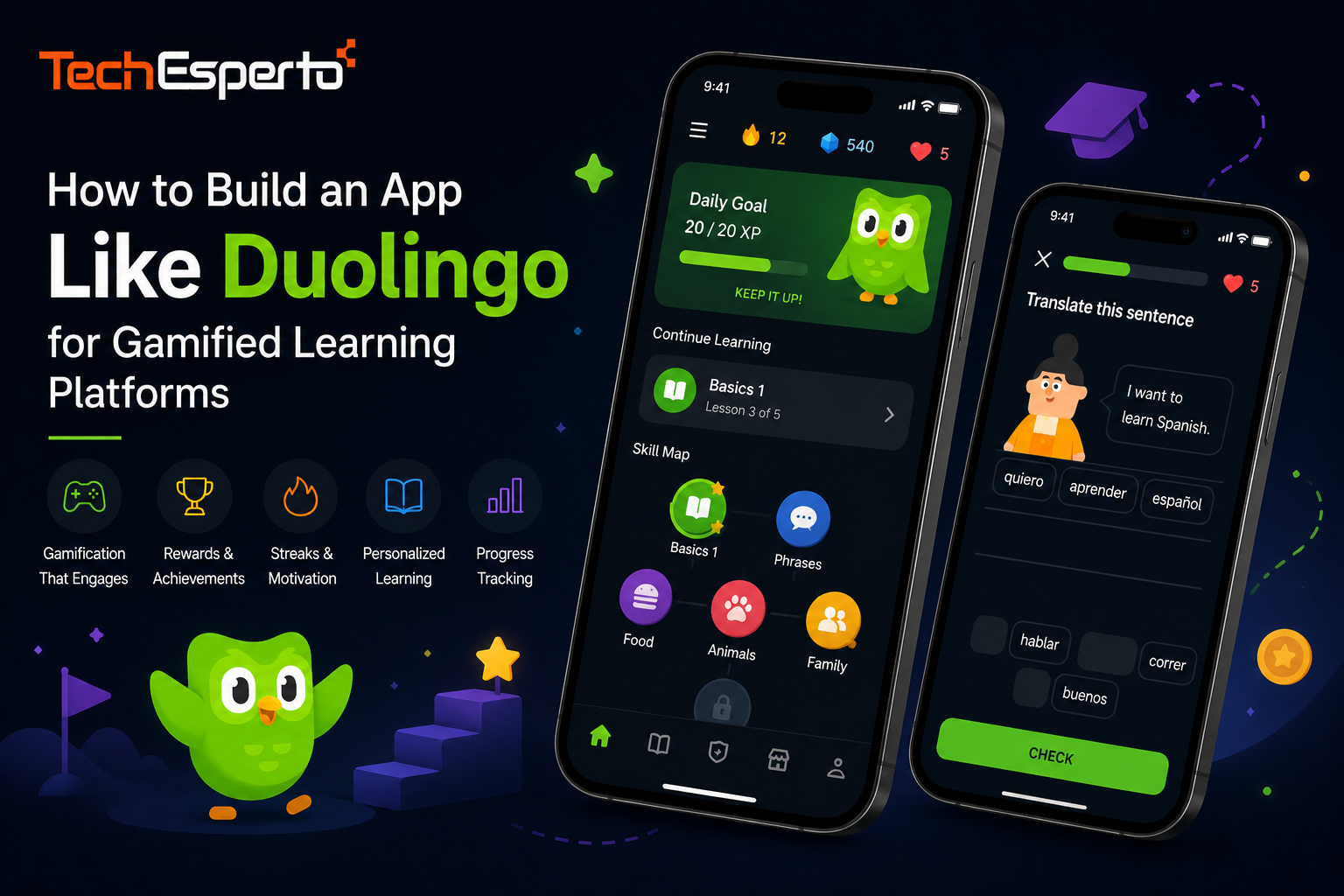
How to Build an App Like Duolingo for Gamified Learning Platforms
Building an app like Duolingo means developing an educational platform with bite-sized lessons, gamification elements, progress tracking, and adaptive difficulty that keeps learners engaged over time. TechEsperto Solutions helps edtech founders plan features, choose the right tech stack, and estimate development costs for a Duolingo-style learning app.
Gamified learning platforms succeed by breaking educational content into short, engaging sessions that build a daily habit rather than requiring long study sessions upfront. TechEsperto Solutions builds platforms like this as part of its broader education app development practice, and this guide covers what it takes to plan and build a Duolingo-style learning app from the ground up.
What Is a Duolingo-Style Learning App
A Duolingo-style app is a gamified learning platform that breaks a subject, often language learning, into short lessons combined with game mechanics like streaks, points, and levels that motivate learners to practice consistently. Unlike a traditional e-learning platform built around long video lectures or full courses, this model prioritizes short, frequent practice sessions designed to fit into a few minutes of a learner’s day. Gamification elements, such as daily streaks and achievement badges, are not just decorative, they are core retention mechanics that directly affect whether learners keep coming back. Building this kind of platform means designing curriculum content and gamification systems together from the start, since the two need to reinforce each other for the habit-forming effect to work.
Bite-Sized Lesson Structure
Content is broken into short lessons designed to be completed in just a few minutes.
Streaks and Daily Habit Mechanics
Streak tracking and daily reminders encourage learners to practice consistently rather than sporadically.
Points, Levels, and Achievement Badges
Gamification elements like points and badges reward progress and motivate continued engagement.
Adaptive Difficulty
The platform can adjust lesson difficulty based on a learner’s performance and progress.
Progress Tracking and Skill Trees
Visual progress tracking, such as skill trees, shows learners how far they have advanced through the curriculum.
Social and Leaderboard Features
Leaderboards and friend comparisons add a social, competitive element that can increase engagement.
Core Features You Need
A functional gamified learning app needs the lesson structure to feel genuinely short and low-commitment, since the entire retention model depends on learners being willing to open the app daily without feeling like it requires significant time investment. Streak mechanics need to be visible and motivating without becoming a source of anxiety when a learner misses a day, so features like streak freezes or forgiveness mechanics matter for long-term retention. Progress tracking needs to give learners a clear sense of advancement, whether through a skill tree, level system, or completion percentage. Push notifications need to feel like helpful reminders rather than nagging, since notification fatigue can drive learners to disable them entirely.
Short, Focused Lesson Sessions
Lessons should be genuinely completable in a few minutes to support daily habit formation.
Streak Tracking with Forgiveness Mechanics
Streak features need options like streak freezes to avoid punishing learners too harshly for missed days.
Visual Progress Indicators
Skill trees or level systems give learners a clear visual sense of advancement through the curriculum.
Adaptive Difficulty Adjustment
The platform adjusts lesson difficulty based on a learner’s demonstrated performance.
Thoughtful Push Notification Design
Notifications need to feel like helpful reminders rather than repetitive nagging that drives learners to disable them.
Offline Lesson Access
Downloaded lessons let learners practice without requiring an active internet connection.
How the Business Model Works
Gamified learning platforms typically generate revenue through a freemium model, where a core set of lessons is free and a subscription unlocks additional features like offline access, ad-free learning, or advanced practice modes. Advertising within the free tier can generate revenue from non-paying users, though ad placement needs to be balanced carefully against the learning experience. Some platforms also offer one-time purchases for specific content packs or certification programs that go beyond the core free curriculum. In-app currency systems, where learners earn virtual currency through practice and can spend it on cosmetic features or streak protections, add another engagement and monetization layer. Understanding this freemium structure early helps founders decide which features to gate behind a subscription versus keep free to build initial user adoption.
Freemium Subscription Model
A subscription unlocks features like offline access, ad-free learning, or advanced practice modes.
Advertising in the Free Tier
Advertising within the free tier generates revenue from non-paying users.
One-Time Content Pack Purchases
Some platforms offer one-time purchases for specific content packs or certification programs.
In-App Virtual Currency
Virtual currency earned through practice can be spent on cosmetic features or streak protections.
Certification and Assessment Fees
Formal certification or assessment features can represent a separate revenue stream from core lessons.
Institutional and School Licensing
Some platforms offer licensing to schools or institutions as a separate business line from individual consumers.
Key Technical Components
Building a gamified learning platform requires a content management system that lets curriculum designers create and organize lessons, exercises, and skill trees. A gamification engine tracks streaks, points, and achievements, feeding into the progress tracking system that visualizes learner advancement. Adaptive learning logic analyzes learner performance to adjust difficulty and recommend review content for concepts a learner is struggling with. Push notification infrastructure supports habit-forming reminders, and offline content syncing lets learners download lessons for practice without an internet connection. All of these systems need to work together to create the cohesive, motivating experience that drives daily engagement.
Content Management System
The content management system lets curriculum designers create and organize lessons and exercises.
Gamification Engine
The gamification engine tracks streaks, points, and achievements across the learner’s activity.
Adaptive Learning Logic
Adaptive logic adjusts lesson difficulty and recommends review content based on learner performance.
Progress Tracking and Visualization
Progress tracking systems visualize learner advancement through skill trees or level indicators.
Push Notification Infrastructure
Notification infrastructure supports habit-forming reminders without becoming repetitive or intrusive.
Offline Content Syncing
Offline syncing lets learners download lessons for practice without requiring an internet connection.
Development Process and Timeline
Building a gamified learning platform typically starts with confirming the subject matter and curriculum structure, since content design and gamification mechanics need to be planned together rather than gamification added as an afterthought to existing content. MVP scoping narrows the feature list to core lessons, streaks, and basic progress tracking, deferring adaptive difficulty and social features to later phases. Curriculum content development often takes significant time alongside the technical build, since creating well-structured lessons is its own substantial project. Testing needs to cover gamification mechanics and notification timing carefully, since these directly affect the retention outcomes the whole platform depends on.
Discovery and Requirement Mapping
Early discovery confirms subject matter, curriculum structure, and target learner audience.
MVP Feature Scoping
MVP scoping narrows the feature list to core lessons, streaks, and basic progress tracking.
UI/UX Design
Design work focuses on making lessons and gamification elements feel motivating and low-friction.
Development and Integration
Development covers the content management system, gamification engine, and progress tracking in parallel.
Testing and Quality Assurance
Testing covers gamification mechanics and notification timing carefully given their role in retention.
Launch and Post-Launch Support
Launch typically starts with a focused curriculum before expanding subject matter and advanced features.
Common Challenges and How to Solve Them
Edtech founders building a gamified learning platform tend to face a specific set of challenges tied to content quality and retention. Curriculum development is often underestimated in scope, since creating genuinely effective short lessons requires significant instructional design expertise beyond just technical development. Balancing gamification with genuine learning outcomes can be tricky, since overly aggressive gamification mechanics can prioritize engagement metrics over actual skill development. Long-term retention is difficult to achieve, since many learning apps see strong initial engagement that drops off after the novelty wears off. Recognizing these challenges early helps founders invest appropriately in curriculum design rather than treating it as a secondary concern to the technical build.
Curriculum Development Complexity
Creating effective short lessons requires significant instructional design expertise beyond technical development alone.
Balancing Gamification and Learning Outcomes
Overly aggressive gamification can prioritize engagement metrics over genuine skill development if not carefully balanced.
Long-Term Retention Challenges
Many learning apps see strong initial engagement that drops off after the novelty of gamification wears off.
Adaptive Difficulty Tuning
Adaptive difficulty logic requires ongoing tuning based on real learner performance data to work well.
Content Localization for New Subjects or Languages
Expanding into new subjects or languages requires significant additional content development investment.
Differentiating from Established Platforms
New entrants often succeed by focusing on a specific subject, audience, or teaching methodology underserved by major platforms.
FAQs
How much does it cost to build an app like Duolingo?
Building an app like Duolingo typically costs between $40,000 and $80,000 for an MVP with core lessons and gamification features, and $80,000 to $200,000 for a full platform including adaptive learning and progress tracking. Enterprise-scale, multi-subject systems start at $200,000 and scale with curriculum breadth and feature complexity.
How long does it take to build a gamified learning app like this?
Timelines vary based on scope, but a learning app with core lessons and gamification features typically takes several months from discovery through launch, not including curriculum content development time, which often runs in parallel with the technical build.
Do I need adaptive difficulty from launch?
Not necessarily. Many platforms launch with a fixed lesson progression and add adaptive difficulty logic in a later phase once there is enough learner performance data to make the adaptive system meaningful.
How much curriculum content do I need to launch?
The amount of content needed depends on the subject and target audience, but most platforms launch with a focused initial curriculum rather than comprehensive coverage, expanding content over time based on learner demand.
What gamification features matter most for retention?
Streak tracking and clear progress visualization tend to be the most impactful retention mechanics, though the right combination of features depends on the specific subject matter and target learner audience.
Can TechEsperto Solutions help build a platform like this?
Yes, TechEsperto Solutions builds custom education app development platforms, including gamification engines and adaptive learning systems, scoped around your subject matter and target audience.