


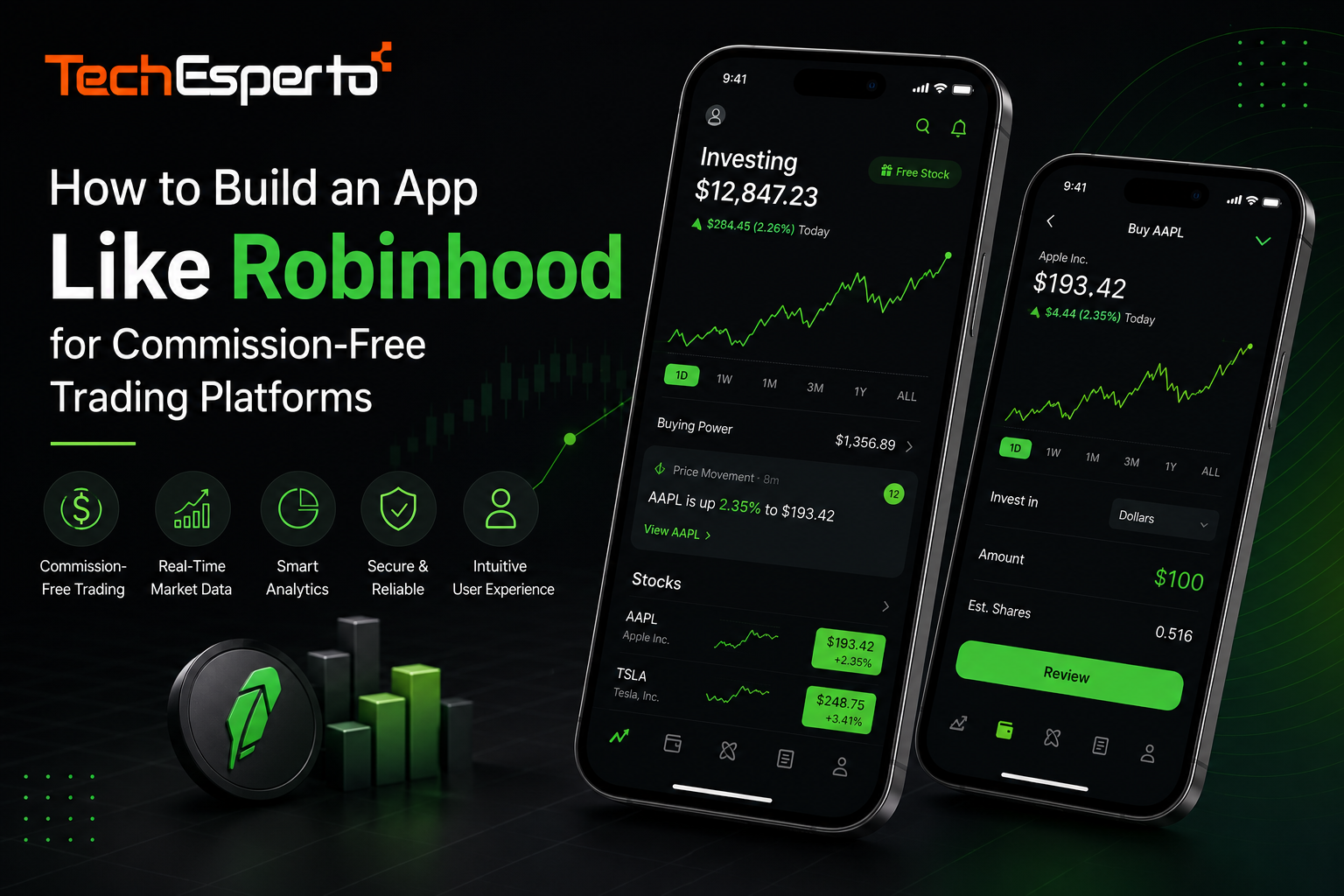
How to Build an App Like Robinhood for Commission-Free Trading Platforms
Building an app like Robinhood means developing a stock trading platform with real-time market data, order execution, portfolio tracking, and account funding that works reliably for retail investors on their phone. TechEsperto Solutions helps fintech founders plan features, choose the right tech stack, and estimate development costs for a Robinhood-style trading app.
Commission-free trading platforms succeed by making investing simple and accessible while handling order execution and market data accurately behind a clean, easy-to-use interface. TechEsperto Solutions builds platforms like this as part of its broader stock trading app development practice, and this guide covers what it takes to plan and build a Robinhood-style trading app from the ground up.
What Is a Robinhood-Style Trading App
A Robinhood-style app is a mobile-first trading platform that lets retail investors buy and sell stocks, and often other assets, without traditional per-trade commission fees, through a simplified interface designed for individual investors rather than professional traders. Unlike a traditional brokerage platform built around complex charting tools and professional order types, this model prioritizes simplicity, fast account opening, and an approachable user experience that lowers the barrier to entry for new investors. Behind that simple interface, the platform still needs to route orders accurately to an exchange or liquidity provider and reflect execution in the user’s portfolio in real time. Building this kind of platform means balancing an accessible, simplified front-end experience with the same order execution accuracy and regulatory rigor that any trading platform requires.
Commission-Free Order Placement
Users can place buy or sell orders without traditional per-trade commission fees.
Real-Time Market Data
The app displays live or near-live price data for supported securities.
Simplified Account Opening
Account opening is designed to be fast and straightforward compared to traditional brokerage onboarding.
Portfolio Tracking
Users can view their holdings, cost basis, and overall portfolio performance in one place.
Some platforms let users invest a specific dollar amount rather than requiring a full share purchase.
Account Funding and Withdrawal
Users can fund their account from a linked bank account and withdraw available balances.
Core Features You Need
A functional commission-free trading app needs the account opening process to feel fast and simple, since a lengthy or confusing onboarding flow is a common point of drop-off for new investors unfamiliar with traditional brokerage processes. Real-time market data needs to update reliably, since investors checking prices expect near-instant accuracy rather than delayed quotes. Order placement needs to be simple enough for a first-time investor to understand while still executing accurately behind the scenes. Portfolio tracking needs to clearly show gains, losses, and overall performance in a way that helps users understand their investment activity without requiring financial expertise to interpret.
Fast Account Opening Flow
Account opening should minimize steps and paperwork while still meeting identity verification requirements.
Real-Time Price Updates
Market data needs to update reliably so users see accurate, near-instant pricing information.
Simple Order Placement Interface
Order placement should be understandable for first-time investors without requiring trading expertise.
Clear Portfolio Performance Display
Portfolio views should clearly show gains, losses, and overall performance in accessible terms.
Fractional investing lets users buy a specific dollar amount rather than requiring a full share purchase.
Instant or Fast Fund Transfers
Fast fund transfer options help reduce the delay between funding an account and being able to trade.
How the Business Model Works
Commission-free trading platforms typically generate revenue through methods other than direct trading commissions, since the commission-free model is central to their competitive positioning. Common revenue sources include payment for order flow, where the platform receives compensation for routing customer orders to specific market makers, and interest earned on uninvested cash balances held in user accounts. Some platforms also offer premium subscription tiers with additional features like margin trading or more advanced market data. Interest earned on securities lending, where the platform lends out shares held in customer accounts to other market participants, can represent another revenue stream. Understanding these alternative revenue models helps founders plan realistic unit economics for a commission-free platform. [VERIFY: specific revenue practices such as payment for order flow are subject to evolving regulatory scrutiny and should be confirmed with legal and compliance counsel before implementation.]
Payment for Order Flow
Some platforms receive compensation for routing customer orders to specific market makers.
Interest on Uninvested Cash
Interest earned on cash balances held in user accounts can represent a revenue stream.
Premium Subscription Tiers
Subscription tiers can offer additional features like margin trading or advanced market data.
Securities Lending Revenue
Lending out shares held in customer accounts to other market participants can generate additional revenue.
Interchange Fees on Linked Debit Cards
Some platforms offering debit cards linked to account balances earn interchange fees on card transactions.
Cryptocurrency Trading Fees
Platforms offering cryptocurrency trading alongside stocks sometimes apply different fee structures for that asset class.
Key Technical Components
Building a commission-free trading platform requires market data provider integration to supply real-time pricing for supported securities. Brokerage or clearing partner integration handles the actual routing and execution of customer orders, since most fintech trading apps partner with an established brokerage infrastructure provider rather than becoming a broker-dealer themselves from day one. Identity verification services support the account opening process, and payment integration handles account funding and withdrawal via linked bank accounts. Portfolio tracking systems calculate performance and cost basis accurately, and the platform’s backend needs to handle these systems together while maintaining strict data accuracy given the financial and regulatory stakes involved.
Market Data Provider Integration
Market data integration supplies real-time or near-real-time pricing for supported securities.
Brokerage and Clearing Partner Integration
Most platforms integrate with an established brokerage or clearing partner rather than becoming a broker-dealer independently.
Identity Verification Services
Verification services support fast, compliant account opening during onboarding.
Payment and Bank Account Integration
Payment integration handles account funding and withdrawal via linked bank accounts.
Portfolio Tracking and Performance Calculation
Portfolio systems calculate holdings, cost basis, and performance accurately over time.
Order Routing and Execution Tracking
Order routing logic connects to the brokerage partner and tracks execution status accurately.
Development Process and Timeline
Building a trading platform typically starts with confirming which asset classes to support and which brokerage or clearing partner to work with, since this partnership decision significantly shapes the platform’s technical architecture. MVP scoping narrows the feature list to core account opening, market data, and order placement, deferring features like fractional shares or margin trading to later phases. Development needs to account for regulatory and compliance requirements from the start, since retrofitting compliance features after launch is far more difficult than building them in initially. Testing needs to cover order execution accuracy and market data reliability extensively before launch, given the financial stakes involved in any errors.
Discovery and Requirement Mapping
Early discovery confirms supported asset classes, brokerage partnership, and regulatory requirements.
MVP Feature Scoping
MVP scoping narrows the feature list to core account opening, market data, and order placement functions.
UI/UX Design
Design work focuses on making the trading experience approachable for first-time investors.
Development and Integration
Development covers market data, order routing, and portfolio tracking in parallel, connected through brokerage partner APIs.
Testing and Quality Assurance
Testing covers order execution accuracy and market data reliability extensively before launch.
Launch and Post-Launch Support
Launch typically starts with a narrower asset class focus before expanding supported securities.
Common Challenges and How to Solve Them
Fintech founders building a trading platform tend to face a specific set of challenges tied to regulation, partnerships, and user trust. Regulatory registration and compliance requirements are significant and vary by jurisdiction, which is why most platforms partner with an established brokerage infrastructure provider rather than pursuing independent broker-dealer registration from day one. Building trust with users handling real financial assets requires strong reliability and transparency, since even minor execution or data errors can seriously damage user confidence. Market data licensing costs can also be substantial depending on the data provider and coverage needed. Recognizing these challenges early helps founders plan realistic partnership and compliance timelines before launch. [VERIFY: specific regulatory and licensing requirements vary significantly by jurisdiction and should be confirmed with legal counsel.]
Regulatory Registration and Compliance
Registration and compliance requirements vary by jurisdiction and typically require specialized legal counsel.
Brokerage Partnership Selection
Choosing the right brokerage or clearing partner significantly affects technical architecture and available features.
Building User Trust with Financial Data
Reliability and transparency in order execution and data accuracy are essential to building user trust.
Market Data Licensing Costs
Market data licensing costs vary based on the data provider and asset classes supported.
Differentiating from Established Platforms
New entrants often succeed by focusing on a specific asset class, region, or underserved investor segment.
Managing Regulatory Scrutiny of Revenue Models
Revenue models like payment for order flow face evolving regulatory attention and should be reviewed with compliance counsel regularly.
FAQs
How much does it cost to build an app like Robinhood?
Building an app like Robinhood typically costs between $40,000 and $80,000 for an MVP with core market data and order placement features, and $80,000 to $200,000 for a full platform including portfolio tracking and brokerage integration. Enterprise-scale, multi-asset-class systems start at $200,000 and scale with integration and compliance complexity.
How long does it take to build a trading app like this?
Timelines vary based on scope, but a trading app with core market data and order placement features typically takes several months from discovery through launch. Adding additional asset classes or advanced portfolio features extends the timeline.
Do I need to become a licensed broker-dealer to launch a trading app?
Most fintech trading platforms partner with an existing brokerage or clearing firm rather than becoming a broker-dealer independently, though specific regulatory requirements vary by jurisdiction and should be confirmed with legal counsel.
How is commission-free trading typically monetized?
Commission-free platforms often earn revenue through payment for order flow, interest on uninvested cash balances, and premium subscription features, rather than charging users directly per trade.
What asset classes can a trading app like this support?
The platform can support stocks, ETFs, options, or cryptocurrency, depending on the operator’s target market, brokerage partnership, and regulatory approvals in place.
Can TechEsperto Solutions help build a platform like this?
Yes, TechEsperto Solutions builds custom stock trading app development platforms, including market data and brokerage integration, scoped around your target asset classes and regulatory environment.