


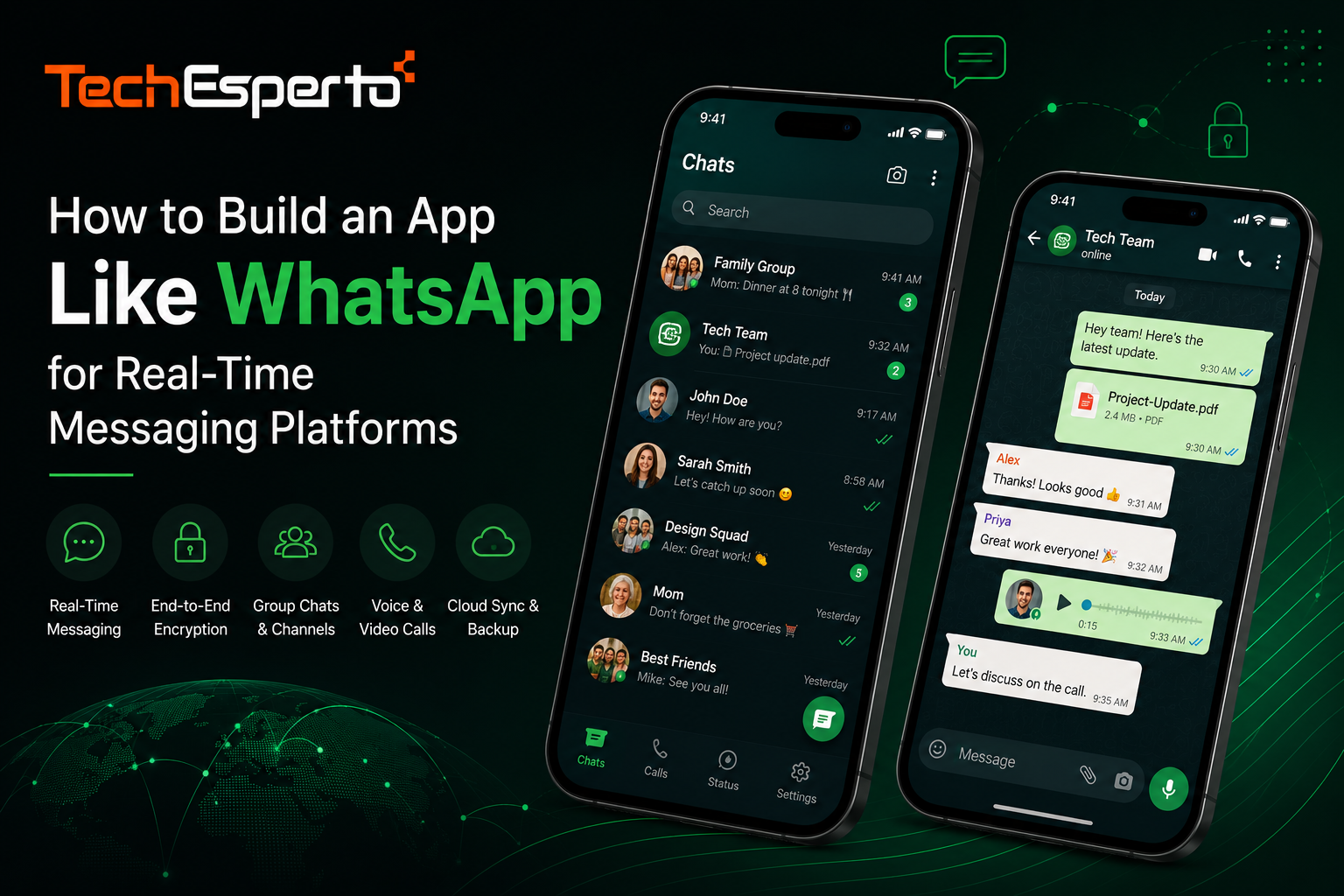
How to Build an App Like WhatsApp for Real-Time Messaging Platforms
Building an app like WhatsApp means developing a real-time messaging platform with end-to-end encryption, group chats, media sharing, and voice or video calling that works reliably across phones and web. TechEsperto Solutions helps founders plan features, choose the right tech stack, and estimate development costs for a WhatsApp-style messaging app.
Messaging platforms succeed by delivering messages instantly and reliably while protecting user privacy through strong encryption, all while scaling to handle millions of concurrent conversations. TechEsperto Solutions builds platforms like this as part of its broader social media app development practice, and this guide covers what it takes to plan and build a WhatsApp-style messaging app from the ground up.
What Is a WhatsApp-Style Messaging App
A WhatsApp-style app is a real-time messaging platform that lets users exchange text, media, and voice or video calls, typically secured through end-to-end encryption so message content is only readable by the sender and recipient. Unlike a simple chat feature bolted onto another app, this model requires messaging infrastructure built for extremely low latency and high reliability, since users expect messages to arrive instantly and consistently regardless of network conditions. Group messaging adds further complexity, since a message sent to a group needs to reach every member reliably and in the correct order. Building this kind of platform means prioritizing message delivery reliability and encryption architecture from the very first line of code, since retrofitting security after launch is far more difficult than building it in from the start.
One-to-One Messaging
Users exchange text, photos, videos, and documents directly with another user in a private conversation.
Group Chat and Broadcast Messaging
Users can create group conversations with multiple participants, along with broadcast lists for one-to-many messaging.
End-to-End Encryption
Messages are encrypted so that only the sender and recipient can read the content, not the platform operator.
Voice and Video Calling
Users can make voice or video calls directly through the app, often supporting group calls as well.
Media and File Sharing
Users can share photos, videos, documents, and voice messages within conversations.
Message Status Indicators
Delivery and read receipts let users know when a message has been delivered and viewed.
Core Features You Need
A functional messaging app needs message delivery to feel instant and reliable above all else, since any perceptible delay or message loss quickly erodes user trust in the platform. End-to-end encryption needs to be implemented correctly from the start, since messaging apps are held to a high privacy standard by users who expect their conversations to remain private. Group messaging needs to handle message ordering and delivery to every participant reliably, even when some members are offline and need to receive messages once they reconnect. Media sharing needs to compress and transmit photos and videos efficiently without excessive data usage, since many users rely on messaging apps over limited mobile data connections.
Instant Message Delivery
Messages need to arrive with minimal delay and be reliably delivered even under poor network conditions.
End-to-End Encryption Implementation
Encryption needs to be implemented correctly so only sender and recipient can read message content.
Group Chat Reliability
Group messages need to reach every participant reliably, including those who reconnect after being offline.
Efficient Media Compression
Photos and videos need efficient compression to reduce data usage without significantly sacrificing quality.
Offline Message Queuing
Messages sent to offline users need to queue and deliver once the recipient reconnects.
Cross-Device Message Sync
Message history needs to sync consistently when a user accesses the app from multiple devices.
How the Business Model Works
Messaging apps have used several different monetization approaches historically, ranging from a small annual subscription fee to fully free access supported by other revenue streams. Many modern messaging platforms monetize indirectly through business messaging APIs, charging companies for the ability to communicate with customers through the platform rather than charging individual users directly. Some platforms explore advertising within status or story features, separate from the core private messaging experience. Business-focused features, such as verified business profiles or customer service tools, can also become a separate revenue stream from individual consumer messaging. Understanding which monetization path fits the target audience early helps shape which features to prioritize during development.
Business Messaging API Revenue
Charging businesses for API access to communicate with customers is a common revenue model for messaging platforms.
Verified Business Profiles
Business accounts with verification and customer service tools can represent a separate monetization stream.
Optional Subscription Models
Some platforms use a small subscription fee, though this has become less common as free models have dominated the category.
Advertising Within Non-Core Features
Some platforms explore advertising within status or story features, separate from private conversations.
Enterprise and Team Communication Tools
Enterprise-focused versions of messaging platforms can monetize through team collaboration features.
Data and Privacy as a Differentiator
Strong privacy and encryption practices can serve as a competitive differentiator that supports premium positioning.
Key Technical Components
Building a messaging platform requires real-time messaging infrastructure capable of handling millions of concurrent connections with minimal latency. End-to-end encryption implementation needs careful architecture to ensure keys are managed correctly without the platform operator having access to message content. Media storage and compression systems handle the efficient transmission of photos, videos, and voice messages. Push notification infrastructure alerts users to new messages when the app is not actively open, and a scalable backend needs to support group messaging logic that reliably delivers messages to every participant in the correct order.
Real-Time Messaging Infrastructure
Messaging infrastructure needs to handle millions of concurrent connections with minimal latency.
End-to-End Encryption Architecture
Encryption architecture manages key exchange and message security without the platform accessing content.
Media Storage and Compression
Media systems handle efficient storage and compression of photos, videos, and voice messages.
Push Notification Infrastructure
Push notifications alert users to new messages when the app is not actively open.
Voice and Video Calling Infrastructure
Calling infrastructure supports real-time voice and video communication, including group calls.
Scalable Group Messaging Backend
The backend needs to reliably deliver group messages to every participant in the correct order.
Development Process and Timeline
Building a messaging platform typically starts with confirming core requirements around encryption standards, expected user scale, and target platforms. MVP scoping narrows the feature list to core one-to-one and group messaging, deferring voice and video calling to a later phase given the additional infrastructure complexity involved. Encryption architecture needs to be designed and implemented early, since this underlying security model shapes many other technical decisions throughout development. Testing needs to cover message delivery reliability under poor network conditions and at scale, along with thorough security testing of the encryption implementation, before launch.
Discovery and Requirement Mapping
Early discovery confirms encryption standards, expected user scale, and target platforms.
MVP Feature Scoping
MVP scoping narrows the feature list to core one-to-one and group messaging functions.
UI/UX Design
Design work focuses on making conversation navigation and media sharing feel fast and intuitive.
Development and Integration
Development covers messaging infrastructure, encryption, and media handling in parallel.
Testing and Quality Assurance
Testing covers message delivery reliability, security of the encryption implementation, and performance at scale.
Launch and Post-Launch Support
Launch typically starts with core messaging features before adding voice, video, and business tools.
Common Challenges and How to Solve Them
Messaging app founders tend to face a specific set of challenges tied to scale, security, and user trust. Achieving reliable message delivery at scale is technically demanding, since the infrastructure needs to handle millions of concurrent users without dropped or delayed messages. Implementing encryption correctly requires specialized security expertise, since flaws in encryption implementation can seriously damage user trust if discovered. Building a large enough user base to make the app useful is also a challenge specific to messaging, since a messaging app has little value if the people someone wants to reach are not also using it. Recognizing these challenges early helps founders plan realistic infrastructure investment and go-to-market strategy.
Reliable Message Delivery at Scale
Handling millions of concurrent users without dropped or delayed messages requires significant infrastructure investment.
Correct Encryption Implementation
Encryption needs specialized security expertise to implement correctly and avoid vulnerabilities.
Network Effect Challenges
A messaging app has limited value until enough of a target audience’s contacts are also using it.
Cross-Platform Consistency
Ensuring consistent behavior across phones and web clients takes ongoing testing and maintenance.
Spam and Abuse Prevention
Preventing spam and abusive messaging requires moderation tools balanced carefully against encryption and privacy commitments.
Differentiating from Established Platforms
New entrants often succeed by focusing on a specific audience, region, or use case underserved by major messaging platforms.
FAQs
How much does it cost to build an app like WhatsApp?
Building an app like WhatsApp typically costs between $40,000 and $80,000 for an MVP with core one-to-one and group messaging features, and $80,000 to $200,000 for a full platform including voice and video calling. Enterprise-scale, high-volume systems start at $200,000 and scale with encryption and infrastructure requirements.
How long does it take to build a messaging app like this?
Timelines vary based on scope, but a messaging app with core text and group messaging features typically takes several months from discovery through launch. Adding voice and video calling or advanced encryption features extends the timeline.
Is end-to-end encryption required for a messaging app?
End-to-end encryption is not strictly required, but it has become a strong user expectation and competitive standard for messaging platforms, particularly given rising awareness of privacy concerns among users.
How does the app handle messages sent to offline users?
Messages sent to offline users are typically queued on the server and delivered once the recipient’s device reconnects, with delivery confirmation sent back once the message is successfully received.
Do I need voice and video calling from launch?
Not necessarily. Many messaging platforms launch with core text and media messaging first, then add voice and video calling in a later phase given the additional infrastructure complexity involved.
Can TechEsperto Solutions help build a platform like this?
Yes, TechEsperto Solutions builds custom real-time messaging and social media app development platforms, including encryption architecture and scalable messaging infrastructure, scoped around your target scale and feature requirements.