


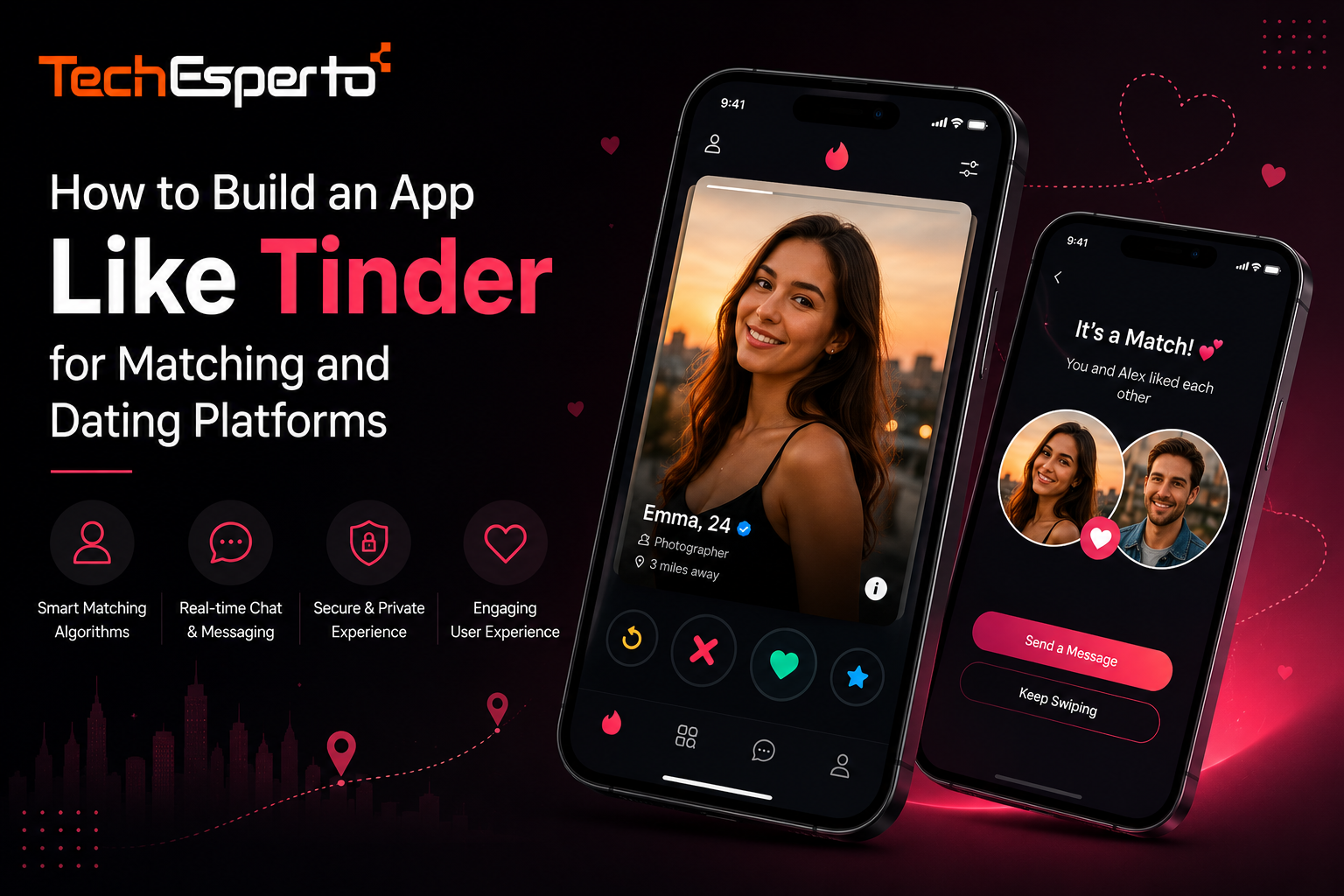
How to Build an App Like Tinder for Matching and Dating Platforms
Building an app like Tinder means developing a profile and matching system, in-app messaging, and safety or verification tools that let users discover and connect with potential matches based on defined preferences. TechEsperto Solutions helps founders plan features, choose the right tech stack, and estimate development costs for a Tinder-style matching app.
Swipe-based matching apps succeed by making profile discovery fast and low-effort while keeping safety and verification features strong enough to build user trust. TechEsperto Solutions builds platforms like this as part of its broader dating app development practice, and this guide covers what it takes to plan and build a Tinder-style matching app from the ground up.
What Is a Tinder-Style Matching App
A Tinder-style app is a location-based matching platform where users view potential matches one at a time and indicate interest through a simple swipe or tap gesture, with messaging unlocked only after both users express mutual interest. Unlike a traditional dating site with detailed questionnaires and search filters, this model prioritizes a fast, low-friction browsing experience over extensive upfront profile matching logic. The mutual-interest requirement before messaging is a core safety and quality feature, since it reduces unwanted contact compared to platforms where anyone can message anyone. Building this kind of platform means designing around quick decision-making while still supporting the safety and verification features that build user trust.
Swipe-Based Profile Discovery
Users view potential matches one at a time, indicating interest through a simple swipe or tap gesture.
Mutual Interest Matching
Messaging unlocks only after both users express interest in each other, reducing unwanted contact.
Location-Based Discovery
Matches are typically surfaced based on user location and a configurable distance radius.
In-App Messaging
Once matched, users can message each other directly within the app.
Identity Verification
Verification tools, such as photo or ID confirmation, help reduce fake profiles.
Safety and Reporting Tools
Users can report or block others, with moderation staff reviewing flagged accounts.
Core Features You Need
A functional swipe-based matching app needs the discovery experience to feel fast and low-friction, since the entire model depends on users being willing to review many profiles quickly. Profile creation needs to be simple enough that users complete it without significant drop-off, typically requiring just a few photos and basic information rather than a lengthy questionnaire. Location-based matching needs to work accurately and respect user-defined distance preferences. Safety features, including reporting, blocking, and identity verification, need to be built in from the start rather than added later, since user trust depends heavily on feeling safe using the platform.
Simple Profile Creation
Profile setup should be quick, typically requiring a few photos and basic information to reduce drop-off.
Fast Swipe or Tap Discovery
The core browsing experience needs to feel quick and responsive to keep users engaged.
Location and Distance Preferences
Users can set a preferred distance radius for discovering potential matches.
Match Notification and Messaging
Users receive notifications when a mutual match occurs and can begin messaging immediately.
Profile Verification Badges
Verified profile badges help signal trustworthy accounts to other users.
Block and Report Tools
Users can block or report others, with flagged accounts reviewed by moderation staff.
How the Business Model Works
Tinder-style platforms typically generate revenue through a freemium model, where basic swiping and matching is free but premium features require a subscription. Common premium features include unlimited swipes, the ability to see who has already expressed interest, and profile boost features that increase visibility for a limited time. Some platforms also offer one-time purchases for individual boosts or “super like” style features that signal stronger interest than a standard match indication. Advertising is less common on these platforms compared to other app categories, since ads within a matching flow can feel intrusive to users. Understanding this freemium structure early helps founders decide which features to gate behind a subscription versus keep free to maximize initial user growth.
Freemium Subscription Model
Basic matching is typically free, with a subscription unlocking premium features like unlimited swipes.
Profile Boost Features
Paid boost features increase a user’s profile visibility for a limited time.
One-Time Purchase Features
Some platforms offer one-time purchases for individual premium actions rather than requiring a full subscription.
Tiered Subscription Levels
Multiple subscription tiers can offer different combinations of premium features at different price points.
Limited Advertising Model
Advertising is less common on matching platforms since ads can feel intrusive within the core browsing flow.
Regional or Market-Specific Pricing
Subscription pricing sometimes varies by region to reflect local purchasing power and market conditions.
Key Technical Components
Building a swipe-based matching app requires a profile and matching system that can quickly surface relevant potential matches based on location and preferences. Real-time messaging infrastructure supports communication once a match occurs, while identity verification services help confirm user authenticity during onboarding. Content moderation tools, including automated image screening, help staff review flagged profiles and content efficiently as the user base grows. Location services power the proximity-based discovery that defines this app category, and push notification infrastructure alerts users to new matches and messages promptly.
Profile and Matching System
The matching system surfaces potential matches based on location, preferences, and platform-specific criteria.
Real-Time Messaging Infrastructure
Messaging infrastructure supports real-time communication once a mutual match occurs.
Identity Verification Services
Verification services confirm user identity during onboarding to reduce fake profiles.
Content Moderation Tools
Automated image and content screening tools help staff review flagged profiles efficiently.
Location Services
Location services power proximity-based match discovery within user-defined distance preferences.
Push Notification Infrastructure
Push notifications alert users promptly to new matches and messages.
Development Process and Timeline
Building a matching app typically starts with confirming the target audience and matching criteria, since these decisions shape the discovery algorithm and profile fields needed. MVP scoping narrows the feature list to core swiping, matching, and messaging functions, deferring premium subscription features and advanced verification to later phases. Safety and moderation tools need to be built in from the earliest development stages rather than treated as optional additions. Testing needs to cover matching accuracy, messaging reliability, and moderation workflows before launch, since safety-related bugs can seriously damage user trust if they surface after release.
Discovery and Requirement Mapping
Early discovery confirms target audience, matching criteria, and required safety features.
MVP Feature Scoping
MVP scoping narrows the feature list to core swiping, matching, and messaging functions.
UI/UX Design
Design work focuses on making the swipe and matching flow feel fast and intuitive.
Development and Integration
Development covers profile, matching, and messaging systems in parallel, connected through shared APIs.
Testing and Quality Assurance
Testing covers matching accuracy, messaging reliability, and moderation workflows before launch.
Launch and Post-Launch Support
Launch typically starts in a focused market or audience segment before expanding.
Common Challenges and How to Solve Them
Matching app founders tend to face a specific set of challenges tied to safety, moderation, and user growth. Fake profiles and catfishing are an ongoing concern that requires investment in verification and moderation tools from the start rather than as an afterthought. Achieving a balanced user base, particularly gender balance where relevant to the platform’s matching model, affects match quality and can be difficult to solve through product features alone. Moderation at scale becomes more challenging as the user base grows, requiring a combination of automated tools and human review. New entrants also face the challenge of achieving enough initial user density in a target area for matching to feel active rather than sparse. Recognizing these challenges early helps founders plan launch strategy and moderation investment accordingly.
Fake Profiles and Catfishing
Investing in identity verification and moderation tools from launch helps reduce fake profiles and build trust.
User Base Balance
Achieving a balanced user base affects match quality and can be difficult to influence through product features alone.
Moderation at Scale
Growing user bases require a combination of automated screening tools and human moderation review.
Achieving Initial Density in a Market
Launching in a focused geographic area or niche audience helps ensure enough active users for matching to feel worthwhile.
Retention After Initial Matches
Keeping users engaged after their first few matches requires ongoing feature development and content freshness.
Differentiating from Established Platforms
New entrants often succeed by focusing on a specific audience, niche, or matching approach underserved by major platforms.
FAQs
How much does it cost to build an app like Tinder?
Building an app like Tinder typically costs between $40,000 and $80,000 for an MVP with core swiping and matching features, and $80,000 to $200,000 for a full platform including messaging and premium subscription features. Enterprise-scale, high-volume systems start at $200,000 and scale with verification and moderation requirements.
How long does it take to build a matching app like this?
Timelines vary based on scope, but a matching app with core swiping, matching, and messaging features typically takes several months from discovery through launch. Adding premium subscription tiers or advanced verification extends the timeline.
What safety features should be included from launch?
Common safety features include identity or photo verification, reporting and blocking tools, and moderation review capability for flagged content, all of which should be planned into the platform from the earliest design stages rather than added later.
How does the matching algorithm typically work?
Matching is usually based on location, user-defined preferences, and mutual interest, where messaging unlocks only after both users express interest in each other, rather than allowing open messaging between any two users.
Do I need a large user base to launch successfully?
Not necessarily a large user base overall, but enough active users within a specific geographic area or niche audience for matching to feel active, which is why many platforms launch in a focused market before expanding.
Can TechEsperto Solutions help build a platform like this?
Yes, TechEsperto Solutions builds custom dating app development platforms, including identity verification and safety tooling, scoped around your target audience and matching approach.