


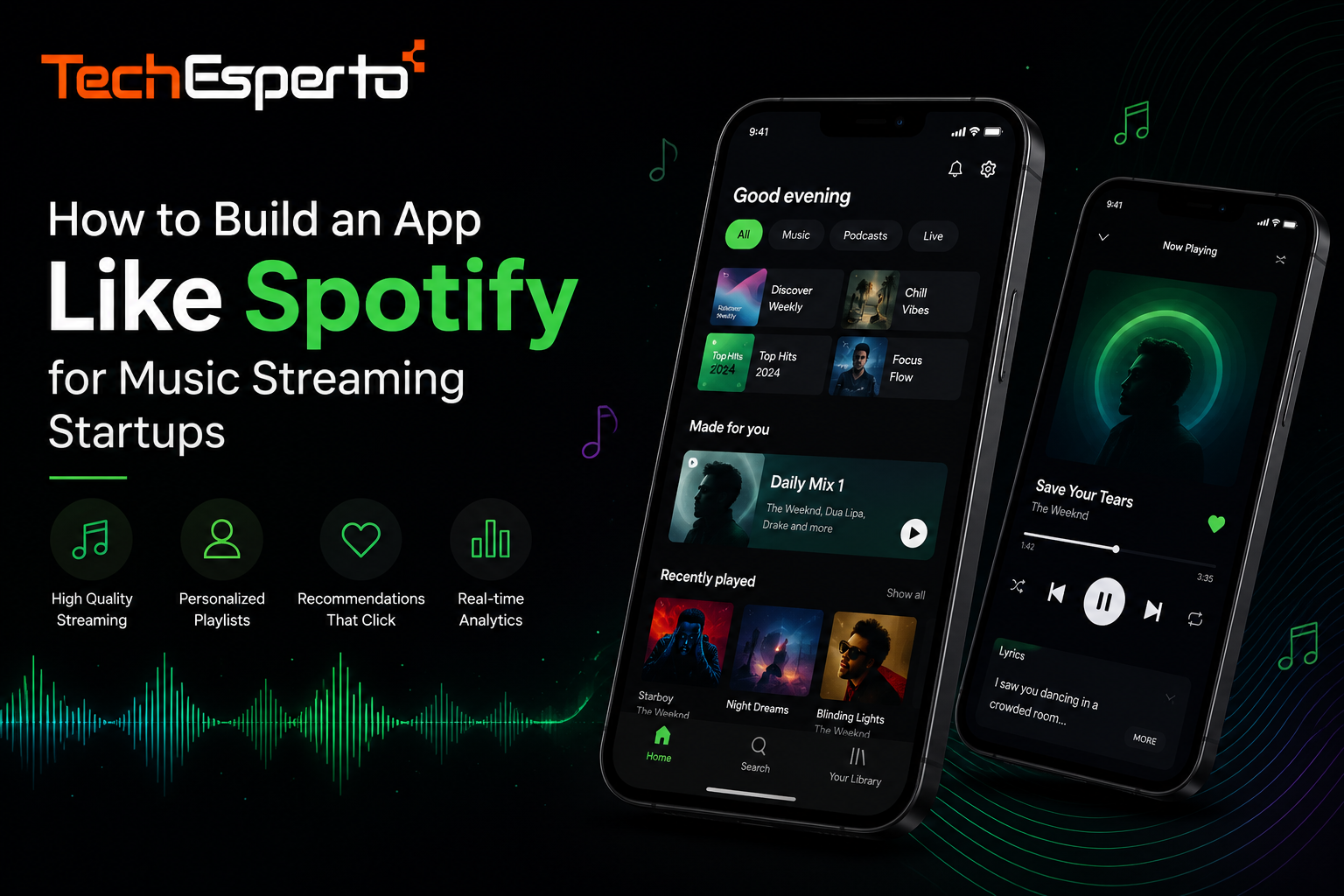
How to Build an App Like Spotify for Music Streaming Startups
Building an app like Spotify means developing a music streaming platform with catalog management, playlist tools, offline playback, and royalty tracking that works reliably across phones, tablets, and web browsers. TechEsperto Solutions helps labels, artists, and audio platforms plan features, choose the right tech stack, and estimate development costs for a Spotify-style streaming app.
Music streaming platforms succeed by making it easy for listeners to find and stream content while keeping accurate usage data for royalty reporting to artists and rights holders. TechEsperto Solutions builds platforms like this as part of its broader music streaming app development practice, and this guide covers what it takes to plan and build a Spotify-style audio streaming app.
What Is a Spotify-Style Music Streaming App
A Spotify-style app is a subscription or ad-supported platform that lets listeners browse a music catalog, stream tracks, build playlists, and discover new content based on their listening habits. Unlike a simple audio hosting site, this model requires accurate usage tracking for royalty calculation, since every stream typically needs to be logged for reporting to artists or rights holders. The platform also needs playlist and recommendation features that keep listeners engaged, since music streaming depends heavily on discovery to introduce listeners to content beyond what they already know. Building this kind of platform means balancing a smooth listening experience with the backend accuracy that licensing and royalty obligations require.
Music Catalog and Browsing
Listeners browse a catalog organized by artist, genre, or release, with search to find specific tracks or albums.
Playlist Creation and Management
Listeners create and manage playlists, both personal and collaborative, that can be shared with other users.
Offline Playback
Subscribers can download tracks for offline listening, typically tied to a paid subscription tier.
Recommendation and Discovery Features
Recommendation logic surfaces new content based on listening history and behavior patterns.
Royalty and Usage Tracking
The platform tracks play counts accurately to support royalty reporting to artists and rights holders.
Subscription and Ad-Supported Access
The platform typically supports both a paid ad-free subscription tier and a free ad-supported tier.
Core Features You Need
A functional music streaming app needs catalog browsing and playback to feel instant and reliable, since listeners expect near-immediate playback when they select a track. Search needs to handle partial matches and misspellings well, since listeners often search by memory rather than exact track titles. Playlist tools need to support both personal organization and social sharing, since playlists are often how listeners discover music through friends or curated collections. Offline playback matters significantly for mobile listeners with limited data plans, and this feature typically becomes a key differentiator between free and paid subscription tiers.
Fast Search and Catalog Browsing
Search needs to handle partial matches and misspellings to help listeners find content quickly.
Playlist Creation and Sharing
Playlist tools support personal organization and social sharing, including collaborative playlists.
Offline Download and Playback
Offline playback lets subscribers download tracks for listening without an active internet connection.
Cross-Device Playback Continuity
Listeners can start playback on one device and continue seamlessly on another.
Personalized Recommendations
Recommendation features surface new content based on listening history and behavior.
Subscription and Free Tier Management
Listeners can view and manage their subscription status, switching between free and paid tiers as needed.
How the Business Model Works
Spotify-style platforms typically generate revenue through a combination of subscription fees from paid listeners and advertising revenue from free-tier users. Paid subscribers get ad-free listening, offline downloads, and sometimes higher audio quality, while free-tier listeners hear periodic advertising between tracks. Royalty payments to artists and rights holders are usually calculated based on stream counts and represent one of the platform’s largest ongoing costs, which is why accurate usage tracking matters so much technically. Some platforms also explore additional revenue through podcast advertising or exclusive content deals with artists. Understanding this cost structure early helps founders plan realistic unit economics before launch.
Subscription Fees from Paid Listeners
Paid subscribers generate recurring revenue in exchange for ad-free listening and additional features.
Advertising Revenue from Free Tier
Free-tier listeners generate revenue through advertising played between tracks.
Royalty Payments to Rights Holders
Royalty payments based on stream counts represent a major ongoing cost tied to licensing agreements.
Family and Group Subscription Plans
Multi-user subscription plans can increase revenue per household while offering a lower per-user price.
Podcast and Spoken Content Advertising
Some platforms generate additional advertising revenue through podcast or spoken audio content.
Exclusive Content and Artist Deals
Exclusive content partnerships with artists can differentiate a platform from competitors.
Key Technical Components
Building a music streaming platform requires audio encoding and content delivery infrastructure that handles smooth playback across varying network conditions. A content management system lets the operator upload tracks and manage metadata that powers search and recommendations. Royalty and usage tracking systems need to log play counts accurately, since this data typically feeds directly into financial reporting to rights holders. Recommendation engines analyze listening behavior to surface relevant content, and offline download management handles the technical complexity of syncing downloaded content with account permissions. All of these systems need to work together without introducing playback delays that frustrate listeners.
Audio Encoding and Content Delivery
Encoding and delivery infrastructure support smooth streaming across devices and network conditions.
Content Management System
The content management system lets operators upload tracks and manage catalog metadata.
Royalty and Usage Tracking
Usage tracking logs play counts accurately to support royalty calculation and reporting.
Recommendation Engine
Recommendation logic analyzes listening behavior to surface relevant content for each listener.
Offline Download Management
Download management handles syncing offline content with account and subscription permissions.
Cross-Platform Client Apps
Client apps need to be built for phones, tablets, and web browsers with consistent playback behavior.
Development Process and Timeline
Building a music streaming platform typically starts with confirming catalog size and rights management approach, since licensing agreements affect what usage tracking and reporting the platform needs to support. MVP scoping narrows the feature list to core browsing, streaming, and playlist functions, deferring offline download and advanced recommendation features to later phases. Development needs to build royalty tracking accuracy in from the start, since retrofitting this after launch is more difficult than including it in the initial architecture. Testing needs to cover playback reliability and usage tracking accuracy under realistic listening patterns before launch.
Discovery and Requirement Mapping
Early discovery confirms catalog size, rights management approach, and monetization model.
MVP Feature Scoping
MVP scoping narrows the feature list to core browsing, streaming, and playlist functions.
UI/UX Design
Design work covers the listener experience across supported platforms, prioritized by target audience.
Development and Integration
Development covers the listener app, content management system, and royalty tracking in parallel.
Testing and Quality Assurance
Testing covers playback reliability and usage tracking accuracy under realistic listening patterns.
Launch and Post-Launch Support
Launch typically starts with a smaller catalog before expanding content library and platform support.
Common Challenges and How to Solve Them
Music streaming startups tend to face a specific set of challenges tied to licensing and royalty accuracy. Music licensing agreements can be complex and costly to negotiate, which is why some platforms start with independently licensed or royalty-free content before pursuing major label deals. Royalty tracking accuracy is critical, since errors in usage reporting can create disputes with artists and rights holders that damage the platform’s reputation. Recommendation quality takes time to improve, since the algorithm needs substantial listening data before it can make genuinely useful suggestions. Recognizing these challenges early helps founders plan realistic content acquisition timelines and royalty infrastructure investment.
Music Licensing Complexity
Licensing agreements can be complex and costly, leading some platforms to start with independently licensed content.
Royalty Tracking Accuracy
Usage tracking errors can create disputes with rights holders, making accurate tracking a technical priority from launch.
Recommendation Quality Over Time
Recommendation accuracy improves gradually as listening data accumulates, so early suggestions may feel less refined.
Offline Playback Rights Management
Offline downloads need to respect licensing terms around content availability and expiration.
Competing with Established Platforms
New entrants often succeed by focusing on a specific genre, region, or independent artist catalog.
Catalog Size and Content Acquisition
Building a competitive catalog takes ongoing content acquisition effort beyond the initial platform launch.
FAQs
How much does it cost to build an app like Spotify?
Building an app like Spotify typically costs between $40,000 and $80,000 for an MVP with core streaming and playlist features, and $80,000 to $200,000 for a full platform including catalog management and royalty tracking. Enterprise-scale, multi-device systems start at $200,000 and scale with catalog size and offline features.
How long does it take to build a music streaming app like this?
Timelines vary based on scope, but a music streaming app with core browsing and playback features typically takes several months from discovery through launch. Adding offline playback or advanced recommendation features extends the timeline.
How is royalty tracking handled technically?
The platform logs play counts and listening duration accurately during playback, feeding this data into reporting systems used to calculate royalty payments to artists and rights holders based on licensing agreement terms.
Do I need a large catalog to launch?
Not necessarily. Many platforms launch with a smaller, focused catalog, such as independent or royalty-free content, and expand licensing agreements as the platform grows and proves demand.
Can the platform support both free and paid listening tiers?
Yes, most music streaming platforms support a free ad-supported tier alongside a paid ad-free subscription, which is a core part of the standard freemium business model in this category.
Can TechEsperto Solutions help build a platform like this?
Yes, TechEsperto Solutions builds custom music streaming app development platforms, including royalty tracking and subscription billing, scoped around your catalog size and monetization model.