


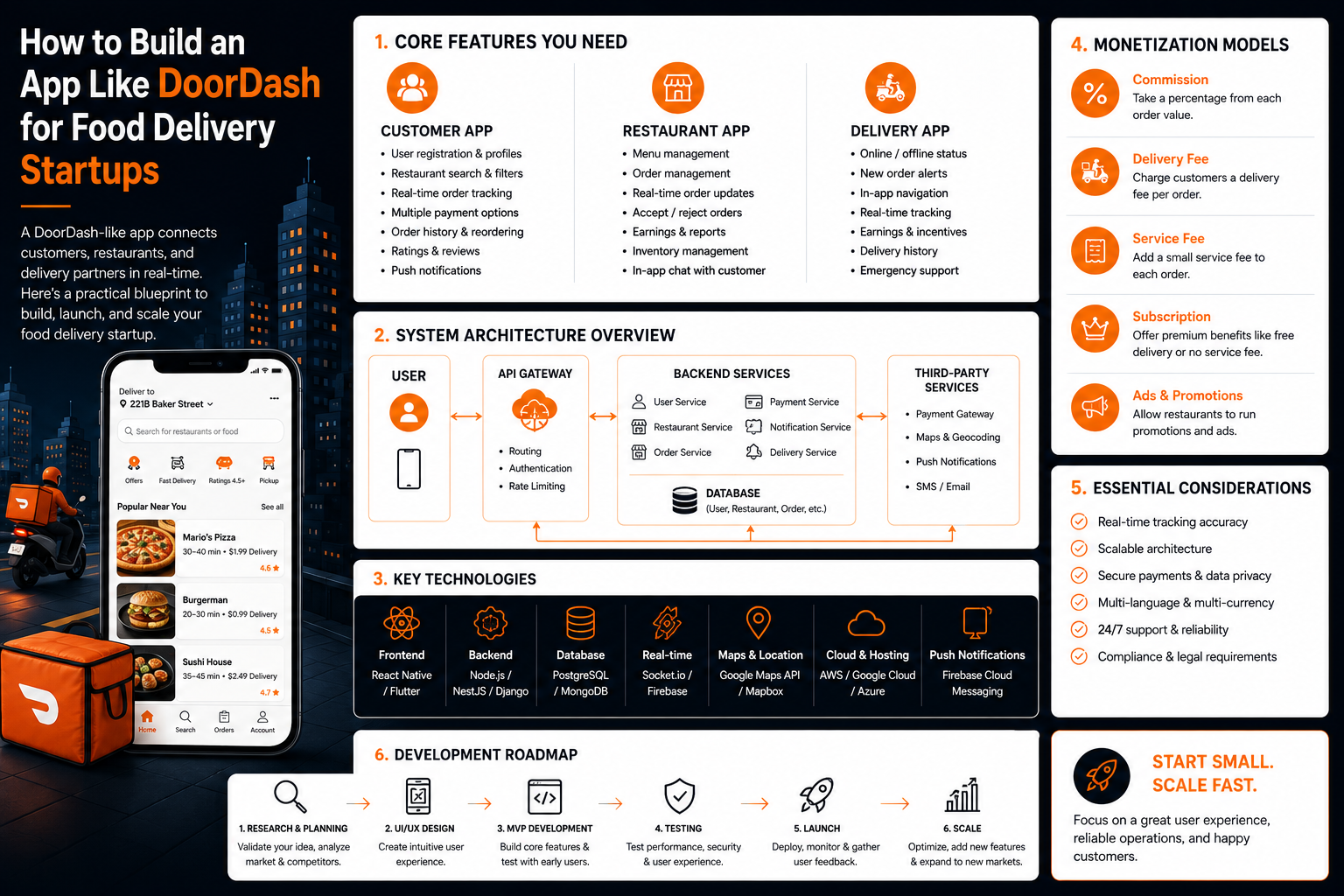
How to Build an App Like DoorDash for Food Delivery Startups
Building an app like DoorDash means developing a three-sided platform connecting customers, restaurants, and delivery drivers through real-time ordering, GPS tracking, and automated dispatch. TechEsperto Solutions helps food delivery startups plan features, choose the right tech stack, and estimate development costs for a DoorDash-style platform.
Food delivery marketplaces succeed by coordinating three separate groups, hungry customers, participating restaurants, and available drivers, all through one connected system. TechEsperto Solutions builds platforms like this as part of its broader on-demand app development practice, and this guide walks through what it actually takes to plan and build a DoorDash-style app from the ground up.
What Is a DoorDash-Style Food Delivery App
A DoorDash-style app is a three-sided marketplace that connects customers who want food delivered, restaurants that prepare the food, and drivers who handle delivery, all coordinated through one platform. Unlike a single-restaurant ordering app, this model requires separate interfaces for each group along with a backend system that matches orders to available drivers automatically. Restaurants need a way to receive and confirm orders without picking up the phone, drivers need a way to accept jobs and navigate to pickup and delivery locations, and customers need to browse restaurant menus and track their order in real time. Building this kind of platform means designing three connected experiences rather than one standalone app, with a shared backend keeping order status consistent across all three.
Three-Sided Marketplace Model
The platform connects three distinct user groups, customers, restaurants, and drivers, each with different needs and interfaces.
Customer Ordering App
Customers browse restaurant menus, place orders, and track delivery status from a single app.
Restaurant Dashboard
Restaurants receive and confirm incoming orders and manage menu availability through a dedicated dashboard or tablet interface.
Driver Delivery App
Drivers accept delivery jobs, navigate to pickup and drop-off locations, and confirm completed deliveries.
Real-Time Order Tracking
Customers and restaurants both see live order status, from confirmation through pickup and delivery.
Commission-Based Revenue Model
The platform typically earns revenue through commission on restaurant orders and delivery fees charged to customers.
Core Features You Need
A functional food delivery app needs a specific set of features on the customer side to drive orders, even before considering the restaurant or driver experience. Restaurant discovery needs to be fast and relevant, since customers browsing a crowded list of options will abandon the app if search and filtering feel slow or inaccurate. The checkout flow needs to support special instructions, tip adjustment, and multiple payment methods without adding friction. Once an order is placed, live tracking becomes the feature customers check most often, so accuracy here directly affects trust in the platform. Getting these customer-facing features right early makes it easier to layer in restaurant and driver tools that depend on the same order and menu data.
Restaurant Discovery and Search
Fast, accurate search and filtering by cuisine, price, or delivery time helps customers find restaurants quickly.
Cart and Checkout
Checkout needs to support special instructions, tipping, and multiple payment methods without unnecessary steps.
Order Assignment and Dispatch
An automated system assigns incoming orders to nearby available drivers based on proximity and current workload.
Live GPS Tracking
Customers see the driver’s live location and estimated arrival time from pickup through delivery.
Ratings and Reviews
Rating systems for restaurants and drivers help maintain quality and give customers confidence in their choices.
In-App Payments
Customers pay through the app using cards or digital wallets, with the platform handling restaurant and driver payouts.
How the Business Model Works
Most DoorDash-style platforms generate revenue through a combination of commission fees charged to restaurants and delivery fees charged to customers, rather than relying on a single revenue stream. Restaurants typically pay a percentage of each order’s value in exchange for access to the platform’s customer base and delivery infrastructure. Customers pay a delivery fee, and sometimes a service fee, on top of the order subtotal, with pricing often varying based on distance or demand. Understanding this revenue structure early matters because it shapes which features are worth prioritizing, such as promoted restaurant listings or subscription programs that reduce delivery fees for frequent customers.
Commission Fees from Restaurants
Restaurants typically pay a percentage of each order in exchange for platform access and delivery logistics.
Delivery Fees from Customers
Customers pay delivery fees that may vary based on distance, order size, or current demand.
Driver Payout Structure
Drivers are typically paid per delivery, sometimes with additional incentives during high-demand periods.
Subscription or Membership Options
Subscription tiers can offer reduced or waived delivery fees in exchange for a recurring membership fee.
Advertising and Promoted Listings
Restaurants may pay additional fees for promoted placement or advertising within the app’s discovery feed.
Dark Kitchen Partnerships
Some platforms partner with delivery-only kitchens that operate without a traditional storefront, expanding available restaurant options.
Key Technical Components
Building a food delivery platform requires several distinct technical components working together rather than one monolithic app. The customer app handles browsing and ordering, while a separate restaurant-facing tool, whether a full app or a simpler tablet interface, manages incoming order confirmation. The driver app needs navigation and job management features distinct from both of the other interfaces. Behind all three sits an admin and dispatch backend that assigns orders to drivers and tracks status across the whole system, along with a payment processing layer that handles the three-way money flow between customers, restaurants, and drivers.
Customer App
The customer-facing app handles restaurant browsing, ordering, payment, and order tracking.
Restaurant App or Portal
Restaurants use a dedicated app or web portal to confirm orders and manage menu availability.
Driver App
The driver app manages job acceptance, navigation, and delivery confirmation.
Admin and Dispatch Backend
The backend system assigns orders to drivers and tracks status across the customer, restaurant, and driver apps.
Payment Processing Layer
Payment processing handles customer charges along with restaurant and driver payouts from a single transaction.
Mapping and Route Optimization
Mapping services provide navigation for drivers and support accurate delivery time estimates for customers.
Development Process and Timeline
Building a platform like this typically starts with market research to confirm which restaurants and delivery zones to target first, since launching in a single market before expanding tends to work better than a broad simultaneous rollout. From there, MVP scoping narrows the feature list to what is needed for a working three-sided marketplace, deferring features like subscriptions or advertising to a later phase. Design and development proceed in parallel across the customer, restaurant, and driver experiences, since all three depend on the same underlying order and dispatch logic. Testing needs to simulate realistic order volume and driver availability before launch, since dispatch logic that works with a handful of test orders can behave differently under real demand.
Discovery and Market Research
Early research confirms which market and restaurant partners to target for an initial launch.
MVP Feature Scoping
MVP scoping narrows the feature list to the core three-sided marketplace functions needed for launch.
UI/UX Design
Design work covers the customer, restaurant, and driver experiences, each suited to its specific use case.
Development and Integration
Development covers all three apps and the shared backend in parallel, connected through common order and dispatch APIs.
Testing and Quality Assurance
Testing simulates realistic order volume and driver availability to catch dispatch and tracking issues before launch.
Launch and Post-Launch Support
Launch typically starts in a single market before expanding, with ongoing support and updates following release.
Common Challenges and How to Solve Them
Most food delivery startups run into a similar set of challenges when building and launching a three-sided marketplace. Driver supply and demand balancing is often the hardest ongoing problem, since too few drivers during peak hours leads to slow deliveries and unhappy customers, while too many drivers with too few orders hurts driver earnings and retention. Restaurant onboarding can also stall growth if the process for adding a restaurant to the platform is manual and slow. Getting delivery time estimates accurate takes tuning over time as real-world traffic and preparation time data accumulate. Recognizing these challenges early helps founders plan for them rather than discovering them after launch.
Driver Supply and Demand Balancing
Matching driver availability to order volume, especially during peak hours, is an ongoing operational challenge.
Restaurant Onboarding Friction
A slow or manual restaurant onboarding process can limit how quickly the platform’s restaurant selection grows.
Delivery Time Accuracy
Estimated delivery times need real-world data to become accurate, since early estimates based on assumptions often run long or short.
Payment and Payout Complexity
Managing three-way payment flows between customers, restaurants, and drivers adds complexity to the payment system.
Scaling to New Markets
Expanding to a new city requires rebuilding restaurant and driver supply from scratch in that market.
Competing with Established Platforms
New entrants often succeed by focusing on an underserved niche or region rather than competing head-on with major platforms everywhere at once.
FAQs
How much does it cost to build an app like DoorDash?
Building an app like DoorDash typically costs between $40,000 and $80,000 for an MVP with core ordering and dispatch features, and $80,000 to $200,000 for a full platform including customer, restaurant, and driver apps. Enterprise-scale, multi-market systems start at $200,000 and scale with feature complexity and integrations.
How long does it take to build a food delivery app like this?
Timelines vary based on scope, but a food delivery app with core three-sided marketplace features typically takes several months from discovery through launch. Adding subscription programs or advertising features extends the timeline. TechEsperto Solutions confirms a project-specific timeline after the discovery phase.
Do I need three separate apps for customers, restaurants, and drivers?
Most platforms use a customer app, a driver app, and either a restaurant app or a simpler web-based restaurant portal, since each group has different workflow needs. Smaller launches sometimes start with a simplified restaurant interface to reduce initial development scope.
How do I get restaurants to join the platform at launch?
Early restaurant onboarding typically relies on direct outreach and manual sign-up in a single target market, since automated self-service onboarding usually comes later as the platform scales. A streamlined onboarding process reduces friction for early restaurant partners.
What is the best way to launch in a new market?
Most successful launches focus on a single city or delivery zone first, building enough restaurant and driver supply to support reliable delivery before expanding to additional markets rather than launching broadly all at once.
Can TechEsperto Solutions help build a platform like this?
Yes, TechEsperto Solutions builds custom grocery delivery and food delivery-style marketplace platforms, including payment gateway integration and dispatch systems, scoped around your target market and launch timeline.