


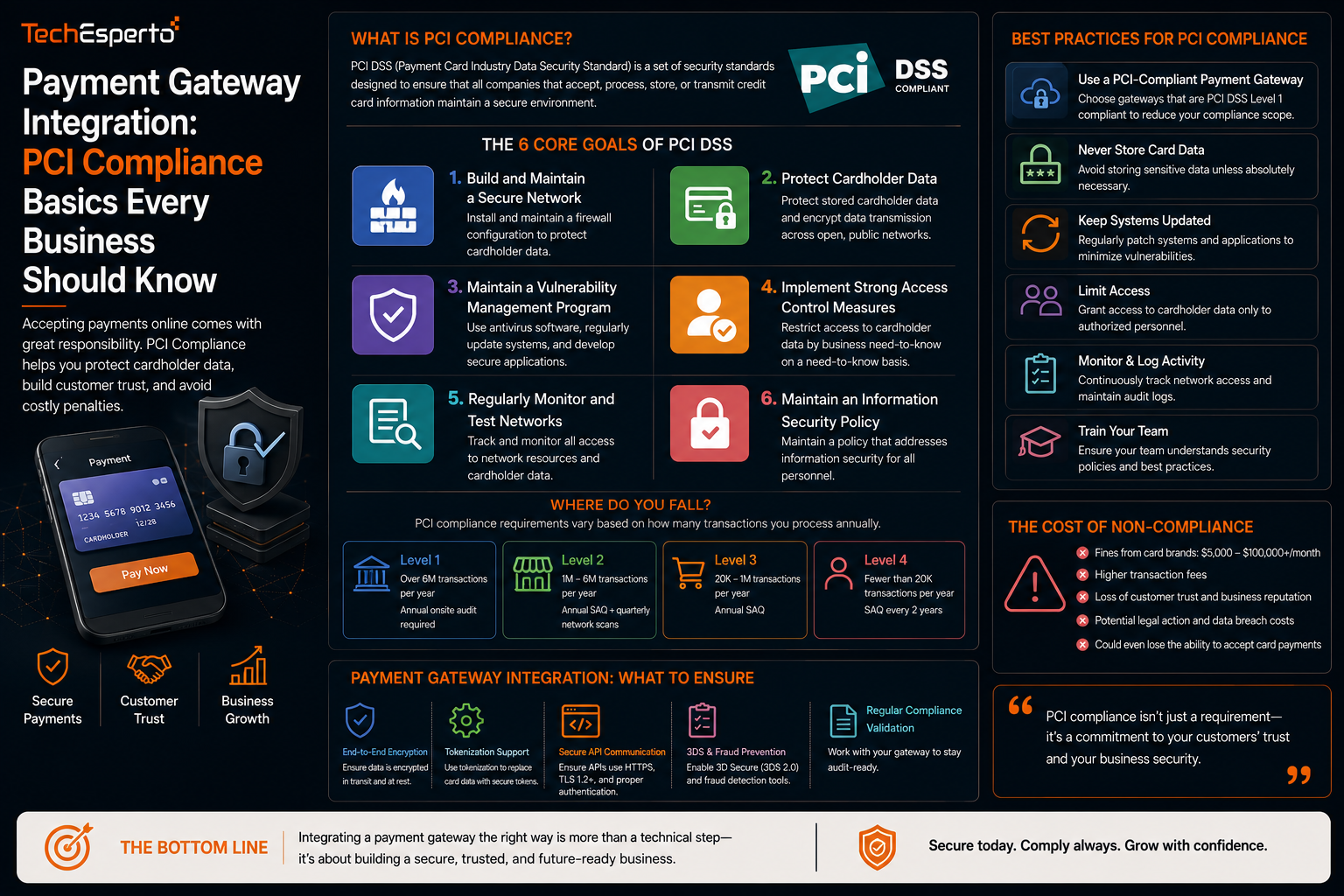
Payment Gateway Integration: PCI Compliance Basics Every Business Should Know
Payment gateway integration compliance is often assumed to be entirely the responsibility of whichever gateway provider a business chooses, when in reality a business’s own implementation choices significantly affect its PCI compliance obligations regardless of which provider sits underneath. This post covers the compliance basics every business should understand before integrating a payment gateway, including what actually determines your compliance scope and the mistakes that unintentionally expand it.
What PCI Compliance Actually Covers
PCI DSS is a set of security standards designed to protect cardholder data during and after a transaction. Compliance requirements apply to any business that stores, processes, or transmits card data, and the specific obligations a business faces depend heavily on how much of that data actually passes through its own systems versus being handled entirely by a third-party gateway.
How Integration Method Affects Compliance Scope
Hosted Payment Pages
The simplest way to minimize compliance burden is using a gateway’s hosted payment page, where the customer is redirected to the gateway’s own secure page to enter card details, meaning sensitive card data never touches your servers at all. This significantly reduces the compliance requirements your business needs to satisfy directly, since the gateway provider assumes most of that responsibility.
Embedded or iFrame-Based Integration
Some businesses prefer an integration that keeps the payment form visually embedded within their own site using an iframe, which can still keep card data isolated from the business’s own servers while offering a more seamless checkout experience, generally maintaining a similarly reduced compliance scope compared to a fully hosted redirect.
Direct API Integration Handling Raw Card Data
Building a payment flow where card data passes directly through your own servers before reaching the gateway significantly increases PCI compliance obligations, since your business is now directly handling sensitive card data rather than delegating that responsibility to the gateway. This approach requires meeting a much stricter set of security requirements and is generally not recommended unless there is a specific business need that cannot be met through a hosted or embedded approach.
Common Compliance Mistakes in Payment Integrations
A frequent mistake is assuming that using a reputable payment gateway automatically makes the business fully compliant, without recognizing that the integration method chosen still affects the business’s own compliance obligations. Another common issue is logging or storing card data for debugging or customer service purposes without recognizing this creates additional compliance scope that would not otherwise exist. And some businesses fail to keep their payment integration code updated, missing security patches that address vulnerabilities relevant to compliance requirements over time.
Building a Compliant Payment Flow From the Start
Choosing a hosted or embedded integration approach rather than handling raw card data directly, avoiding any storage or logging of sensitive card details within your own systems, and keeping the integration updated with the gateway provider’s current security recommendations are the core practices that keep compliance obligations manageable. This is a central consideration in any payment gateway integration project, since decisions made early in the integration architecture directly determine the ongoing compliance burden a business carries afterward.
Compliance Considerations for Ecommerce Specifically
Ecommerce businesses face particular scrutiny given the volume of transactions typically involved, and the integration choices made during platform development have a direct effect on ongoing compliance obligations. This is a key part of ecommerce development planning, since retrofitting a more secure payment architecture after launch is considerably more disruptive than designing it correctly from the outset, particularly for businesses operating in the retail and ecommerce space where transaction volume tends to be high.
Key Takeaways
PCI compliance obligations depend significantly on the integration method chosen, not just on which payment gateway provider is used. Hosted and embedded payment integrations minimize a business’s direct compliance scope by keeping card data away from its own servers. Direct API integrations handling raw card data significantly increase compliance requirements and should be approached carefully. And building compliance into the payment integration architecture from the start avoids the cost and disruption of retrofitting stronger security after launch.
Frequently Asked Questions
Does using a reputable payment gateway automatically make a business PCI compliant?
No. The gateway provider being compliant does not automatically cover your business’s own compliance obligations, which depend significantly on how your integration is architected and how card data flows through your systems.
Is a hosted payment page the easiest way to reduce compliance burden?
Generally yes, since it keeps sensitive card data from ever touching your own servers, significantly reducing the compliance requirements your business needs to satisfy directly.
Can storing card data for customer service purposes create compliance issues?
Yes, storing or logging card data for any reason, including customer service or debugging, creates additional compliance scope that would not otherwise exist and should generally be avoided.
Do compliance requirements differ for high-volume ecommerce businesses?
The core requirements are similar, but high transaction volume increases the practical stakes of a compliance failure and often warrants more rigorous ongoing monitoring and review.
Should a business ever handle raw card data directly rather than using a hosted page?
Generally only when there is a specific, well-justified business need that cannot be met through a hosted or embedded integration, given the significantly stricter compliance requirements direct handling involves.