


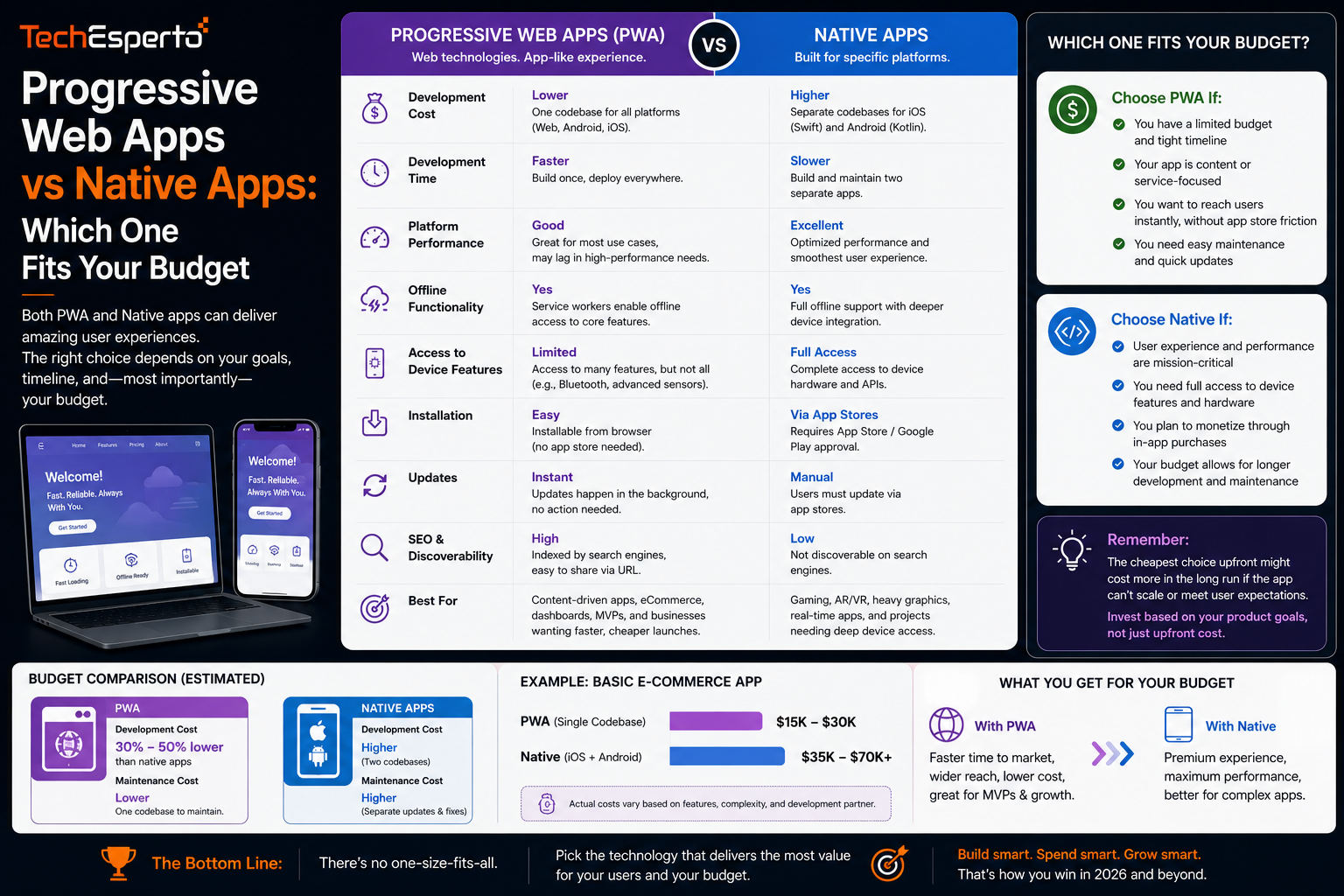
Progressive Web Apps vs Native Apps: Which One Fits Your Budget
PWA vs native app is often framed as a technical decision, but for most businesses evaluating their options, budget and timeline drive the decision as much as any feature comparison. This post looks at the real cost differences between building a progressive web app and a native application, along with the tradeoffs in device capability and distribution that come with each choice, so the decision reflects actual constraints rather than a general assumption about which approach is better.
What Separates the Two Approaches
A progressive web app is a website built to behave like an app, offering offline capability, push notifications, and an installable icon, all delivered through a browser rather than an app store. A native app is built specifically for a platform, such as iOS or Android, using that platform’s own development tools, giving it full access to device hardware and capabilities that a browser-based experience cannot fully replicate.
Development Cost Comparison
Single Codebase Advantage of PWAs
A PWA is built once and runs across any device with a modern browser, meaning there is no need to build and maintain separate codebases for iOS and Android. This significantly reduces both initial development cost and the ongoing cost of maintaining and updating the application over time.
Native App Development Costs
Native apps, particularly when built separately for each platform rather than through a cross-platform framework, generally involve higher development cost due to the need for platform-specific expertise and, often, two parallel codebases to build and maintain. A detailed breakdown of what drives this cost is covered in this guide to app development cost, which outlines how platform choice affects the overall budget significantly.
Distribution and Discoverability
PWAs can be accessed directly through a web link and do not require app store approval, which removes both the delay and the review risk associated with app store submission. Native apps, by contrast, benefit from app store visibility and discovery, which can be a meaningful advantage for consumer apps relying on organic app store search to acquire new users, an advantage a PWA does not have in the same way.
Device Capability Access
Native apps have full access to device hardware, including advanced camera controls, certain sensors, and deeper background processing capabilities that browsers restrict for security and battery reasons. PWAs have narrowed this gap considerably in recent years but still face limitations for apps requiring the most demanding hardware access, such as advanced augmented reality features or continuous background location tracking.
When a PWA Is the Better Budget Choice
For businesses building a content-driven app, an internal tool, or an early-stage product validating demand before committing to a larger investment, a PWA typically delivers strong functionality at a fraction of the cost of native development. This is particularly relevant for startups needing to move quickly on a limited budget while still delivering an app-like experience to users.
When Native Development Justifies the Higher Cost
Applications that depend heavily on advanced device capabilities, need maximum performance for graphically intensive use cases, or rely significantly on app store discovery as a customer acquisition channel generally justify the higher cost of native development. The decision ultimately comes down to whether the specific capabilities native development unlocks are essential to the product, or whether a PWA’s lower cost and single-codebase efficiency deliver comparable value for the actual use case.
Key Takeaways
PWAs offer a significantly lower development and maintenance cost due to their single-codebase approach, while native apps require higher investment but unlock full device capability access. PWAs skip app store approval and distribution delays, while native apps benefit from app store discoverability. The right choice depends on how much a business depends on advanced device features or app store visibility, weighed against available budget. And for early-stage products or budget-conscious projects, a PWA often delivers strong value without the cost of full native development.
Frequently Asked Questions
Can a PWA send push notifications like a native app?
Yes, most modern PWAs support push notifications, though implementation and reliability can vary slightly by platform and browser compared to native app notification systems.
Is a PWA a good starting point before building a native app later?
Yes, this is a common approach for businesses validating demand before committing to the higher cost of native development, since a PWA can deliver core functionality quickly at lower initial investment.
Do PWAs work offline like native apps?
PWAs can support offline functionality through caching mechanisms, though the depth of offline capability generally does not match what a fully native app can achieve with local data storage.
Why do some businesses still choose native apps despite the higher cost?
Businesses needing advanced device capability access, maximum performance, or reliance on app store discovery for customer acquisition often find native development’s benefits justify the additional cost.
Does a PWA require app store approval to be updated?
No, PWAs are updated directly through the web, without app store review, which allows for faster iteration compared to native apps that require submission and approval for each update.