


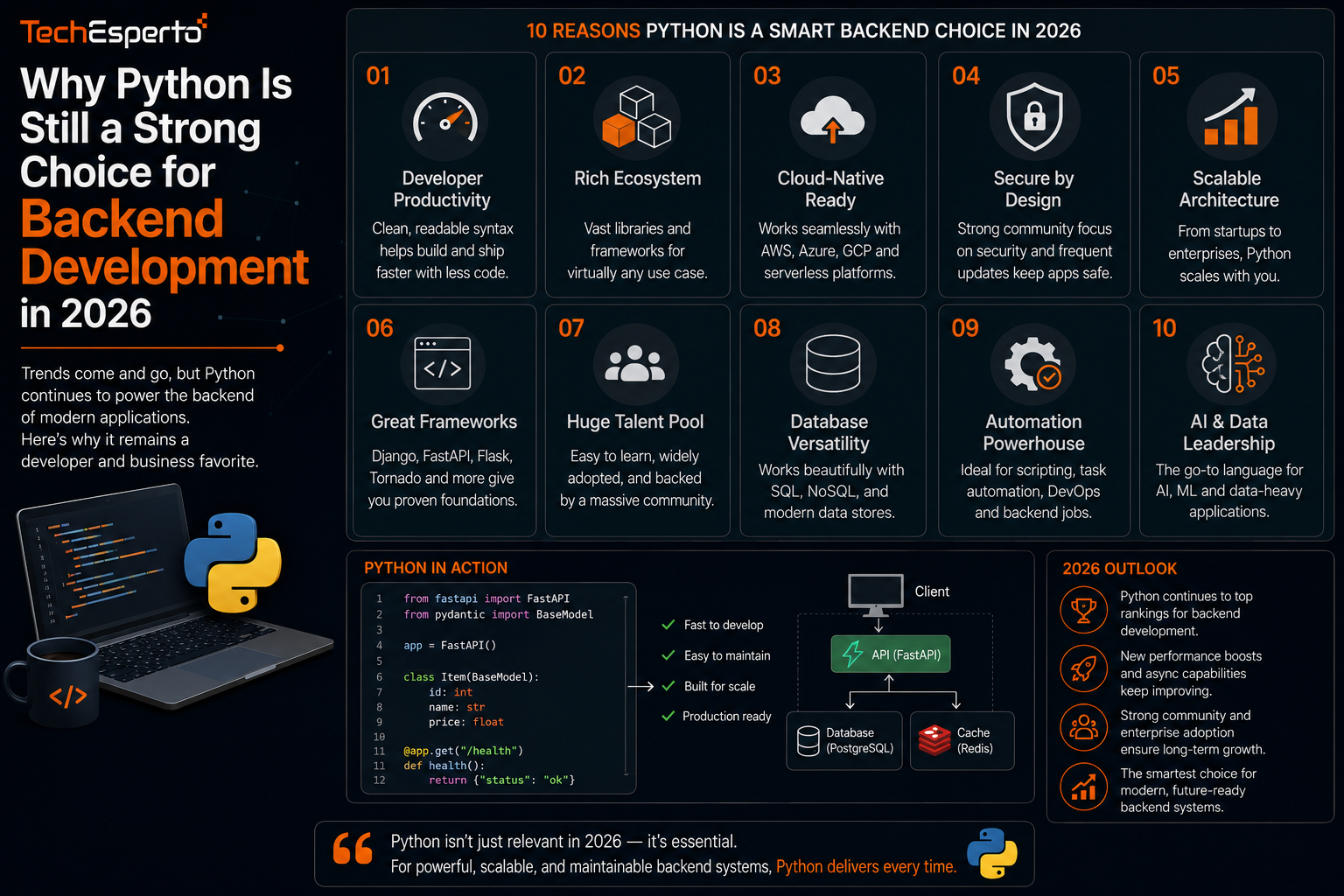
Why Python Is Still a Strong Choice for Backend Development in 2026
Python backend development keeps getting questioned as newer frameworks and languages promise better performance, yet Python continues to be a leading choice for backend systems well into 2026, largely because the reasons businesses adopted it in the first place, readability, a mature ecosystem, and strong support for data-heavy applications, have only strengthened over time. This post looks at where Python genuinely excels for backend work today, where its limitations show up, and how to think about the decision honestly rather than based on either hype or outdated assumptions.
Why Python’s Reputation Persists
Python’s core appeal has always been how quickly a team can go from an idea to working code, thanks to clean syntax and a low barrier to entry for new developers joining a project. This has not changed, and it continues to matter significantly for businesses that need to iterate quickly or bring new engineers up to speed without a steep learning curve.
Where Python Genuinely Excels
Data-Heavy and AI-Driven Applications
Python’s ecosystem for data processing, machine learning, and AI integration remains unmatched by most alternatives, since the majority of modern AI and data science libraries are built primarily for Python first. Any backend that needs to integrate closely with data pipelines or AI models benefits from staying in the same language ecosystem those tools were designed for.
Rapid Development for MVPs and Internal Tools
Python’s combination of readability and a rich set of mature frameworks, such as Django and FastAPI, makes it a strong choice for building functional backends quickly, which matters significantly for MVP development where speed to a working product often outweighs marginal performance gains from a different language.
API Development
FastAPI in particular has become a widely adopted choice for building performant APIs, offering automatic documentation generation and strong type validation that reduces a class of bugs common in less structured API code. This has made Python considerably more competitive for API development than it was in earlier years when performance concerns were more pronounced.
Where Python’s Limitations Still Show Up
Python is not the strongest choice for applications with extremely demanding raw computational performance requirements, since its execution speed for CPU-bound tasks still lags behind compiled languages. For backends handling very high concurrency with minimal latency tolerance, other ecosystems, including Node.js, sometimes offer better raw throughput for I/O-heavy workloads specifically, depending on the nature of the application.
Choosing Python Versus Alternatives for a New Project
The decision generally comes down to what the backend actually needs to do. If the project involves significant data processing, AI integration, or needs to move from concept to working product quickly, Python remains a strong default choice. If the project’s primary demand is extremely high-throughput, low-latency request handling with minimal data processing involved, a different runtime may offer a meaningful edge. Neither choice is universally correct, and the right decision depends on matching the language to the actual workload rather than a general reputation either language carries.
Python’s Role in Broader Software Architecture
Many modern systems do not rely on a single language throughout, using Python specifically for the components where its strengths matter most, such as data processing or AI-driven features, while other parts of the system use a different language better suited to their specific demands. This kind of mixed architecture is common in broader software development projects, where the goal is matching each component to its ideal technology rather than forcing a single language across an entire system.
Key Takeaways
Python remains a strong backend choice in 2026 due to its readability, mature ecosystem, and unmatched strength in data and AI-driven applications. It excels particularly for rapid development, MVPs, and modern API development through frameworks like FastAPI. Its main limitation remains raw computational performance for CPU-intensive workloads compared to compiled languages. And the right choice between Python and alternatives depends on matching the language to the specific demands of the backend, not a general assumption about which language is objectively best.
Frequently Asked Questions
Is Python still a good choice for building APIs in 2026?
Yes, particularly with frameworks like FastAPI, which combine Python’s readability with strong performance and built-in documentation and validation features that reduce common API bugs.
Does Python struggle with high-traffic backend systems?
Python can handle significant traffic well, especially for I/O-bound workloads, though extremely high-throughput, low-latency systems sometimes perform better with other runtimes depending on the specific demands involved.
Why is Python still dominant for AI and data-driven backends?
The majority of modern AI and data science libraries are built primarily for Python, making it the natural choice for backends that need close integration with data pipelines or machine learning models.
Can a backend use Python alongside other languages?
Yes, many modern systems use Python specifically for components where its strengths matter most, such as data processing, while using other languages for parts of the system with different performance demands.
Is Python a good choice for a startup building its first product?
Often yes, particularly for MVPs and early-stage products, since Python’s readability and rapid development speed help teams move from concept to working product quickly without a steep learning curve for new hires.