


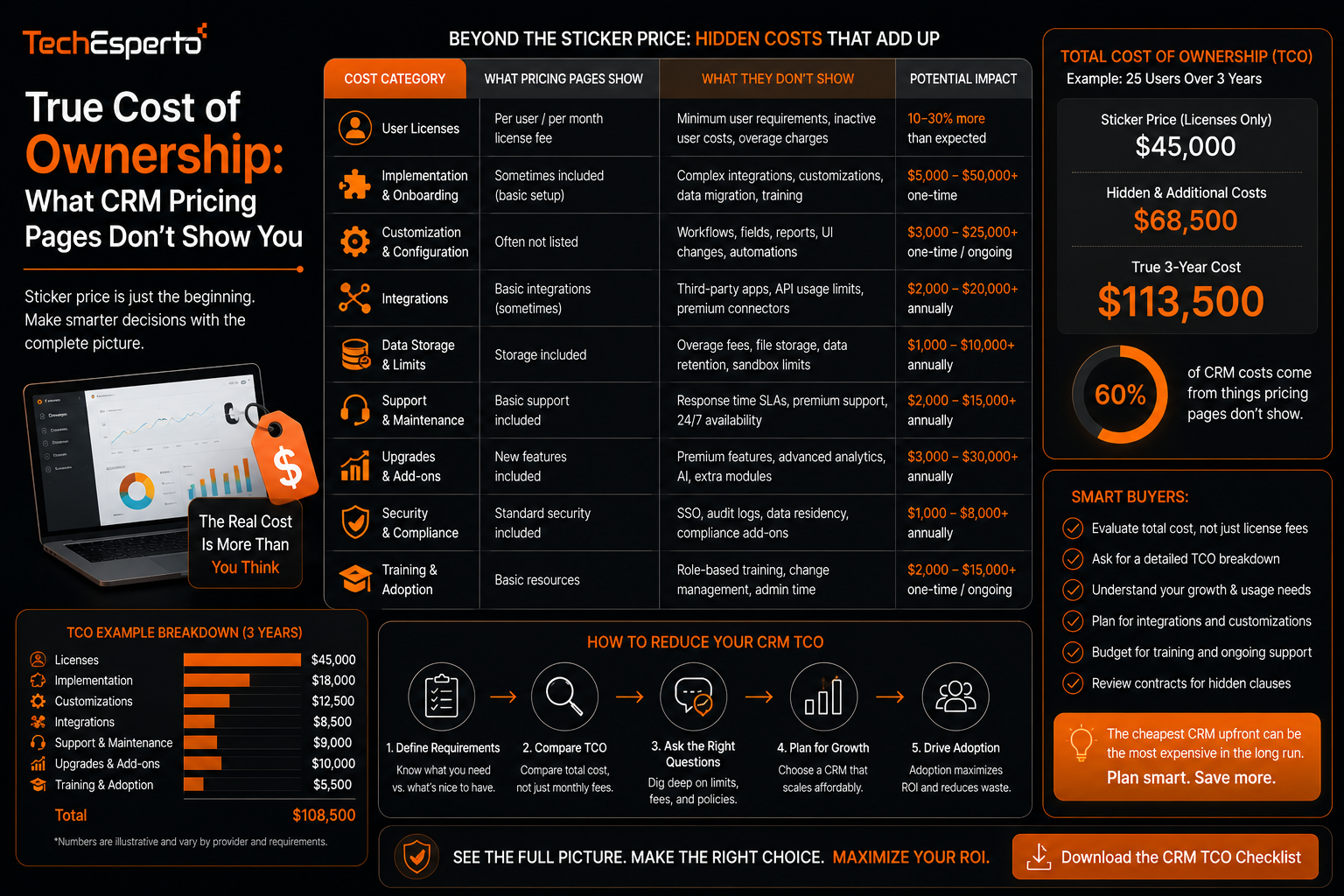
True Cost of Ownership: What CRM Pricing Pages Don’t Show You
CRM total cost of ownership is almost always higher than the subscription price advertised on a vendor’s pricing page, since that number rarely includes implementation, customization, data migration, training, and ongoing maintenance, all of which add up over the life of a system. This post walks through the full framework for calculating what a CRM actually costs, so comparisons between platforms reflect reality rather than just the sticker price.
Why Subscription Price Is Only the Starting Point
A TCO calculation looks at the total cost of a system across its entire useful life, not just what appears on a monthly invoice. Two platforms with identical per-user pricing can end up costing very different amounts once implementation complexity, customization needs, and long-term maintenance are factored in.
Implementation and Onboarding Costs
Initial Setup and Configuration
Every CRM requires configuration to match how a specific business actually sells and operates, from setting up pipelines and fields to configuring user roles. This work is rarely included in subscription pricing and varies significantly depending on how far a business’s needs sit from the platform’s default setup.
Data Migration
Moving existing customer data into a new CRM, including cleaning up duplicates and mapping fields correctly, is a cost that is easy to underestimate, particularly for businesses with years of accumulated data spread across multiple previous systems.
Customization and Development Costs
Platforms vary widely in how much customization is included versus billed separately, and how expensive that customization becomes over time. A platform with a low subscription price but expensive, developer-dependent customization can end up costing more over several years than a platform with a higher upfront price but more accessible configuration options. This is a central reason SuiteCRM’s pricing model, with no per-user licensing fee, often compares favorably in a full TCO calculation once customization needs grow.
Ongoing Maintenance and Support
Internal Administration Time
Someone inside the business typically needs to manage user permissions, troubleshoot issues, and handle day-to-day configuration changes, and this time cost is rarely reflected in vendor pricing comparisons even though it represents real ongoing expense.
Vendor Support and Upgrade Costs
Support tiers, premium feature add-ons, and mandatory upgrade cycles can all add cost that was not apparent during initial evaluation. Some platforms bundle support into the base price, while others charge separately for anything beyond basic email support, which matters significantly for businesses that expect to need regular assistance.
Hidden Costs Specific to Proprietary Platforms
Businesses evaluating well-known proprietary platforms often discover cost increases tied specifically to that platform’s pricing structure, an issue covered in detail in this breakdown of Salesforce’s hidden costs, which walks through add-ons and tier upgrades that are easy to miss during an initial sales conversation but add up significantly over a multi-year contract.
Building a Realistic TCO Comparison
A useful TCO comparison lays out subscription cost, implementation cost, expected customization cost over a defined period such as three years, ongoing administration time, and support costs side by side for each platform under consideration. This exercise often surfaces a very different ranking than a simple subscription price comparison would suggest, and it is worth doing before signing any multi-year contract rather than relying on a vendor’s own pricing page as the deciding factor, particularly when factoring in typical CRM development costs for any custom work a business anticipates needing.
Key Takeaways
CRM total cost of ownership includes far more than subscription price, encompassing implementation, data migration, customization, and ongoing maintenance. Platforms with lower advertised pricing can end up more expensive over time if customization is developer-dependent and costly. Ongoing administration time and vendor support costs are frequently left out of initial comparisons but represent real, recurring expense. And building a full TCO comparison across a multi-year period gives a far more accurate picture than comparing subscription prices alone.
Frequently Asked Questions
What time period should a CRM TCO calculation cover?
A three-year period is common, since it is long enough to capture meaningful customization and maintenance costs without being so far out that projections become unreliable.
Do open-source CRM platforms always have a lower total cost of ownership?
Not always, but they often compare favorably for businesses expecting significant customization, since there is no per-user licensing fee and customization is not restricted to a vendor’s own tools.
Is data migration cost included in most CRM vendor pricing?
Rarely. Data migration is usually treated as a separate implementation cost, whether handled internally or through a development partner, and is often underestimated during initial budgeting.
Reviewing exactly what is included in the base support tier, and what triggers an upgrade to a paid support plan, before signing helps avoid unexpected costs after the contract is already in place.
Does customization cost vary significantly between CRM platforms?
Yes, significantly. Some platforms offer accessible low-code customization tools, while others require specialized development work for anything beyond basic configuration, which affects long-term cost considerably.