


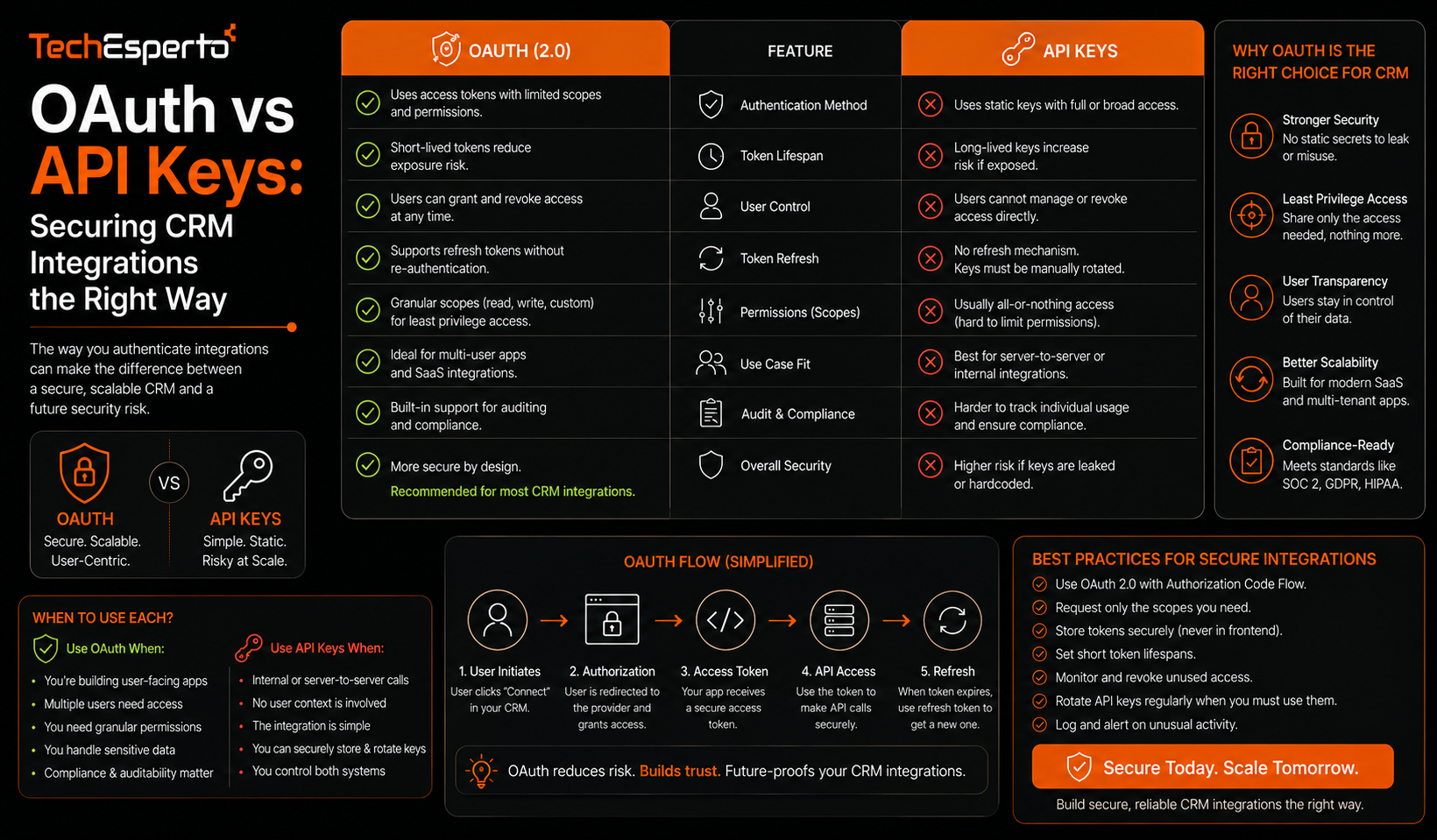
OAuth vs API Keys: Securing CRM Integrations the Right Way
OAuth CRM integration decisions come up early in almost every connected system project, since choosing between OAuth and a simple API key affects both how secure the integration is and how much ongoing maintenance it requires. This post explains how each authentication method actually works, where each one is appropriate, and the security tradeoffs businesses often overlook when connecting a CRM to external systems.
Why Authentication Method Matters More Than It Seems
Every integration connecting to a CRM needs a way to prove it is authorized to access data, and the method chosen affects far more than initial setup convenience. It determines how easily access can be revoked, how much damage a leaked credential can do, and how much visibility you have into what a connected application is actually doing inside your CRM.
How API Keys Work
An API key is a single, static credential that grants access to an API, typically with the same level of permission every time it is used. It is simple to implement, since a request just needs to include the key, but that simplicity comes with tradeoffs.
The Security Risk of Static Keys
Because an API key does not expire on its own and often grants broad access, a leaked key can remain a security risk indefinitely until someone notices and manually revokes it. Keys are also frequently over-scoped, granting more access than the specific integration actually needs, since narrowing permissions per key is not always straightforward to configure.
How OAuth Works
OAuth is a more structured authorization framework where an application requests specific, limited permissions, and the user or system owner explicitly approves that access. Instead of a single static credential, OAuth issues tokens that expire and can be refreshed, which limits how long a compromised token remains useful.
Scoped Permissions and Revocability
OAuth’s biggest practical advantage is scope control, letting an integration request access only to what it needs, such as read-only contact data, rather than full account access. Tokens can also be revoked individually without affecting other integrations, which is not always true of a shared static API key.
When a Simple API Key Is Still the Right Choice
Not every integration justifies the added complexity of OAuth. For internal tools built and maintained entirely within your own infrastructure, where the risk of external exposure is low and rotation can be managed directly, a well-scoped API key can be a reasonable and simpler choice. The decision should be based on who controls the integration and how exposed the credential actually is, not a blanket rule that one method is always superior.
When OAuth Is the Better Choice
Any integration involving a third-party application, particularly one your business does not control directly, benefits from OAuth’s ability to limit scope and revoke access independently. This is especially relevant for integrations connecting a CRM to external platforms such as HubSpot, where a compromised or misbehaving connection needs to be shut off without disrupting every other integration relying on a shared credential.
Building Secure Integrations in Practice
Regardless of which authentication method is used, a few practices matter across the board. Credentials, whether API keys or OAuth tokens, should never be hardcoded directly into application code where they can be exposed through version control. Access should be scoped as narrowly as the integration actually requires, rather than granted broadly for convenience. And every credential should have a documented owner responsible for rotating or revoking it if the integration is ever decommissioned. These practices are a standard part of well-built API integration services, where security is treated as part of the integration design rather than an afterthought.
Key Takeaways
API keys are simple to implement but carry more risk due to their static, often broadly scoped nature. OAuth provides scoped, expiring access that can be revoked independently, making it the stronger choice for third-party integrations. Simple API keys can still be appropriate for tightly controlled internal tools where exposure risk is low. And regardless of method, credentials should be scoped narrowly, never hardcoded, and assigned a clear owner for ongoing management.
Frequently Asked Questions
Is OAuth always more secure than an API key?
Generally yes, due to its scoped permissions and revocability, though a well-managed API key in a low-risk internal context can still be a reasonable choice depending on the situation.
Do OAuth tokens expire automatically?
Yes, OAuth tokens typically have a defined expiration and require a refresh process, which limits the window of risk if a token is ever compromised.
Can a CRM support both OAuth and API key authentication at the same time?
Many CRM platforms support both, allowing different integrations to use whichever method fits their specific risk profile and technical requirements.
What should happen if an OAuth-connected integration is no longer needed?
The associated tokens and application authorization should be explicitly revoked rather than simply disconnecting the integration on the receiving end, to ensure access is fully closed off.
Is setting up OAuth more complex than using an API key?
Yes, OAuth generally requires more initial setup, including handling token refresh logic, but this added complexity is usually worthwhile for integrations involving external or less trusted systems.