


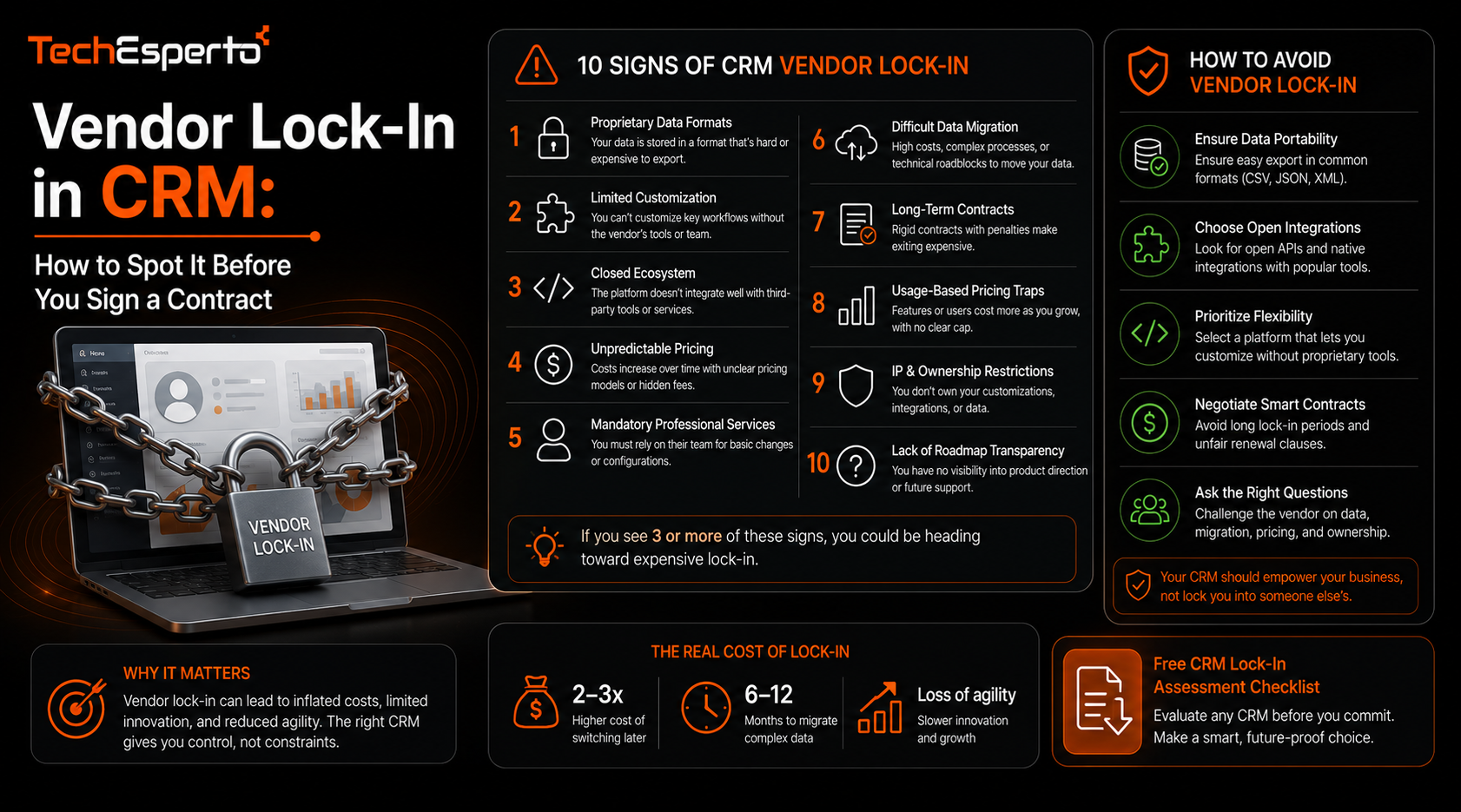
Vendor Lock-In in CRM: How to Spot It Before You Sign a Contract
Vendor lock-in in CRM rarely announces itself during a sales demo. It shows up later, usually when a business tries to leave a platform and discovers that exporting years of customer data, disconnecting integrations, or replicating custom workflows built inside that CRM is far harder and more expensive than the original purchase decision suggested. This post covers the specific signs of lock-in worth checking before signing a contract, and how the choice between proprietary and open-source platforms changes the risk.
What Vendor Lock-In Actually Means
Vendor lock-in describes a situation where switching away from a provider becomes so costly, in time, money, or technical effort, that a business effectively feels stuck with a platform even when it is no longer the best fit. It is not the same as simply being satisfied with a vendor. Lock-in is specifically about the difficulty of leaving, regardless of how the relationship is going.
Data Export Limitations
Format and Completeness of Exports
Some CRM platforms allow data export only in limited formats or without complete history, such as excluding activity logs or custom field data from a standard export. Before signing, it is worth explicitly testing what a full export actually contains, since a vendor’s marketing claim of “easy data export” does not always match what the export tool produces in practice.
Custom Field and Workflow Portability
Data itself is often only part of the problem. Custom fields, automation rules, and workflow logic built inside a proprietary platform frequently do not transfer to a new system in any usable form, meaning a business effectively has to rebuild years of configuration work from scratch after a migration, not just move the underlying records.
Contractual and Pricing Lock-In
Multi-Year Commitments and Price Escalation
Contracts with steep penalties for early termination, or pricing structures that increase significantly after an initial discounted period, create financial lock-in even when the technical migration itself would be straightforward. Reviewing contract terms for automatic renewal clauses and future price guarantees is worth doing before signing, not after a renewal notice arrives.
Bundled Ecosystem Dependency
Platforms that encourage adopting an entire suite of connected tools, such as email, support, and marketing products alongside the core CRM, create a deeper form of lock-in, since leaving means replacing multiple interconnected systems at once rather than a single platform.
Technical Dependency Beyond the CRM Itself
Integration Depth
The more deeply a CRM is integrated with other business systems, such as billing platforms or internal tools, the harder it becomes to leave without significant rework. This is not necessarily a reason to avoid deep integration, but it is a reason to understand upfront how much of that integration work would need to be redone elsewhere.
Proprietary APIs and Data Structures
Some platforms use proprietary data structures or limited APIs that make it difficult for a third-party developer to build a clean migration path, effectively requiring specialized expertise or the original vendor’s own migration services to move away, which adds cost and reduces a business’s negotiating position.
Open-Source Platforms as a Structural Alternative
Open-source CRM platforms, by design, reduce several forms of lock-in since the underlying code, database structure, and hosting are not controlled exclusively by a single vendor. An open-source CRM can be self-hosted, migrated, or handed to a different development partner without needing permission or cooperation from an original vendor. This does not eliminate all lock-in risk, since custom development still needs to be documented and maintainable by whoever takes over the system, but it removes the structural dependency on one company’s continued goodwill and pricing decisions. This distinction is a central part of the broader decision covered in build versus buy CRM planning, since the build-versus-buy question is really a question about long-term control, not just upfront cost.
Questions to Ask Before Signing Any CRM Contract
Before committing to a platform, it is worth getting specific answers in writing about what a complete data export includes, what happens to custom fields and automations if you leave, what the contract’s early termination and renewal terms actually say, and whether the vendor or a third party can independently migrate your data without additional paid services. Vague or evasive answers to these questions are themselves a signal worth taking seriously. Working through this evaluation with an experienced SuiteCRM partner or similar consulting relationship before committing to a platform often surfaces lock-in risks that are not obvious from a vendor’s own sales materials.
Key Takeaways
Vendor lock-in in CRM shows up through limited data export options, non-portable custom configurations, restrictive contract terms, and deep technical dependency on a vendor’s proprietary systems. These risks are often invisible during the sales process and only become apparent when a business tries to leave. Open-source CRM platforms structurally reduce several forms of lock-in by keeping data and code outside a single vendor’s exclusive control. And asking specific, written questions about export completeness and contract terms before signing is the most effective way to catch lock-in risk early.
Frequently Asked Questions
Is vendor lock-in only a risk with proprietary CRM platforms?
It is more common with proprietary platforms, but some lock-in risk exists with any CRM, including open-source ones, if custom development is poorly documented or overly specialized to one development team.
How can I test for data export limitations before signing a contract?
Ask the vendor for a full sample export, including custom fields and activity history, and review it directly rather than relying on marketing claims about export capability.
Does switching to an open-source CRM eliminate all lock-in risk?
It significantly reduces structural lock-in tied to a vendor’s pricing and platform control, but risk can still exist if custom development is not well documented or maintainable by a different team later.
What contract terms are the biggest red flags for lock-in?
Automatic renewal clauses, steep early termination penalties, and pricing that increases sharply after an introductory period are among the clearest signs worth negotiating or reconsidering before signing.
Should integration depth be avoided to reduce lock-in risk?
Not necessarily. Deep integration often delivers real business value, but it should be entered into with a clear understanding of how much rework a future migration would require, rather than avoided outright.