


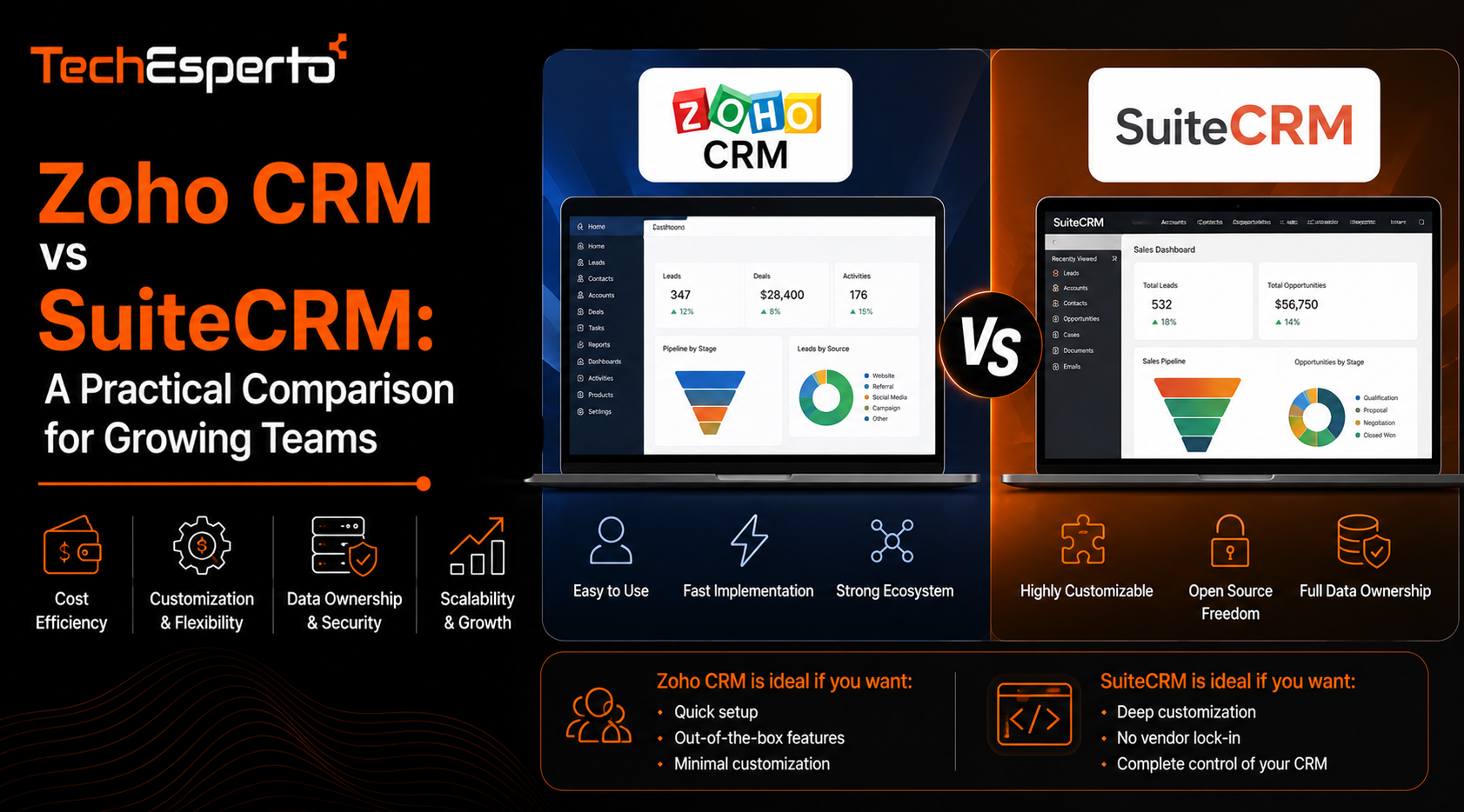
Zoho CRM vs SuiteCRM: A Practical Comparison for Growing Teams
Zoho CRM vs SuiteCRM is a decision that comes up often for growing businesses trying to decide between a polished subscription platform and an open-source alternative that trades a monthly fee for more control. This comparison looks at the practical differences that actually affect day-to-day use, including cost structure, customization depth, data ownership, and how each platform handles scale, so you can weigh the decision against what actually matters for your business rather than a generic feature checklist.
How the Two Platforms Are Fundamentally Different
Zoho CRM is a proprietary, subscription-based platform hosted entirely by Zoho, while SuiteCRM is open-source software that can be self-hosted or run through a managed hosting provider. This foundational difference shapes nearly every other point of comparison, since one model trades flexibility for convenience and the other trades some convenience for control.
Cost Structure Over Time
Zoho CRM’s pricing scales per user per month, which is predictable at small team sizes but grows substantially as headcount increases, and premium features are often locked behind higher subscription tiers. SuiteCRM has no per-user licensing cost since the software itself is free, though hosting, maintenance, and customization work carry their own expense. For businesses expecting significant headcount growth, the SuiteCRM pricing model tends to become more cost-effective over a multi-year horizon, while Zoho’s per-seat model can become expensive at scale even though it requires less upfront setup investment.
Customization Depth
Zoho CRM’s Customization Limits
Zoho CRM offers a reasonable degree of configuration through its admin panel and a low-code layer for building custom modules and automations. This covers a wide range of common needs without requiring a developer, but it has ceilings. Highly specific business logic, deep integrations with internal systems, or workflows that fall outside what Zoho’s framework anticipates can be difficult or impossible to build without working within the constraints of the platform’s own tools.
SuiteCRM’s Customization Depth
SuiteCRM, being open-source, allows direct access to the underlying codebase, meaning there is effectively no ceiling on what can be built, from custom modules to logic hooks to deep API-level integrations. This flexibility comes with a tradeoff: meaningful customization generally requires development expertise rather than being achievable purely through an admin interface. Businesses that have outgrown what a closed platform allows often move toward this kind of SuiteCRM customization specifically because they have hit a wall with what a proprietary system permits.
Data Ownership and Portability
With Zoho CRM, your data lives on Zoho’s infrastructure, and while export tools exist, you are ultimately operating within the constraints of their platform and terms of service. With SuiteCRM, since it can be self-hosted, the business retains full physical control over where data lives and how it is backed up, which matters more for businesses in regulated industries or those wary of long-term vendor lock-in with a proprietary provider.
Feature Set Comparison
Both platforms cover the core CRM functions well, including contact and lead management, pipeline tracking, and basic automation. Zoho CRM has an edge in built-in AI features and its broader suite of adjacent business tools that integrate natively, such as its own email and helpdesk products, which appeals to businesses wanting an all-in-one ecosystem. SuiteCRM’s feature set is comparably strong in its core CRM functions and gains ground specifically in scenarios requiring custom-built functionality that a general-purpose platform does not offer out of the box, a full breakdown of which is covered in SuiteCRM’s feature set.
Which Platform Fits Which Type of Business
The right choice depends less on which platform is objectively better and more on what a business actually needs. A small team wanting to get running quickly, without dedicated technical staff, often finds Zoho CRM’s structured, ready-made approach faster to deploy. A business with specific, non-standard requirements, plans for significant scale, or a preference for owning its infrastructure outright tends to get more long-term value from SuiteCRM, even though the initial setup involves more development work upfront. A good starting point if you are still deciding is reviewing what SuiteCRM actually is and how its open-source model compares directly against your specific requirements rather than a generic pros and cons list.
Key Takeaways
Zoho CRM is a subscription-based platform offering quick deployment and a broad built-in tool ecosystem, while SuiteCRM is open-source software offering deeper customization and full data ownership. Cost structures diverge significantly over time, with Zoho scaling per user and SuiteCRM carrying no licensing fee but requiring investment in hosting and development. Customization depth is the clearest differentiator, since SuiteCRM has no practical ceiling while Zoho’s low-code tools have limits. And the right choice depends on whether a business values speed and simplicity or long-term flexibility and control.
Frequently Asked Questions
Is SuiteCRM harder to set up than Zoho CRM?
Generally yes, initially. SuiteCRM’s self-hosted, open-source nature means setup typically involves more technical work upfront compared to Zoho’s ready-to-use subscription model.
Does Zoho CRM support custom development?
Zoho CRM supports low-code customization and custom modules within its own framework, but it does not offer the same level of direct codebase access that an open-source platform like SuiteCRM provides.
Which platform is cheaper for a growing team?
It depends on the size and trajectory of the team. Zoho’s per-user pricing is often cheaper at small scale, while SuiteCRM tends to become more cost-effective as headcount grows, since it carries no per-seat licensing fee.
Can data be migrated from Zoho CRM to SuiteCRM?
Yes, data migration between the two platforms is a common project, typically involving exporting Zoho data and mapping it into SuiteCRM’s data structure with appropriate cleanup along the way.
Is SuiteCRM a good fit for regulated industries?
SuiteCRM’s self-hosted option gives businesses full control over where data is stored and how it is secured, which is often an advantage for regulated industries with strict data residency or audit requirements.