


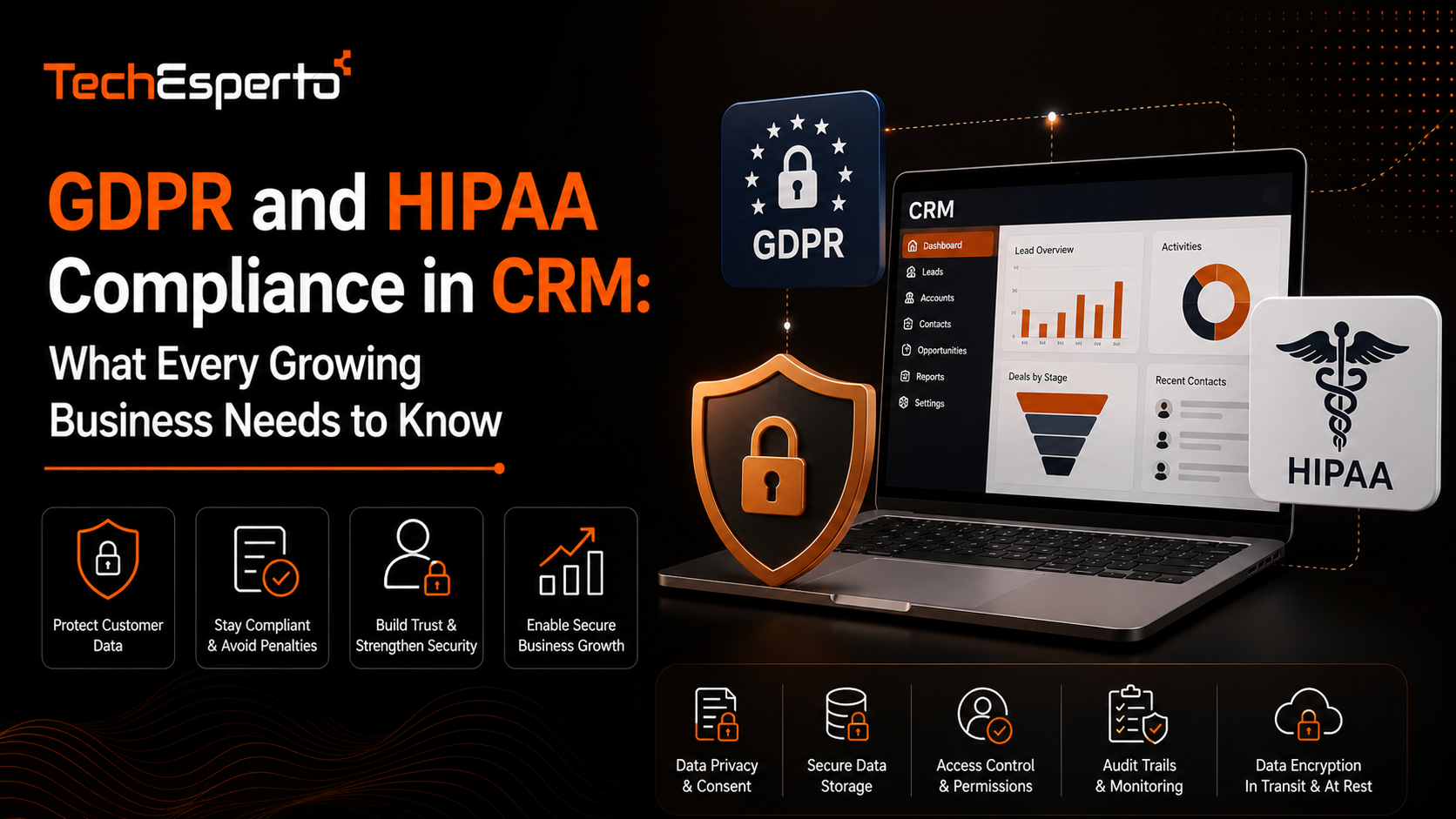
GDPR and HIPAA Compliance in CRM: What Every Growing Business Needs to Know
GDPR and HIPAA compliance in CRM often gets treated as a checkbox exercise, addressed once during setup and rarely revisited, even though both regulations carry real financial and legal consequences when a CRM handling customer or patient data falls short. This post breaks down what each regulation actually requires from a CRM system, where the two overlap, and where they differ enough that a compliance approach built for one will not automatically satisfy the other.
Why CRM Systems Sit at the Center of Compliance Risk
A CRM is often the single system holding the most complete profile of a person a business has, including contact details, communication history, and in some industries, health or financial information. That concentration of data is exactly why regulators pay close attention to how CRM systems are configured, accessed, and audited. A compliance gap in a CRM is rarely a minor issue, since it usually means a large volume of records were exposed to the same risk at once.
What GDPR Actually Requires of a CRM
GDPR governs how personal data of individuals in the European Union is collected, stored, and processed, and it applies to any business handling that data regardless of where the business itself is located.
Consent and the Right to Be Forgotten
A CRM needs a documented, verifiable record of consent for each contact, along with the ability to fully delete a person’s data on request. This is more involved than it sounds, since deletion needs to cascade through related records, integrations, and any backups the CRM feeds into.
Data Minimization and Access Controls
GDPR expects businesses to collect only the data actually needed for a defined purpose, and to restrict who inside the organization can access sensitive fields. A CRM configured with broad, unrestricted access for every user works against this principle even if no breach ever occurs, since the exposure risk itself is part of what regulators evaluate.
What HIPAA Actually Requires of a CRM
HIPAA applies specifically to protected health information in the United States, and it governs a different set of obligations than GDPR even though both are commonly grouped together in compliance discussions.
Business Associate Agreements
Any CRM vendor or integration touching protected health information needs a signed business associate agreement in place, confirming that vendor’s own handling of that data meets HIPAA’s requirements. This is a step businesses sometimes miss entirely when connecting a CRM to a new tool, assuming the CRM’s own compliance covers every system it touches.
Audit Trails and Encryption
HIPAA requires detailed audit logs showing who accessed protected health information and when, along with encryption both in transit and at rest. A CRM used in a healthcare context needs these capabilities built in or added through customization, since not every CRM platform includes this level of logging by default.
Where GDPR and HIPAA Overlap and Where They Diverge
Both regulations share a common thread around restricting access to sensitive data and maintaining records of how that data is handled. Where they diverge is in scope and mechanics. GDPR applies broadly to personal data of any kind and grants individuals specific rights, including deletion, that HIPAA does not include in the same form. HIPAA is narrower in scope, focused specifically on health information, but stricter in its technical requirements around audit logging and encryption. A business operating in fintech alongside international customers may need to satisfy GDPR’s consent framework and a separate set of financial data regulations, which is a reminder that compliance requirements should be mapped to the actual data your CRM holds rather than assumed from the industry alone.
Building a Compliant CRM Setup From the Ground Up
Compliance works best when it is designed into the CRM configuration rather than patched on after a system is already in use. This typically means defining role-based access before onboarding data, setting up consent tracking fields as part of the initial lead capture process, and configuring audit logging before the CRM goes live rather than trying to add it retroactively. Businesses handling either regulation, or both, often find it more efficient to build these requirements into a broader CRM implementation project from the start, since retrofitting compliance into an already-configured system tends to surface gaps that are harder to fix once workflows and integrations are already built around the existing structure.
Key Takeaways
GDPR governs personal data broadly and includes specific individual rights like deletion, while HIPAA governs protected health information with strict requirements around audit logging and encryption. Both regulations require restricting data access and documenting how sensitive data is handled, but they are not interchangeable frameworks. Any integration touching regulated data needs its own compliance verification, not just the CRM itself. And compliance is far easier to build into a CRM from the start than to retrofit into a system already in daily use.
Frequently Asked Questions
Does GDPR apply to businesses outside the European Union?
Yes, GDPR applies to any business processing personal data of individuals located in the European Union, regardless of where the business itself is headquartered.
Can a single CRM system be both GDPR and HIPAA compliant?
Yes, a CRM can meet both sets of requirements, but it requires deliberately configuring the system to satisfy each regulation’s specific obligations rather than assuming one automatically covers the other.
What happens if a CRM integration is not covered by a business associate agreement?
If protected health information flows through an integration without a signed business associate agreement, the business handling that data can be found in violation of HIPAA regardless of whether a breach actually occurs.
Does HIPAA require specific encryption standards for CRM data?
HIPAA requires that protected health information be encrypted both at rest and in transit, though it does not always mandate one specific encryption method, leaving some flexibility in how that requirement is implemented.
Is consent tracking in a CRM only relevant for GDPR?
Consent tracking is central to GDPR, but many other data protection frameworks outside the EU also require documented consent, so building this capability into a CRM benefits compliance beyond GDPR alone.