


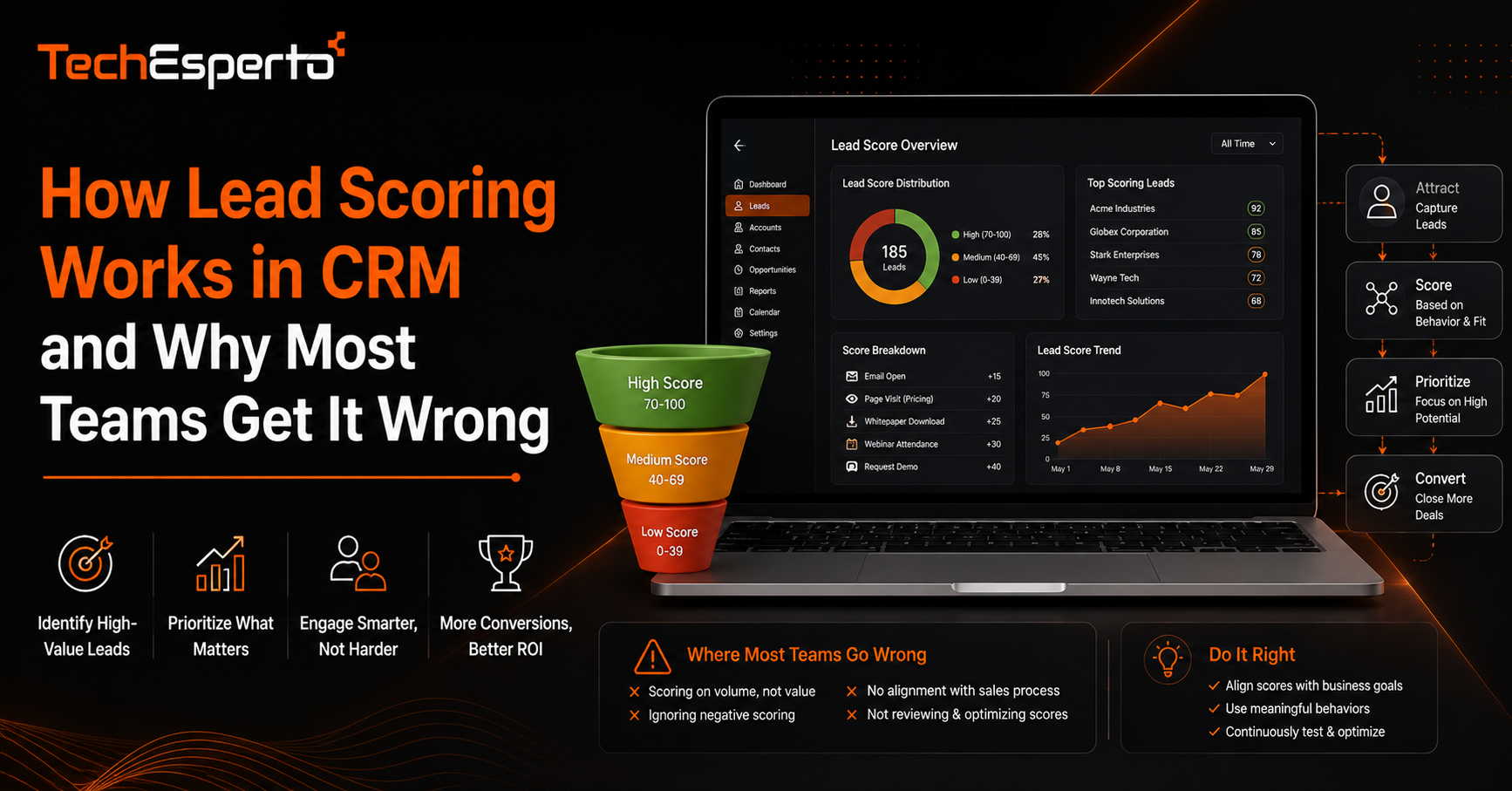
How Lead Scoring Works in CRM and Why Most Teams Get It Wrong
Lead scoring in CRM is meant to solve a simple problem: telling your sales team which leads deserve attention first. In practice, a lot of businesses set up scoring once, never revisit it, and end up with a system that quietly misdirects effort for months without anyone noticing. This post covers how lead scoring actually works, the different models used to build it, and the specific mistakes that cause scores to stop reflecting reality.
What Lead Scoring Actually Measures
At its core, lead scoring assigns a numerical value to a lead based on attributes and behavior that correlate with a higher likelihood of converting into a customer. A higher score signals a lead worth prioritizing, while a lower score suggests one that needs more nurturing before it is sales-ready. The score itself is only useful to the extent that it reflects what has actually driven conversions in your business, which is where many setups start to drift from reality.
The Two Main Types of Scoring Criteria
Most lead scoring models combine two categories of signals, and businesses that only use one tend to end up with an incomplete picture.
Demographic and Firmographic Fit
This category scores a lead based on who they are, such as company size, industry, job title, or geography. A lead matching your ideal customer profile scores higher regardless of how they have engaged with your business so far, since fit alone is a meaningful predictor of whether a deal is even winnable.
Behavioral Signals
This category scores a lead based on what they have done, such as visiting a pricing page, opening emails, attending a demo, or downloading specific content. Behavioral signals capture intent and timing in a way that firmographic data alone cannot, since a perfect-fit company that has shown zero engagement is a very different opportunity than one actively researching a purchase.
How Scores Get Calculated in Practice
Most CRM platforms let you assign point values to specific actions and attributes, which then sum into a total score for each lead. Visiting a pricing page might add ten points, while opening a newsletter might add one. Job titles matching a decision-maker role might add fifteen points, while a mismatched industry might subtract points entirely. The specific weights should come from actual data about what your closed-won deals looked like before they converted, not guesswork about what seems important.
Predictive Scoring
More advanced setups use predictive models that analyze historical deal data to calculate scoring weights automatically, adjusting as new data comes in rather than relying on values a person set once and never revisited. This kind of approach is typical of platforms built around predictive analytics, where scoring evolves continuously instead of staying frozen at whatever assumptions were true when it was first configured.
Where Lead Scoring Connects to the Rest of the Sales Process
A score by itself does not do much unless it is tied to action. Scores are commonly used to trigger automated routing, so high-scoring leads reach senior reps immediately while lower-scoring ones enter a nurture sequence instead. They also inform where a lead sits in the sales pipeline, helping teams distinguish between a lead that just entered the funnel and one close to a decision. Scoring that exists purely as a number on a record, without feeding into these downstream processes, rarely earns its keep.
Common Mistakes That Undermine Lead Scoring
The most frequent mistake is setting scoring criteria once at launch and never revisiting it as the business and its customer profile change. A scoring model built around your first year of customers may not reflect who is actually converting two years later. Another common issue is over-weighting easy-to-track behaviors, like email opens, which are a weak signal of genuine intent compared to something like requesting a demo, simply because they are easier to measure. Some businesses also score leads without ever validating the model against actual outcomes, meaning nobody has checked whether high-scoring leads are genuinely converting at a higher rate than low-scoring ones. Left unchecked, this can quietly send your best reps chasing leads that look promising on paper but rarely close, while the highest-intent buyers slip into a lower-priority queue.
Reviewing and Recalibrating Your Scoring Model
A working lead scoring system needs periodic review, ideally by comparing scores against actual close rates every few months. If leads scoring in the top tier are closing at a similar rate to those in the middle tier, the weighting needs adjustment. This review process is often folded into broader CRM AI automation work, since recalibrating scoring alongside other automated workflows tends to be more effective than treating it as a standalone task nobody owns.
Key Takeaways
Lead scoring combines demographic fit and behavioral signals to estimate which leads are most likely to convert, and both categories matter on their own. Scores should be calculated from actual historical deal data rather than assumptions about what seems important. Scoring only creates value when it feeds into downstream processes like routing and pipeline prioritization. And scoring models need periodic validation against real close rates, since a model that goes unreviewed drifts away from reality as the business changes.
Frequently Asked Questions
What is a good lead score threshold for sales handoff?
There is no universal number. The right threshold comes from analyzing your own historical data to see what score range correlates with the highest actual conversion rate, which varies by business and industry.
How often should lead scoring criteria be reviewed?
Most businesses benefit from reviewing scoring criteria every few months, comparing scores against actual close rates to check whether the weighting still reflects reality.
Can lead scoring work without a large volume of historical data?
It can, using reasonable estimates based on general firmographic fit and known buyer signals, though the model becomes more accurate over time as more closed deal data becomes available to refine it.
Is behavioral scoring more important than demographic scoring?
Neither is inherently more important. Demographic scoring identifies whether a lead is a realistic fit at all, while behavioral scoring captures timing and intent, and most effective models weigh both.
Does every CRM platform support lead scoring natively?
Many modern CRM platforms include native lead scoring functionality, though the sophistication varies, and some businesses extend this with custom scoring logic to reflect factors specific to their sales process.