


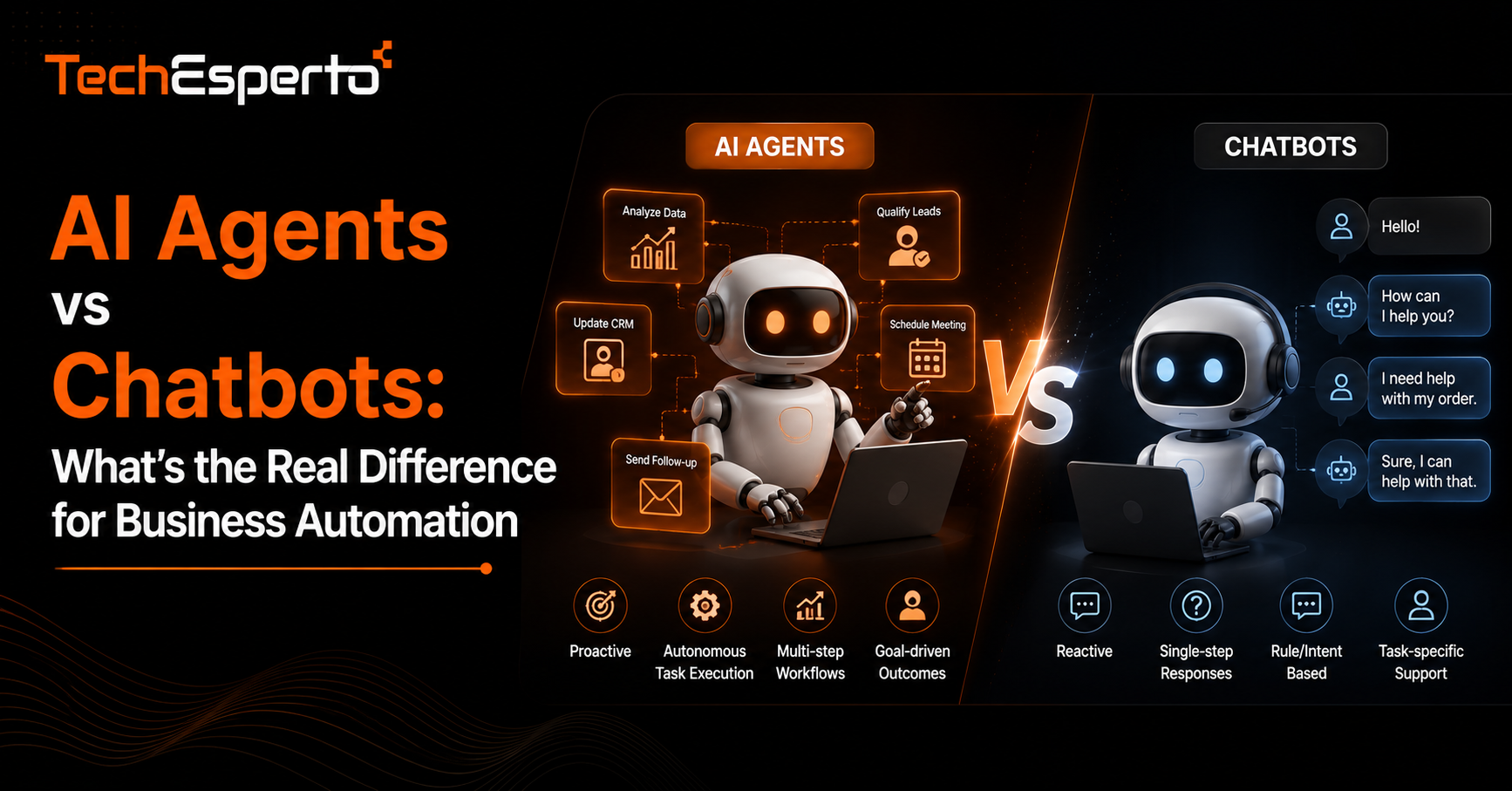
AI Agents vs Chatbots: What’s the Real Difference for Business Automation
AI agents vs chatbots is one of the most common points of confusion for businesses planning their next automation project, and the confusion is understandable because both terms get used interchangeably in marketing copy even though they describe genuinely different technology. This post breaks down what separates a chatbot from an AI agent in practical terms, where each one fits in a real business workflow, and how to figure out which one your business actually needs before you commit a budget to either.
Why the Terms Get Confused
Part of the problem is that both chatbots and AI agents often show up in the same place: a chat window on a website or inside an app. From a user’s perspective, typing a question and getting a text response looks the same whether a simple script or a sophisticated reasoning system is generating that reply. The real difference is not in how the interaction looks, but in what happens behind it, specifically how much independent decision-making and action-taking the system is capable of.
What a Chatbot Actually Does
A chatbot, at its core, is designed to answer questions and guide a conversation within a defined scope. It does not take independent action beyond generating a response.
Rule-Based Chatbots
The earliest and simplest chatbots follow decision trees. If a user’s input matches a predefined pattern, the bot returns a scripted response. These work fine for narrow, predictable use cases like answering store hours or guiding someone through a returns policy, but they break down quickly outside their scripted paths.
AI-Powered Conversational Chatbots
More advanced chatbots use language models to understand intent and generate natural responses rather than relying on rigid scripts. These can handle a much wider range of phrasing and context, and they are the backbone of most modern customer support deployments. Even so, their job stops at conversation. They can look up an order status or answer a policy question, but they are not making decisions about what to do next on their own.
What an AI Agent Actually Does
An AI agent goes further than conversation. It is built to pursue a goal, which means it can plan a sequence of steps, use external tools, and take action without a human approving each individual move.
Autonomous Task Execution
When a chatbot answers “what is my order status,” an agent can be given a goal like “resolve this customer’s shipping delay” and independently check the order system, decide whether a refund or reshipment applies based on your policies, and execute that action. The agent is reasoning through a problem rather than retrieving a matched response.
Tool and API Use
The defining capability of an agent is its ability to call external systems, whether that is a CRM, a billing platform, or an internal API, as part of completing its task. This is often built on the same infrastructure used in AI agent development, where the agent is connected to real business systems rather than operating in isolation.
Key Differences Side by Side
The clearest way to separate the two is by what each one is capable of doing without a human in the loop. A chatbot answers questions within a defined scope and hands off anything outside that scope. An agent pursues a goal across multiple steps, decides which tools to use along the way, and only escalates to a human when it hits a genuine edge case. Chatbots are typically scoped to a single channel, like a website widget, while agents are usually built to operate across systems, since their value comes from connecting and acting on data that lives in more than one place.
Which One Fits Your Business
Neither option is inherently better. The right choice depends entirely on what problem you are trying to solve.
When a Chatbot Is Enough
If your goal is to reduce response time on repetitive questions, whether that is FAQ handling, appointment scheduling, or basic lead qualification, a well-built chatbot solves that problem without the added complexity of autonomous decision-making. Most AI chatbot development projects fall into this category, and they tend to launch faster and cost less to maintain.
When You Need an Agent
If the process you want to automate involves multiple steps, decisions based on business rules, and interaction with more than one system, an agent is the better fit. Examples include automatically triaging and routing support tickets based on severity, or reconciling data discrepancies between a CRM and a billing platform without a human manually checking both.
How to Start Without Overbuilding
The most common mistake businesses make is building agent-level complexity for a problem a chatbot could have solved, which drives up both cost and long-term maintenance. A more practical path is to start with clearly scoped generative AI development for the conversational layer, then layer in agentic capability only for the specific tasks that genuinely require independent action. Pairing this with AI consulting early on helps map which parts of a process actually need an agent versus which parts just need a good conversational interface, before any development work begins.
Key Takeaways
Chatbots handle conversation within a defined scope, while AI agents pursue goals and take independent action across systems. The technology behind both often overlaps, but the deciding factor is how much autonomous decision-making the task actually requires. Most repetitive, single-channel tasks are well served by a chatbot, while multi-step processes involving several systems are better suited to an agent. Starting with the simplest solution that solves the actual problem avoids the common trap of overbuilding agent complexity where a chatbot would have worked.
Frequently Asked Questions
Is an AI agent just a more advanced chatbot?
Not exactly. An agent can incorporate conversational ability, but its defining feature is autonomous action across systems and multi-step planning, which a chatbot does not do on its own.
Can a chatbot be upgraded into an agent later?
In many cases, yes. A conversational layer built well from the start can often be extended with agentic capabilities, such as tool use and task execution, without a full rebuild, though this depends on how the original system was architected.
Do AI agents need to be connected to a CRM to be useful?
Not always, but many of the most valuable business use cases for agents involve acting on customer or operational data, which usually means connecting to a CRM or similar system of record.
Which is cheaper to build, a chatbot or an AI agent?
Chatbots are generally less expensive to build and maintain because their scope is narrower and they do not require the same level of integration testing across multiple systems that agent-based automation does.
How do I know if my business actually needs an agent instead of a chatbot?
Look at whether the task you want automated involves more than one system and requires a decision to be made partway through, rather than a single question-and-answer exchange. If it does, an agent is likely the better fit.